
Behavioral interview questions ask candidates to describe specific past experiences to predict future job performance. They follow a "Tell me about a time when..." format and test competencies like leadership, conflict resolution, adaptability, and teamwork. The best answers use the STAR method (Situation, Task, Action, Result) and include quantifiable outcomes. Below are 40+ common behavioral questions organized by theme, with example STAR answers for each.
Why Behavioral Interviews Have Taken Over
Five years ago, technical interviews were the gatekeepers. If you could solve the coding challenge or design the system, you got the job.
Today? Behavioral interviews are eliminating candidates at every stage—including people who ace the technical rounds.
The market has fundamentally shifted:
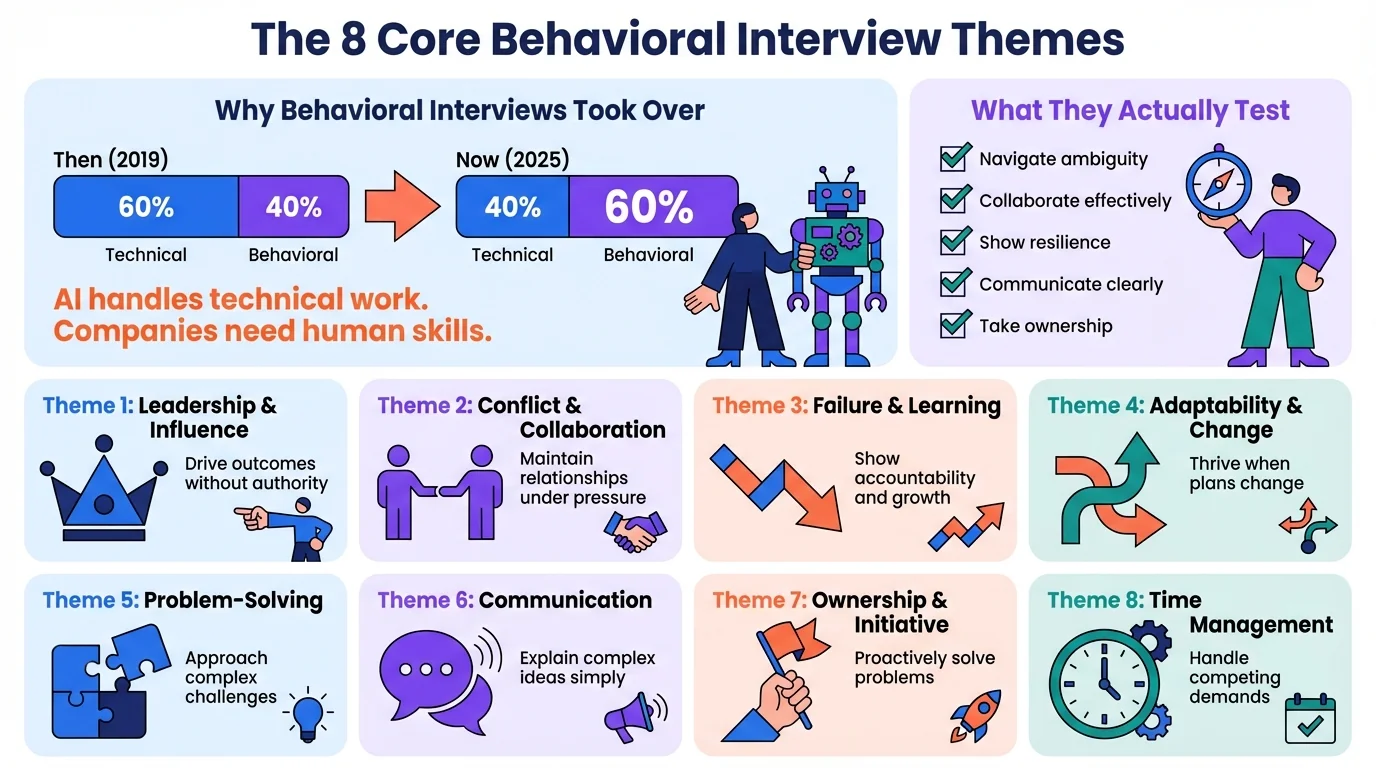
- Then (2019): 60% technical assessment, 40% behavioral/cultural fit
- Now (2026): 40% technical assessment, 60% behavioral/cultural fit
Why the flip? Because AI can handle a lot of the technical work now. Code generation, data analysis, debugging—AI does it in minutes. So companies are asking: "What do we need humans for?"
The answer is behavioral skills that can't be automated:
- Judgment in ambiguous situations
- Collaboration across teams
- Navigating complex stakeholder relationships
- Adaptability when requirements change
- Leadership and influence without authority
Reality check: You passed the technical screen. But you failed the behavioral interview. That's happening more and more—because the interview landscape has fundamentally shifted.
What Behavioral Interviews Actually Test
When an interviewer asks "Tell me about a time you resolved a conflict," they're not just making conversation. They're testing specific competencies that predict job success.
1. Can You Navigate Ambiguity?
Most real work doesn't have clear answers. Can you make decisions when the path forward isn't obvious?
2. Do You Collaborate Effectively?
Can you work with people who disagree with you? Can you influence without authority? Can you manage up and down?
3. Are You Resilient?
When projects fail or plans change, do you adapt or freeze? Do you learn from setbacks?
4. Can You Communicate Clearly?
Can you explain complex ideas simply? Can you align stakeholders with different priorities?
5. Do You Take Ownership?
When things go wrong, do you blame others or take accountability? Do you proactively solve problems?
The STAR Method: Beyond the Basics
Everyone knows STAR (Situation, Task, Action, Result). But knowing the framework doesn't mean you can apply it under pressure.
Here's how to actually use it:
S - Situation (2 sentences max)
Set the context with specific details about the challenge or scenario. Keep it brief—the interviewer wants to get to your actions quickly.
Example: "In my role as product manager, our team faced a critical decision about whether to delay our Q3 launch to add a heavily requested feature."
T - Task (1 sentence)
Explain your role and what needed to be accomplished.
Example: "I was responsible for balancing stakeholder expectations, technical constraints, and user needs to make a recommendation to leadership."
A - Action (This is the bulk—3-4 sentences)
Describe the specific steps YOU took. Use "I" not "we." Be concrete, not abstract.
Example: "I organized separate conversations with engineering, design, and sales to understand the real impact of delay versus shipping without the feature. I analyzed user data to quantify how many users would actually use the requested feature. I created a decision matrix showing trade-offs and presented three options with my recommendation to ship on time with a commitment to add the feature in Q4."
R - Result (2 sentences)
What happened? What did you learn? Quantify when possible.
Example: "We launched on schedule and saw 92% user satisfaction in the first month. When we added the requested feature in Q4, adoption was only 18%—validating that shipping on time was the right call."
Pro tip: Goal is 60-90 seconds per story. Practice out loud until it flows naturally without sounding memorized. The first few times will feel awkward—that's normal. By the 5th time telling a story, it should feel natural.
Learn more about structuring answers effectively
The 8 Core Behavioral Themes
Almost every behavioral question falls into one of these categories. If you have one strong story for each category, you can handle 90% of behavioral questions.
Theme 1: Leadership & Influence
What they're really asking: Can you drive outcomes without formal authority?
Common questions:
- "Tell me about a time you led a project"
- "Describe a situation where you had to influence someone"
- "Give an example of when you motivated a team"
- "Tell me about a time you made a tough decision"
- "Describe when you had to lead without authority"
What makes you credible: Showing how you aligned different stakeholders, navigated resistance, and achieved buy-in through influence rather than mandate.
Theme 2: Conflict & Collaboration
What they're really asking: Can you maintain relationships under pressure?
Common questions:
- "Tell me about a time you disagreed with a colleague"
- "Describe a conflict you had with a team member"
- "Give an example of handling a difficult stakeholder"
- "Tell me about working with someone you didn't get along with"
- "Describe a time you received critical feedback"
What makes you credible: Demonstrating that you can disagree without being disagreeable, that you listen to understand (not just to respond), and that you prioritize outcomes over being right.
Why behavioral questions matter more than technical skills
Theme 3: Failure & Learning
What they're really asking: Do you take accountability and learn from mistakes?
Common questions:
- "Tell me about a time you failed"
- "Describe a project that didn't go as planned"
- "Give an example of a mistake you made"
- "Tell me about your biggest professional regret"
- "Describe when you received negative performance feedback"
What makes you credible: Showing accountability (not blame), demonstrating what you learned, and proving you applied those lessons to future situations.
Theme 4: Adaptability & Change
What they're really asking: Can you thrive when things don't go according to plan?
Common questions:
- "Tell me about a time requirements changed mid-project"
- "Describe how you handled an unexpected challenge"
- "Give an example of pivoting your strategy"
- "Tell me about working in ambiguous situations"
- "Describe a time you had to learn something quickly"
What makes you credible: Showing flexibility without losing sight of goals, demonstrating how you assessed new information and adjusted your approach accordingly.
Theme 5: Problem-Solving
What they're really asking: How do you approach complex challenges with no obvious solution?
Common questions:
- "Tell me about a complex problem you solved"
- "Describe your approach to ambiguous situations"
- "Give an example of creative problem-solving"
- "Tell me about debugging a difficult issue"
- "Describe when you had to make a decision without complete information"
What makes you credible: Walking through your thought process, showing how you broke down the problem, considered alternatives, and made trade-offs.
Theme 6: Communication
What they're really asking: Can you explain complex ideas and align diverse stakeholders?
Common questions:
- "Tell me about explaining technical concepts to non-technical people"
- "Describe a time you had to persuade someone"
- "Give an example of aligning stakeholders with different priorities"
- "Tell me about giving difficult feedback"
- "Describe presenting to senior leadership"
What makes you credible: Demonstrating that you adapt your communication style to your audience, that you listen actively, and that you can distill complexity into clarity.
Theme 7: Ownership & Initiative
What they're really asking: Do you wait to be told what to do, or do you proactively solve problems?
Common questions:
- "Tell me about a time you went above and beyond"
- "Describe when you took initiative"
- "Give an example of identifying and solving a problem proactively"
- "Tell me about a time you improved a process"
- "Describe when you took responsibility for something outside your role"
What makes you credible: Showing that you see problems others miss, that you take action without being asked, and that you deliver results beyond expectations.
Theme 8: Time Management & Prioritization
What they're really asking: Can you handle competing demands and make smart trade-offs?
Common questions:
- "Tell me about managing competing deadlines"
- "Describe a time you had to say no"
- "Give an example of how you prioritize work"
- "Tell me about working with limited resources"
- "Describe balancing short-term and long-term priorities"
What makes you credible: Showing a clear prioritization framework, demonstrating how you assessed impact and urgency, and proving you can communicate trade-offs to stakeholders.
How to Actually Prepare
Reading this guide is step one. But behavioral interview mastery requires practice—speaking out loud, handling follow-ups, refining your stories.
Here's the preparation strategy that works:
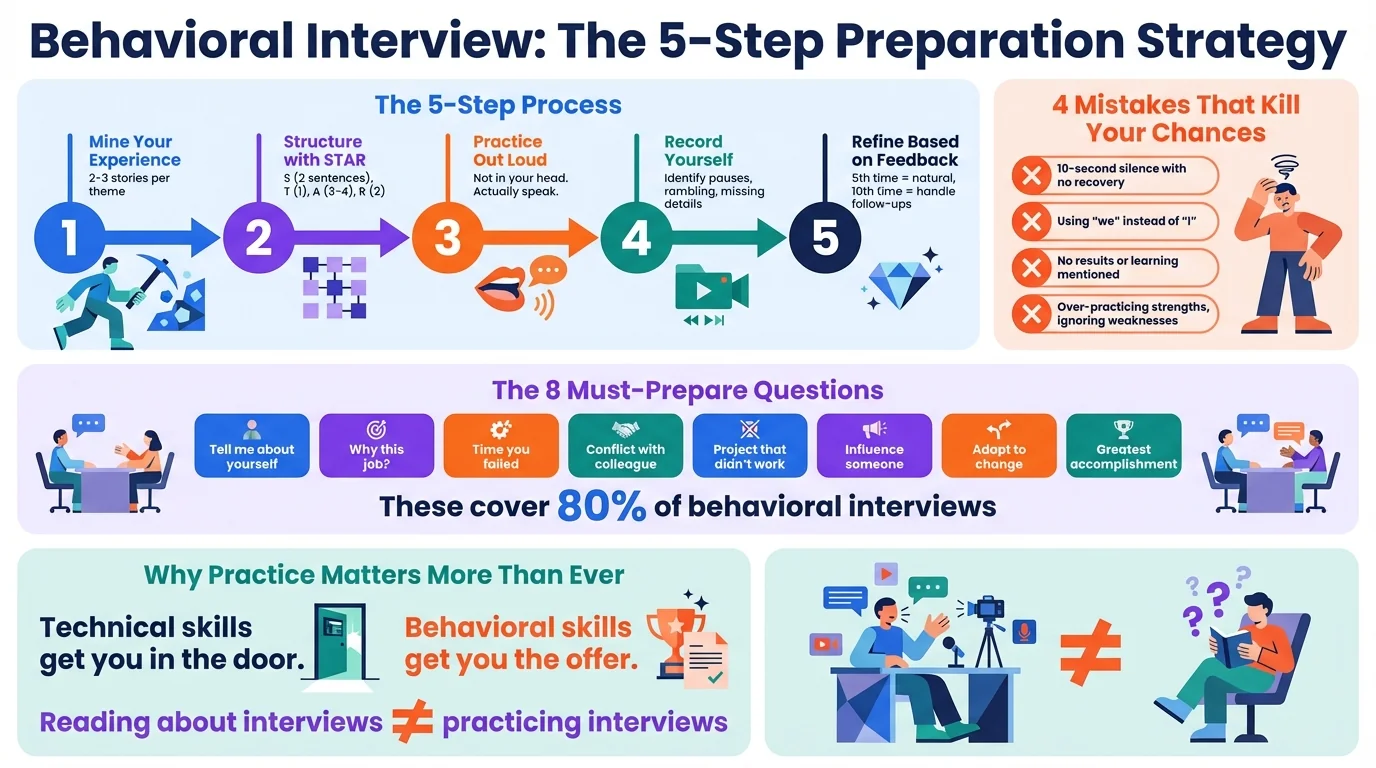
Step 1: Mine Your Experience
Write down 2-3 stories for each of the 8 themes above. Real situations where you demonstrated that skill. Don't worry about perfection—just get them documented.
Step 2: Structure Each Story Using STAR
Take each story and format it: Situation (2 sentences), Task (1 sentence), Action (3-4 sentences), Result (2 sentences). Goal: 60-90 seconds per story.
Step 3: Practice Out Loud
Not in your head. Actually speak the story. Multiple times. Until it flows naturally without sounding memorized. This is where most people skip—and why most people struggle in real interviews. (Here's exactly how to practice interview answers out loud, and why typing them fails.)
There's something magical—and intimidating—that happens when the mic turns on. You're nervous, you're organizing thoughts in real-time, you're trying to remember details. That's too much cognitive load for your brain to handle smoothly without practice.
Why "just be yourself" is terrible interview advice
Step 4: Record Yourself
Listen for long pauses, rambling, missing key details, unclear structure. Each practice round makes your story clearer, more concise, and more confident.
Step 5: Refine Based on Feedback
By the 5th time telling a story, it should feel natural. By the 10th time, you can handle follow-up questions smoothly.
Common Mistakes That Kill Your Chances
Mistake 1: The 10-Second Silence
Candidate is asked a behavioral question. 10 seconds of silence while they search their memory. They're picking an example on the fly, rambling through with no structure. The interviewer thinks: "They couldn't articulate their thought process. That probably means they don't have a clear thought process."
Fix: Prepare stories in advance. Practice them out loud.
Mistake 2: Using "We" Instead of "I"
"We decided to pivot the strategy..." The interviewer doesn't know what YOU did. They're evaluating YOU, not your team.
Fix: Use "I" and be specific about your individual contributions.
Mistake 3: No Results or Learning
You tell the story but never state what happened or what you learned. The interviewer is left wondering: "So... did it work?"
Fix: Always close with quantifiable results and explicit learning.
Mistake 4: Over-Practicing Strengths
Most people practice what they're already good at because it feels comfortable. Then they get blindsided by a question they haven't prepared for.
Fix: Deliberately practice your weakest themes. Your weakest answer is your weakest link.
Why your preparation strategy matters more than talent
The Questions You'll Definitely Get Asked
If you prepare for nothing else, practice these 8 questions. They cover 80% of behavioral interviews:
- "Tell me about yourself" - Your professional story in 60-90 seconds
- "Why do you want this job?" - Alignment of your goals with the role
- "Tell me about a time you failed" - Accountability and learning
- "Describe a conflict you had with a colleague" - Collaboration and conflict resolution
- "Give an example of a project that didn't go as planned" - Adaptability
- "Tell me about a time you had to influence someone" - Leadership without authority
- "Describe a situation where you had to adapt to change" - Resilience
- "What's your greatest accomplishment?" - Impact and ownership
If you can answer these clearly and confidently, you'll stand out.
Why Practice Matters More Than Ever
The market is competitive. Companies are picky. They can afford to be.
If you can't articulate how you've demonstrated the skills they need, someone else will. And here's the kicker: They might be less qualified than you technically, but better prepared behaviorally.
That's who's getting the offers.
Technical skills get you in the door. Behavioral skills get you the offer. Companies are hiring for human skills that AI can't replicate: judgment, collaboration, adaptability, communication, leadership.
The candidates who understand this shift and prepare accordingly are the ones landing offers. The ones still treating behavioral interviews as an afterthought? They're wondering why they're not getting past final rounds despite being technically qualified.
Why smart people fail interviews (and what to do about it)
Deep Dive: Common Behavioral Questions
For detailed frameworks and 20+ examples for specific questions, see these comprehensive guides:
- How to Answer "Tell Me About Yourself"
- How to Answer "What Are Your Weaknesses?"
- How to Answer "Tell Me About a Time You Failed"
- How to Answer "Why Should We Hire You?"
- How to Answer "Where Do You See Yourself in 5 Years?"
- See all interview questions →
Your Next Steps
Reading this guide was the easy part. Here's what actually builds confidence:
- Document 8-10 STAR stories covering the 8 core themes above
- Practice speaking them out loud until they flow naturally
- Record yourself and identify what needs refinement
- Practice with realistic pressure - speaking in real-time with follow-up questions
- Get expert feedback on what's working and what's not
Just like you wouldn't go to one gym session and expect to be fit, or play one tennis match and expect to win tournaments—interview mastery requires practice.
Reading about interviews ≠ practicing interviews. There's something that happens when the mic turns on—pressure, nerves, the need to think in real-time. You can't simulate that by reading.
Ready to Master Behavioral Interviews?
Practice speaking your answers out loud with AI that listens and responds like a real interviewer. Get expert feedback on every response. Build confidence through repetition.
Try a Practice Question - Free • Start Free Trial
No credit card required • Unlimited practice • Instant feedback

