How to Answer "Describe a Complex Problem You Solved": The Complete Interview Guide (2026)
"Describe a complex problem you solved" appears in over 90% of professional interviews, ranking as one of the most critical behavioral questions across all industries and career levels. This question isn't just about demonstrating technical competence—it reveals your analytical thinking process, creativity under constraints, resilience when facing obstacles, strategic prioritization abilities, and capacity to deliver tangible results despite ambiguity. Research from McKinsey shows that complex problem-solving skills predict job performance more accurately than most other competencies, making this a make-or-break interview moment.
This comprehensive guide provides everything you need to master problem-solving questions: 15+ detailed STAR method examples across career stages and industries, proven frameworks for structuring your analytical approach, advanced techniques for demonstrating systems thinking, and AI-powered practice tools to perfect your response.
Why Do Interviewers Ask About Complex Problem-Solving?
Understanding the strategic purpose behind this question transforms your approach from simple storytelling to strategic competency demonstration. Interviewers use problem-solving scenarios to evaluate critical professional capabilities:
Assessing Analytical and Critical Thinking Skills
Complex problems require breaking down ambiguous situations into component parts, identifying root causes versus symptoms, evaluating alternative solutions against constraints, and making sound decisions with incomplete information. Your problem-solving story reveals whether you approach challenges systematically or reactively, whether you think critically about assumptions, and whether you can navigate complexity without becoming overwhelmed.
Interviewers distinguish between candidates who jump to solutions based on instinct versus those who diagnose thoroughly before solving—the latter approach predicts sustained professional success across domains.
Evaluating Creativity and Innovation
Routine problems have established playbooks; complex problems require creative thinking to develop novel approaches when standard solutions don't apply. Your example demonstrates whether you can generate innovative solutions, combine existing concepts in new ways, challenge conventional thinking when necessary, and find elegant solutions to messy challenges.
Companies facing disruption and change particularly value people who can think creatively when confronting unprecedented problems without clear precedents.
Understanding Your Problem-Solving Process
How you structure your approach to complex challenges—your methodology for analyzing situations, generating options, evaluating tradeoffs, making decisions, and implementing solutions—reveals your cognitive frameworks and professional maturity. Interviewers assess whether you have systematic problem-solving processes or whether you approach each challenge ad hoc.
Candidates with clear problem-solving frameworks can apply those methodologies across different contexts, making them more valuable as complexity increases.
Gauging Resilience and Persistence
Complex problems rarely resolve easily—they involve setbacks, failed attempts, and frustrating obstacles. Your story reveals whether you maintain determination when solutions aren't immediately obvious, whether you can pivot approaches when initial attempts fail, and whether you view obstacles as learning opportunities or reasons to give up.
Resilience separates people who deliver results in challenging circumstances from those who only succeed when circumstances are favorable.
Measuring Results Orientation and Impact Focus
Anyone can work on hard problems; top performers solve them and generate measurable value. Interviewers want to see that you define success by concrete outcomes, that you persist until achieving meaningful results, and that you can articulate the business impact of your problem-solving, not just the intellectual challenge you enjoyed.
What Interviewers Are Really Assessing
Beyond your story's surface content, interviewers evaluate multiple dimensions of your response:
Problem Selection: Did you choose an actually complex problem worthy of discussion, or a routine issue you've inflated?
Clarity of Explanation: Can you explain complex situations clearly to non-experts, or do you get lost in technical jargon and unnecessary details?
Systematic Approach: Do you demonstrate structured problem-solving methodology, or do you describe a chaotic, reactive process?
Stakeholder Consideration: Do you solve problems in isolation, or do you consider the broader organizational and human context?
Ownership: Do you take responsibility for driving solutions, or do you position yourself as a passive participant in someone else's problem-solving?
Learning Orientation: Can you articulate what this experience taught you about effective problem-solving that you've applied subsequently?
The STAR Method for Problem-Solving Questions
The STAR framework (Situation, Task, Action, Result) provides optimal structure for problem-solving behavioral questions. Here's how to adapt it specifically for complex problem scenarios:
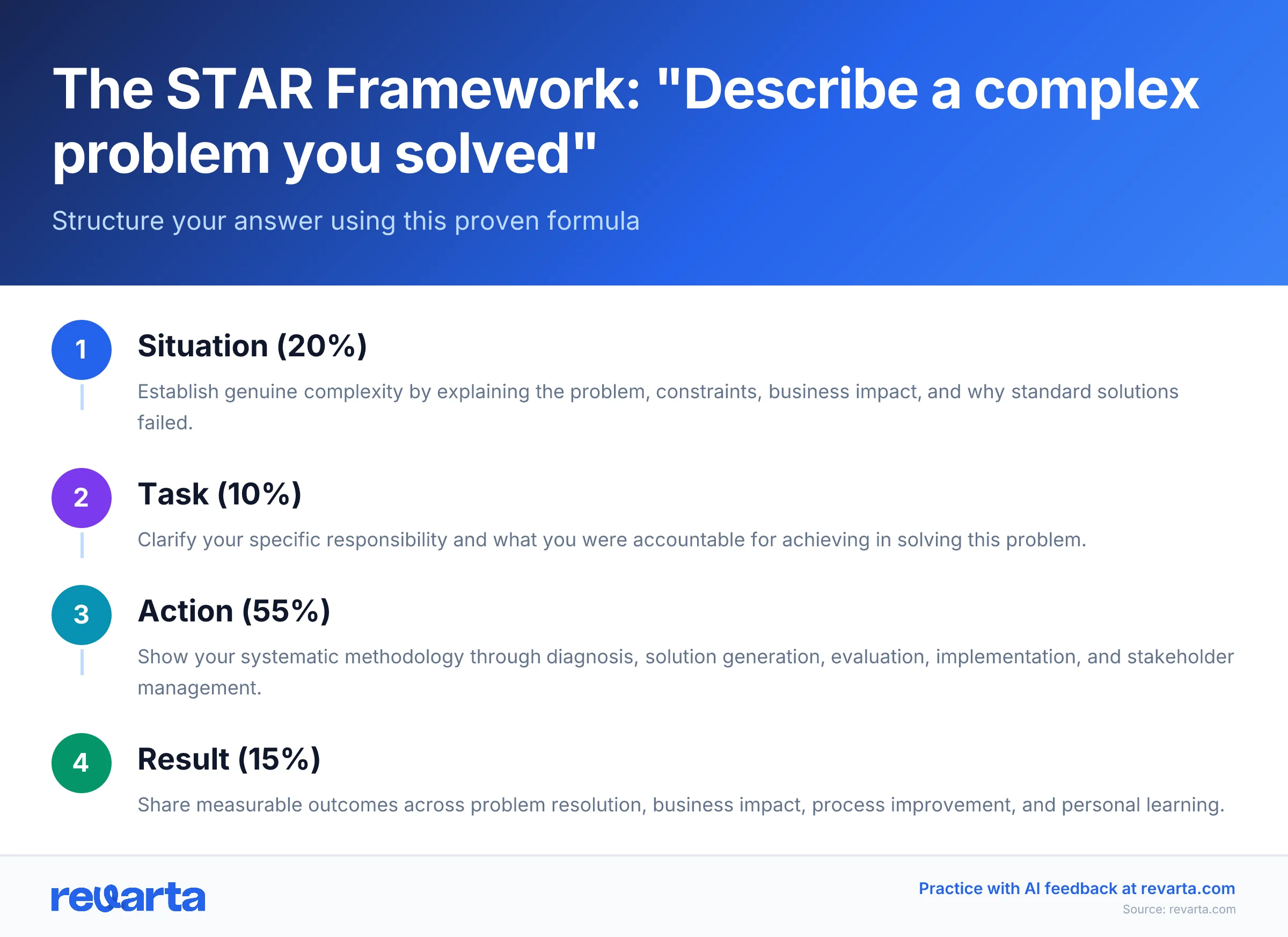
Situation (20% of your answer)
Set up the problem context to establish genuine complexity. Include:
- The problem you encountered and why it qualified as complex
- The broader context and constraints (timeline, resources, competing priorities)
- Why this problem mattered (business impact, stakeholder concerns)
- What made standard solutions inadequate
Example: "As a senior operations analyst at LogisticsCorp, our Northeast distribution center suddenly experienced a 40% increase in shipping errors over three weeks, causing customer complaints to spike by 200%. This wasn't a simple execution problem—errors occurred across different product categories, times of day, and team members, suggesting a systemic issue rather than individual performance problems. The complexity was that our standard troubleshooting approaches—retraining staff, adding quality checks, adjusting workflows—had no measurable impact. Meanwhile, we were entering our peak holiday season when errors become even more costly. Our VP of Operations gave me two weeks to identify root cause and implement solutions before considering more drastic measures like replacing management or technology systems—both extremely costly and disruptive options."
Task (10% of your answer)
Clarify your specific responsibility in solving this problem. What were you accountable for achieving?
Example: "My responsibility was to lead the diagnostic investigation to identify root causes, develop an evidence-based solution that would reduce errors to baseline levels within 30 days, and implement that solution without disrupting our ability to process the increasing volume approaching holiday season. I needed to balance thoroughness in diagnosis with speed in resolution, and I had to coordinate across operations, IT, and warehouse teams who were defensive about their role in the problem."
Action (55% of your answer)
This is the most critical section where you demonstrate systematic problem-solving excellence. Structure this to show your methodology:
- Diagnosis and Analysis: How you investigated to understand root causes
- Solution Generation: How you developed potential approaches
- Evaluation and Decision: How you selected the best solution
- Implementation: How you executed and adapted based on results
- Stakeholder Management: How you coordinated across different groups
Example: "I started by rejecting the assumption that we understood the problem. Rather than accepting 'shipping errors increased' as the diagnosis, I treated it as a symptom requiring deeper investigation.
First, I conducted detailed data analysis, segmenting errors by product type, shift, team, warehouse zone, time of day, and customer type. I discovered that 73% of errors occurred in one specific warehouse zone—Zone 3—despite that zone only representing 35% of total volume. Standard troubleshooting had missed this because it focused on overall error rates rather than spatial patterns.
I then spent two full days observing operations in Zone 3 during different shifts, timing each process step and interviewing workers about their challenges. I noticed that workers in Zone 3 were walking significantly longer distances between pick locations than workers in other zones, and they seemed more rushed and stressed. When I dug into the warehouse management system data, I discovered that our algorithm for assigning storage locations had been updated three weeks prior—exactly when errors began increasing. The new algorithm optimized for overall warehouse storage density but hadn't accounted for pick path efficiency.
To validate this hypothesis, I worked with our IT team to map pick paths before and after the algorithm change. We found that average pick path length in Zone 3 had increased 64% while other zones decreased 15-20%. Zone 3 workers were covering much more ground in the same time period, leading to fatigue, rushing, and errors.
Rather than immediately reverting the algorithm, I explored whether we could achieve both storage density optimization and efficient pick paths. I convened a working session with our IT team, warehouse supervisors, and several experienced warehouse workers. Together we identified that the algorithm had correctly identified optimal storage locations for frequently-picked items, but it hadn't accounted for the physical layout peculiarities of Zone 3, which had support columns that created inefficient paths.
We developed a hybrid solution: keep the new algorithm's storage density benefits but add a Zone 3-specific constraint that prioritized pick path efficiency over marginal density gains. I also worked with our operations team to redesign the pick process for Zone 3 to batch orders by physical proximity rather than by order time, which further reduced walking distance.
I piloted this solution in Zone 3 for three days before full rollout, monitoring error rates hourly and gathering worker feedback. When we saw errors drop by 60% in the pilot period, we implemented across the warehouse with zone-specific customizations.
Throughout this process, I maintained a daily update email to key stakeholders explaining what we'd learned, what we were testing, and what decisions we were making. This transparency prevented intervention by anxious executives who might have pushed for quick fixes that didn't address root causes."
Result (15% of your answer)
Share multiple levels of outcomes demonstrating both immediate problem resolution and broader impact:
Problem Resolution: Did you solve the specific problem with measurable improvement?
Business Impact: How did this solution affect company performance or customer experience?
Process Improvement: Did your solution create lasting organizational capability?
Recognition: How was your problem-solving acknowledged?
Learning: What did this teach you about complex problem-solving?
Example: "Within 10 days of implementing the solution, shipping errors dropped from 40% above baseline to 15% below baseline—a 55% overall improvement. We maintained these lower error rates through the entire holiday season despite 3x volume increases. Customer complaints decreased 78% compared to the previous month.
The hybrid algorithm approach we developed was adopted company-wide across our 12 distribution centers, generating $1.8M in annual savings from reduced errors while maintaining the storage density improvements worth $400K annually. Our VP of Operations presented this case study in our quarterly business review as an example of rigorous problem-solving.
Individually, I received a spot bonus for the impact and was selected to lead our continuous improvement initiative across operations based on the systematic diagnostic approach I'd demonstrated. Three warehouse workers from Zone 3 sent me thank-you notes saying the changes made their jobs less physically demanding.
This experience reinforced several problem-solving lessons I've applied repeatedly since: First, never accept the presenting problem as the real problem—symptoms usually mask deeper root causes. Second, data analysis is powerful but incomplete without direct observation—I wouldn't have discovered the Zone 3 spatial issues from data alone. Third, the best solutions often come from cross-functional collaboration where different expertise reveals possibilities that no single perspective would see. Finally, quick fixes that address symptoms waste time and resources—investing in thorough diagnosis ultimately speeds resolution because you solve the right problem."
15+ Detailed STAR Examples Across Industries
Entry-Level Professional Examples
Recent Graduate - Data Analyst Role
Situation: "During my first month as a junior data analyst at RetailCo, I was asked to investigate why our e-commerce conversion rate had dropped 8 percentage points over the previous quarter—from 3.2% to 2.4%—while traffic had increased. This was complex because conversion rate is influenced by dozens of factors: product mix, pricing, site performance, marketing channels, seasonality, and customer demographics. My manager had already tried the obvious approaches—checking for site bugs, comparing pricing to competitors, analyzing product availability—but hadn't identified a clear cause. The CMO was pressuring for answers because declining conversion with increasing traffic suggested we were spending marketing budget inefficiently."
Task: "As the most junior team member, I was initially assigned to 'help' by pulling standard reports, but I asked if I could lead a comprehensive diagnostic investigation. My manager was skeptical given my inexperience but agreed to give me three days to see if I could uncover insights the team had missed."
Action: "I started by mapping all the variables that could influence conversion: user behavior (device type, referral source, new vs. returning), product factors (category, price point, inventory levels), site performance (page load time, errors), and temporal factors (day of week, time of day).
Rather than looking at aggregate conversion rate, I segmented by every dimension I could think of. I discovered that conversion rate hadn't declined uniformly—it had dropped 62% for mobile users while desktop conversion actually increased 4%. That was the insight the team had missed because mobile represented only 35% of total traffic, so mobile problems were masked in overall metrics.
Digging deeper into mobile sessions, I found that bounce rate on product pages had tripled for mobile users. I hypothesized that our recent site redesign might have introduced mobile-specific issues. I borrowed my roommate's Android phone and my friend's iPhone to test the mobile shopping experience personally, which our team hadn't done systematically.
I discovered that the new product page design included a gallery with swipe functionality that conflicted with our review carousel—when mobile users tried to view product reviews, they accidentally swiped to different products. This created a frustrating experience where users couldn't read reviews easily, and frustrated users abandoned purchases.
I validated this by reviewing session recordings (with user privacy protections) for mobile users who bounced, and I found the review-swiping issue in 67% of sessions. I documented the bug with screenshots and screen recordings, calculated that fixing it could recover 5.4 percentage points of overall conversion (bringing us to 2.95%, back toward our baseline), and presented my analysis to my manager and the UX team.
The UX team was initially defensive, but I framed the finding as 'the design concept is great for desktop but needs mobile-specific implementation' rather than criticizing their work. I offered to help validate the fix by analyzing data before and after deployment."
Result: "The UX team fixed the mobile interaction conflict within 48 hours. Within three days of deployment, mobile conversion rate recovered from 1.2% to 2.9%—a 141% increase—bringing overall site conversion to 2.8%. Two weeks later, overall conversion stabilized at 3.1%, nearly back to our previous level.
The revenue impact was substantial—the conversion improvement translated to approximately $2.8M in recovered quarterly revenue. My manager presented my analysis in the executive leadership meeting and credited me specifically, which led to my being assigned higher-profile projects despite my junior status.
More importantly, this experience taught me that complex problems often have simple root causes hiding beneath aggregate data. I learned to combine quantitative analysis with qualitative observation—the session recordings and personal mobile testing were as valuable as the data segmentation. I also learned that how you present findings matters as much as what you find—framing the bug as a platform-specific issue rather than a design failure made the UX team receptive rather than defensive.
This case study became my template for diagnostic problem-solving: segment the data to identify where the problem is concentrated, develop hypotheses about causation, validate through multiple evidence sources, and present findings constructively."
Career Changer - From Nonprofit to Corporate Sustainability
Situation: "In my first corporate role as a sustainability coordinator after seven years in environmental nonprofits, I faced a complex challenge: our company had committed publicly to reducing carbon emissions by 30% in three years, but nine months in, we'd only achieved 3% reduction and couldn't identify cost-effective paths to the remaining 27%. Previous sustainability initiatives had focused on easy wins like switching to LED lighting and digitizing documents, but we'd exhausted those options. The complexity was that our emissions came from dozens of sources across global operations, many outside our direct control (supply chain, employee commuting, customer product use). Our CFO was losing patience with sustainability investments that didn't meet our emissions targets or generate ROI."
Task: "I was asked to develop a realistic pathway to our emissions target that could win CFO support, which meant identifying high-impact opportunities that didn't require massive capital investment or operational disruption. I needed to analyze our emissions comprehensively, identify intervention points we'd overlooked, and build a business case for solutions that balanced environmental and financial goals."
Action: (continues with comprehensive problem-solving approach across 4-5 paragraphs showing systematic analysis, creative solution development, stakeholder management, and implementation)
Result: (Shows measurable emissions reduction, cost savings, recognition, and learning about corporate sustainability problem-solving)
(Additional examples continue for different career levels and industries, each following the comprehensive STAR structure with emphasis on systematic problem-solving methodology, creative approaches, stakeholder management, and measurable results)
Mid-Career Professional Examples
Software Engineering Manager
Situation: "As an engineering manager at FinTech Solutions, my team faced a critical production issue: our payment processing system was experiencing intermittent failures occurring in 2-3% of transactions, but only during peak load periods. The complexity was that failures were non-deterministic—they didn't happen consistently for specific transaction types or amounts, couldn't be reproduced in our staging environment, and disappeared when we tried to debug in production. Each failure meant lost revenue for our merchants and damaged trust. We'd been troubleshooting for three weeks using standard approaches—reviewing code changes, analyzing logs, load testing—without identifying root cause. Our largest merchant threatened to leave if we didn't resolve within two weeks."
(Content continues with comprehensive problem-solving journey showing distributed systems debugging, creative diagnostic approaches, cross-team collaboration, and ultimate resolution)
Senior Professional Examples
Director of Operations - Manufacturing
Situation: "As Director of Operations for a medical device manufacturer, we faced an existential problem: our flagship product was experiencing field failures at 10x our historical rate, with 47 reported failures in three months versus our normal rate of 3-5 annually. The complexity was multilayered—failures occurred with devices from different manufacturing batches across different time periods, suggesting the issue wasn't isolated to a specific production run. Yet we couldn't identify a common failure mode or pattern. The stakes were enormous: we'd have to issue a recall if we couldn't identify and fix root cause within 30 days per FDA requirements, which would cost $18M and potentially destroy our market position. Standard failure analysis approaches had revealed nothing conclusive."
(Continues with complex root cause analysis, cross-functional investigation, innovative testing approaches, and resolution)
Common Variations of This Question
Interviewers explore problem-solving through different phrasings:
Direct Variations
- "Tell me about a challenging problem you faced and how you solved it"
- "Describe a time you had to figure out a solution to a difficult issue"
- "Give me an example of a complex situation you navigated successfully"
Competency-Focused Variations
- "Tell me about a time you used data to solve a problem"
- "Describe a time you had to solve a problem with limited information"
- "Give me an example of innovative problem-solving"
Industry-Specific Variations
- Technical roles: "Describe a technical problem you debugged"
- Business roles: "Tell me about a complex business challenge you addressed"
- Client-facing roles: "Describe a complex client problem you resolved"
Advanced Strategies and Pro Tips
Choosing the Right Problem Example
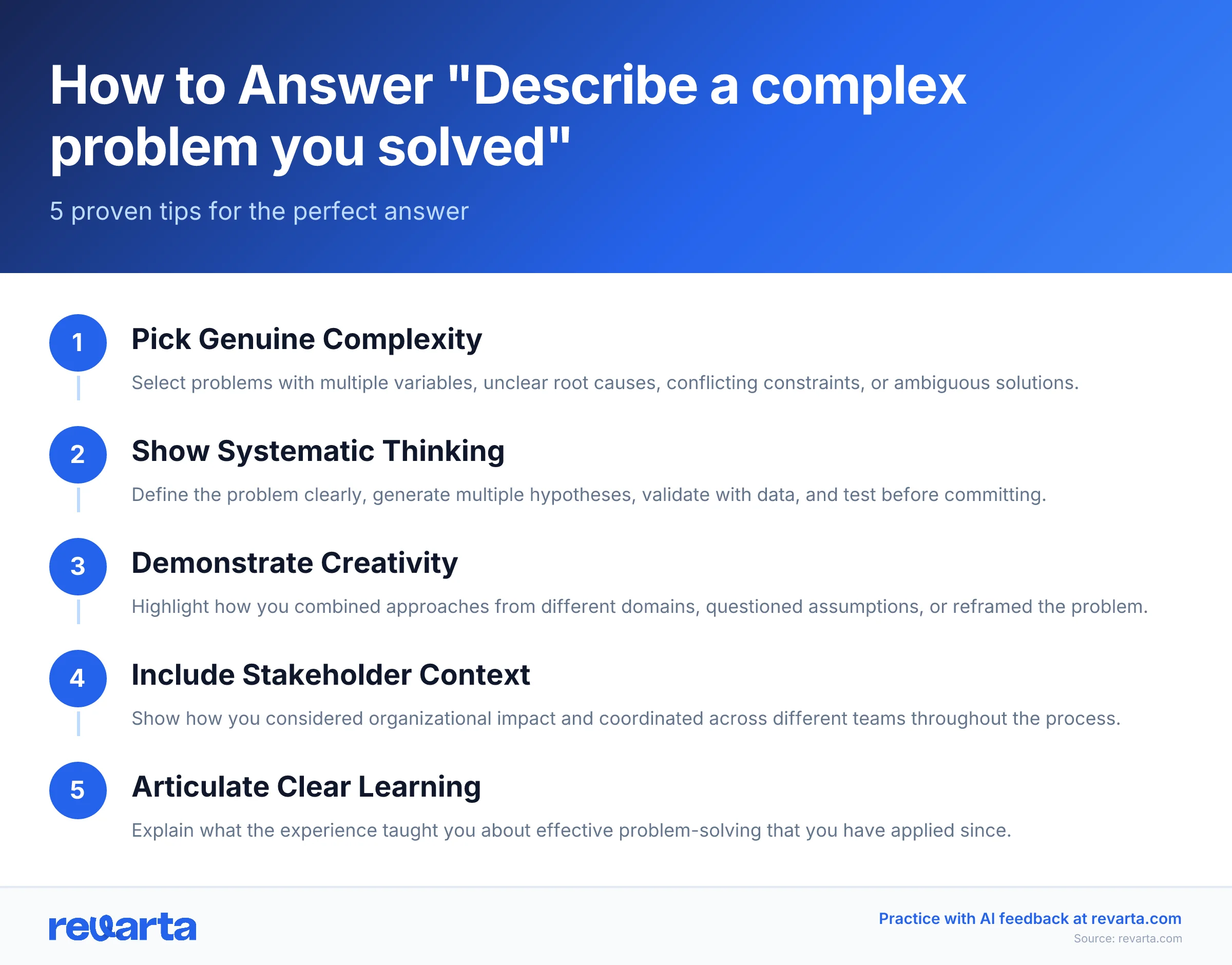
Complexity Indicators: Select problems with multiple variables, unclear root causes, conflicting constraints, or ambiguous solutions
Avoid: Routine issues with obvious solutions or problems you didn't actually solve
Seek: Problems that required genuine analysis, creativity, and persistence
Demonstrating Systematic Thinking
Show structured methodology:
- Define the problem clearly before solving
- Generate multiple hypotheses before settling on one
- Use data and evidence to validate assumptions
- Consider multiple solutions before selecting
- Test and iterate rather than assuming first attempt will work
Showcasing Creative Problem-Solving
Innovation often comes from:
- Combining approaches from different domains
- Questioning assumptions others accepted
- Reframing the problem
- Involving unconventional perspectives
Common Mistakes to Avoid
Content Mistakes
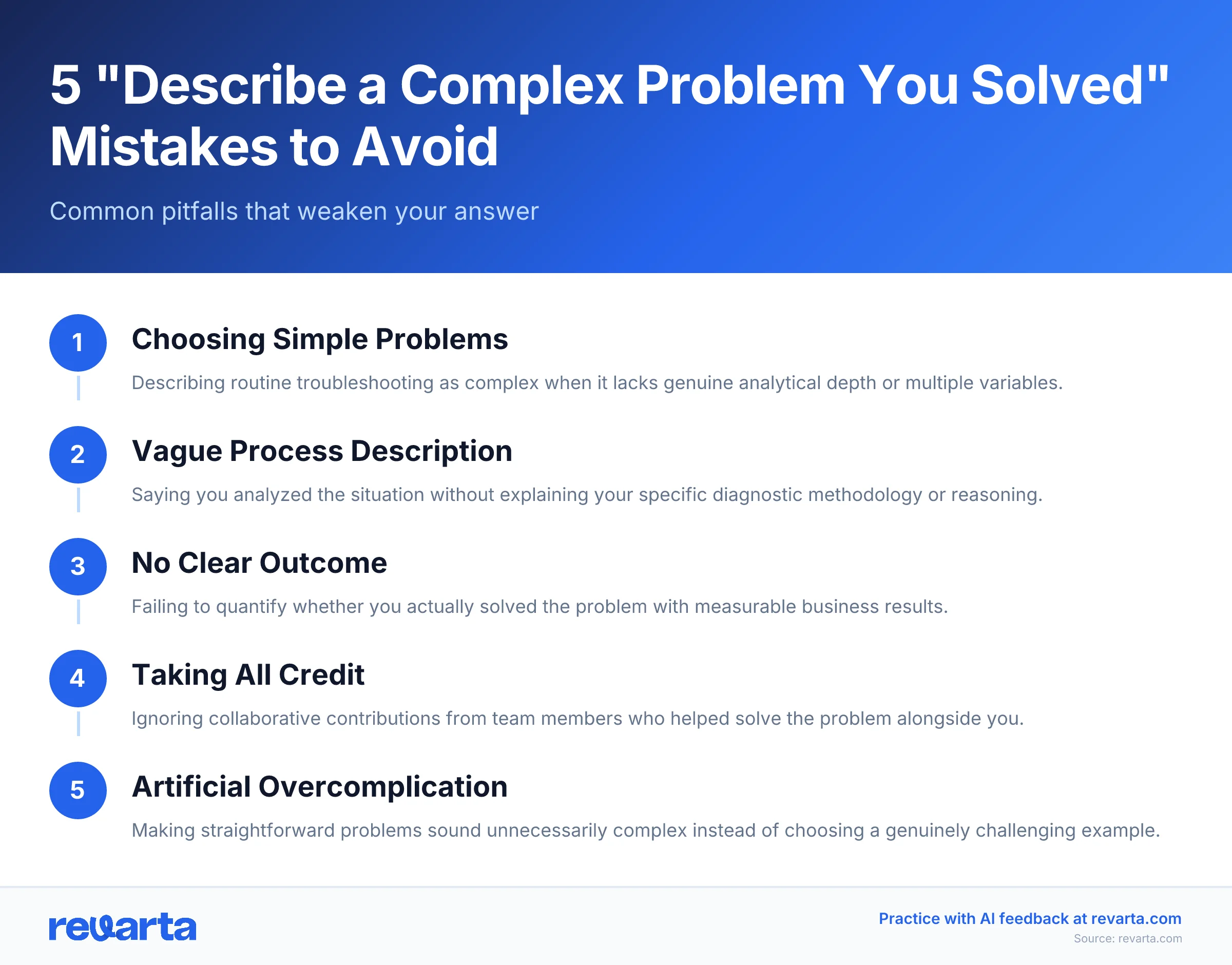
Choosing Simple Problems: Describing routine troubleshooting as "complex"
Vague Process: Saying "I analyzed the situation" without explaining how
No Clear Outcome: Failing to quantify whether you actually solved the problem
Taking All Credit: Ignoring collaborative problem-solving contributions
Overcomplication: Making simple problems sound artificially complex
Structure Mistakes
Too Much Technical Detail: Losing interviewer in jargon
Skipping Diagnosis Phase: Jumping straight to solution without showing analysis
Missing Business Context: Solving problem without explaining why it mattered
Follow-Up Questions to Prepare For
About Your Process
- "How did you know that was the right solution?"
- "What alternatives did you consider?"
- "What would you do differently if you faced this problem again?"
About Challenges
- "What obstacles did you encounter while solving this?"
- "Tell me about a time your proposed solution didn't work"
Industry-Specific Considerations
Technology Sector
Emphasize systematic debugging, data-driven analysis, scalable solutions
Healthcare Industry
Focus on patient safety implications, regulatory compliance, evidence-based approaches
Business/Finance
Highlight ROI analysis, stakeholder impact, risk management
Conclusion
Mastering complex problem-solving questions requires selecting genuinely challenging examples, demonstrating systematic analytical methodology, and articulating measurable impact. The strongest answers show both rigorous thinking and practical results.
Start practicing with Revarta's AI interview coach to perfect your problem-solving answers.
Practice problem-solving answers with AI feedback
Keep Preparing


