How to Answer "Describe a Customer Service Challenge": The Complete Interview Guide (2026)
"Describe a customer service challenge" appears in over 85% of interviews for client-facing roles and 60% of interviews overall. This question reveals your customer orientation, problem-solving under pressure, emotional intelligence with frustrated customers, communication skills, and ability to balance customer needs with business constraints. Research shows that customer experience quality predicts business growth more than product features or pricing.
This comprehensive guide provides 15+ STAR method examples, frameworks for demonstrating customer-centric problem solving, and strategies for showcasing relationship management under difficult circumstances.
Why Interviewers Ask About Customer Service Challenges
Assessing Customer-Centric Mindset
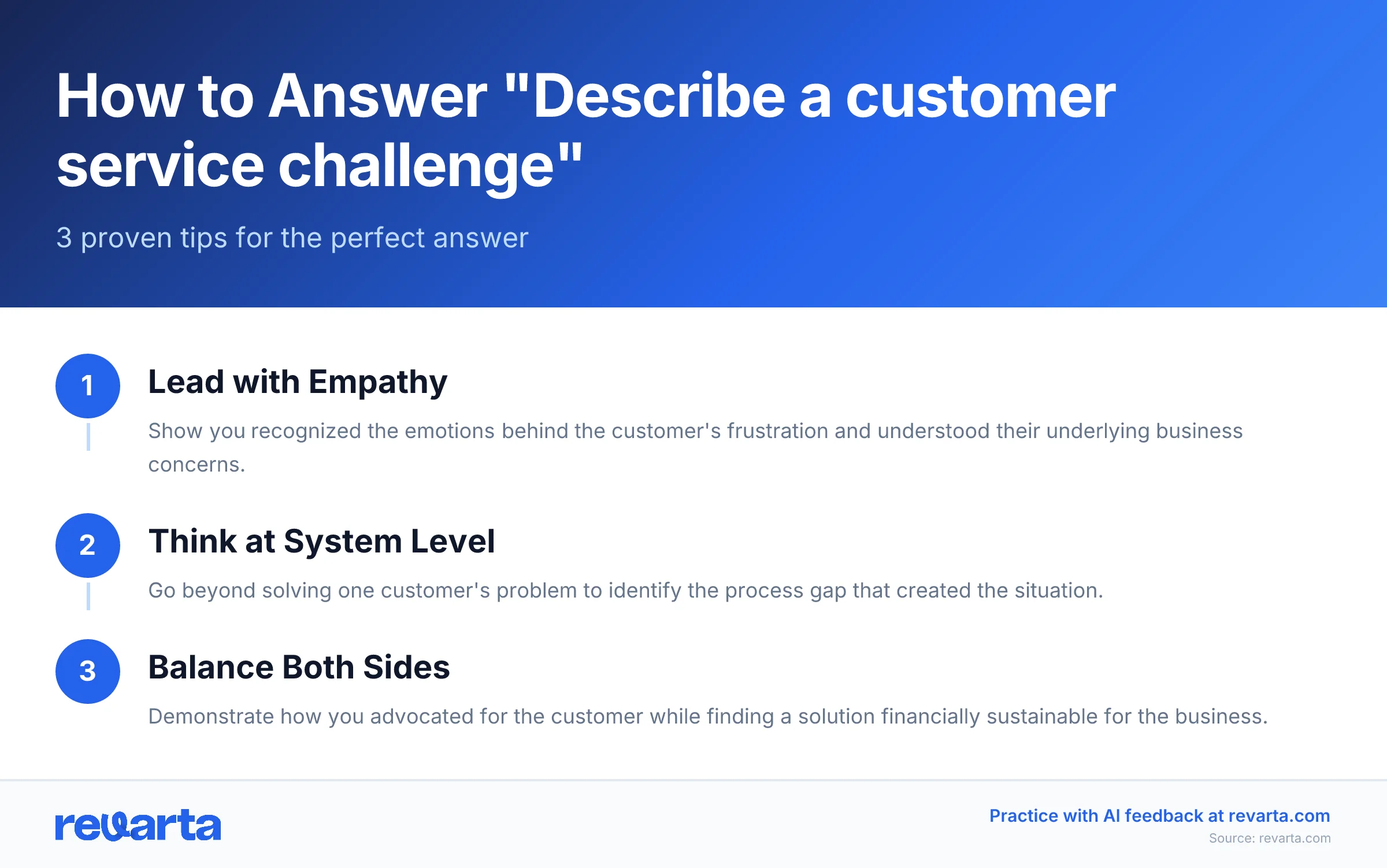
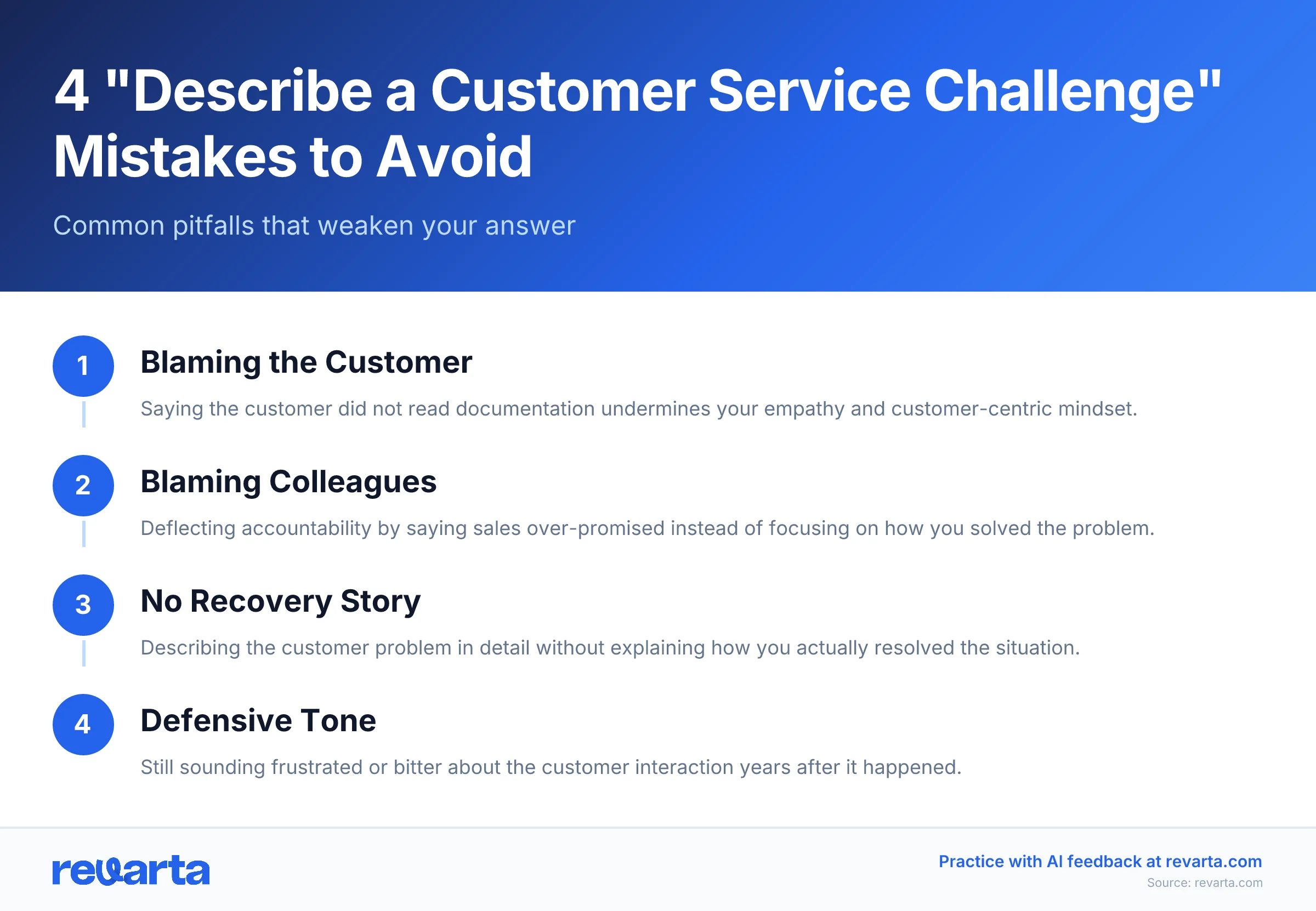
Organizations need employees who genuinely prioritize customer success. Your response reveals whether you view customers as obstacles or opportunities, empathize with customer frustrations, take customer complaints seriously rather than defensively, and advocate for customer needs even when inconvenient.
Evaluating Emotional Intelligence with Upset Customers
Frustrated customers trigger defensive reactions. Interviewers assess whether you can regulate emotions when customers are angry, remain professional despite personal attacks, de-escalate tense situations effectively, and separate customer frustration from personal criticism.
Understanding Creative Problem-Solving
Customer challenges often lack standard solutions. Your story shows whether you think creatively within constraints, find win-win solutions balancing needs, go beyond script to solve actual problems, and use judgment to bend rules appropriately.
Measuring Communication and Relationship Skills
Customer service requires artful communication. Interviewers evaluate whether you listen actively to understand root concerns, explain complex situations clearly, set appropriate expectations, and rebuild trust after service failures.
Gauging Resilience and Recovery
Service challenges test professional composure. Your example reveals whether you maintain quality despite difficult interactions, learn from customer complaints, recover relationships after mistakes, and stay motivated despite criticism.
The STAR Method for Customer Service Challenges
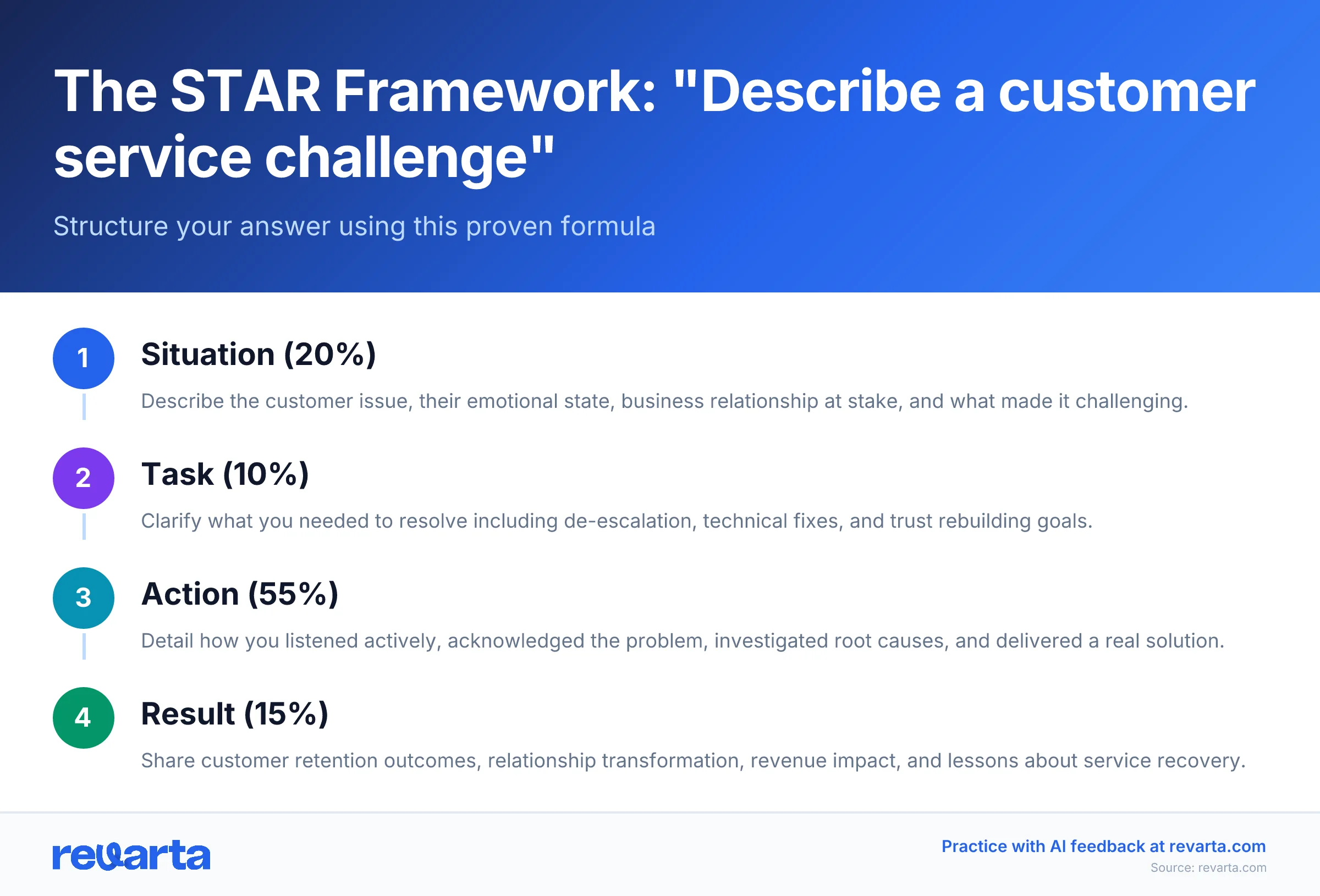
Situation (20%)
Example:
"As an account manager at Enterprise Software Inc., I managed a Fortune 500 client whose implementation was experiencing significant delays. Their IT director, Karen, called me extremely frustrated because our platform wasn't working with their legacy systems as promised during sales. She was furious, saying we'd misrepresented capabilities and that she'd recommended our solution to her executive team based on false promises. She threatened to cancel their $450K annual contract and mentioned potential legal action for misrepresentation."
Task (10%)
Example:
"I needed to de-escalate an extremely angry customer, investigate whether we had actually misrepresented capabilities, find a technical solution to make our platform work with their systems, rebuild trust in our partnership, and do all this while she was threatening contract cancellation and legal action."
Action (55%)
Example:
"Despite feeling defensive about the misrepresentation accusation, I recognized that Karen's anger stemmed from legitimate business problems I needed to help solve, not attack her credibility or blame sales.
First, I focused purely on listening. I said, 'Karen, I hear how frustrated you are, and I want to understand exactly what's not working so we can fix this. Walk me through what you were expecting versus what's happening.' I took detailed notes and asked clarifying questions without making excuses.
Through active listening, I learned that during sales, our rep had indeed promised integration with their specific ERP system without verifying technical compatibility. We could integrate with their ERP category generally, but their specific legacy version required custom development we hadn't scoped.
I acknowledged the problem honestly: 'You're right that we should have verified compatibility with your specific ERP version before promising integration. That's on us, not on you. I'm going to personally make sure we fix this, and here's how.'
I immediately engaged our technical team to assess what it would take to build the custom integration. I learned it would require 120 hours of development at a cost we hadn't budgeted. Rather than telling Karen this was impossible, I went to my VP with a business case: losing this client would cost $450K annually and damage our reputation in their industry. Investing in custom development now would retain the client and create reusable integration capabilities for similar customers.
My VP approved custom development as a customer success investment. I went back to Karen within 48 hours with a concrete plan: our technical team would build the custom integration at no additional cost to her, we'd complete it in 3 weeks, and I'd personally provide daily progress updates.
I also proposed bringing in our Customer Success Director for a call with Karen and her team to demonstrate company-level commitment to solving this.
Throughout the three-week development period, I sent daily updates even when there was limited progress, kept Karen informed of any complications, and made myself available whenever she had concerns.
When we delivered the custom integration, I personally attended their internal launch meeting to ensure successful deployment and address any final issues."
Result (15%)
Example:
"The custom integration worked successfully, enabling Karen's team to use our platform fully. Her initial fury transformed into appreciation that we'd taken ownership and invested significantly to solve the problem we'd created.
Not only did we retain the $450K contract, but Karen became one of our strongest advocates. She provided a reference for three prospects in her industry, leading to $1.2M in new business. The custom integration we'd built became a competitive advantage for selling to other companies with similar legacy ERP systems.
Karen later told my VP that while she'd been ready to cancel and write scathing reviews, our response—taking full ownership, investing in a real solution, and communicating transparently—had actually increased her trust in our partnership.
This experience taught me that angry customers usually have legitimate underlying concerns, even if expressed harshly. I learned that acknowledging problems honestly builds more trust than defensive excuse-making. Most importantly, I learned that investing in solving customer problems, even when they're partially self-created, generates long-term business value that exceeds short-term costs.
This challenge shaped my entire approach to customer service: listen first to understand, own problems regardless of whose fault they are, invest in real solutions rather than Band-Aids, and communicate proactively throughout recovery."