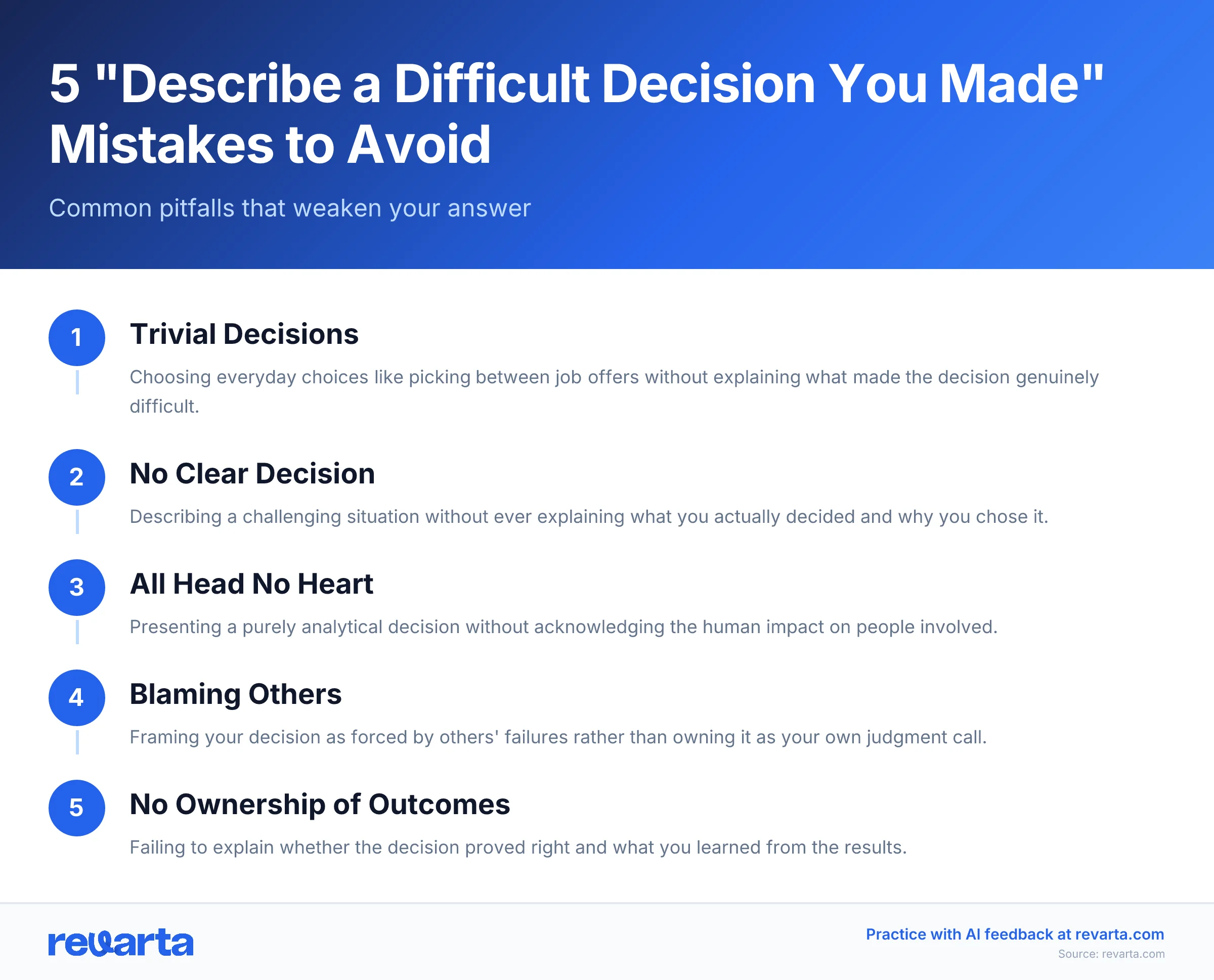
How to Answer "Describe a Difficult Decision You Made": The Complete Interview Guide (2026)
"Describe a difficult decision you made" appears in over 85% of professional interviews, particularly for roles requiring independent judgment, strategic thinking, or leadership responsibilities. This question isn't just about choosing between options—it reveals your decision-making framework, comfort with ambiguity, ethical grounding, ability to balance competing priorities, courage to make unpopular choices, and capacity to act decisively despite incomplete information. Research from McKinsey shows that decision quality predicts organizational performance more than most other leadership competencies.
This comprehensive guide provides everything you need to master difficult decision questions: 15+ detailed STAR method examples demonstrating sound judgment, proven frameworks for articulating decision-making processes, advanced strategies for showcasing decisiveness balanced with thoughtfulness, and AI-powered practice tools to perfect your response.
Why Do Interviewers Ask About Difficult Decisions?
Assessing Decision-Making Framework
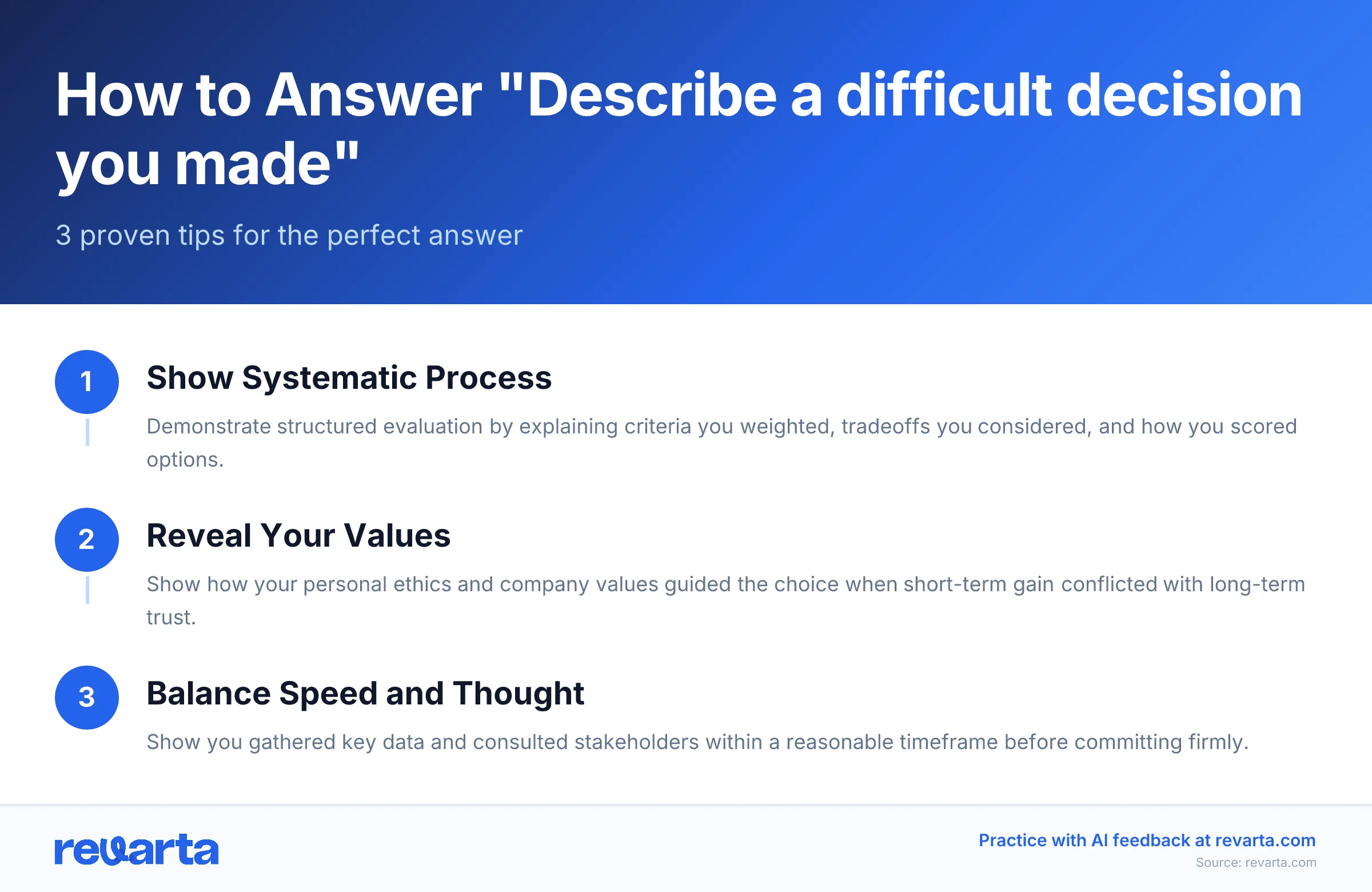
Interviewers want to understand your mental model for approaching complex choices. Do you have systematic frameworks for evaluating options, or do you decide based on gut instinct? Can you articulate the factors you weighed, the tradeoffs you considered, and the criteria that guided your choice? Systematic decision-makers scale their effectiveness as complexity increases; reactive decision-makers hit capability ceilings.
Evaluating Comfort with Ambiguity and Risk
Most important decisions involve incomplete information and uncertain outcomes. Your response reveals whether you can act decisively despite ambiguity, make sound judgments with imperfect data, balance analysis with timely action, and take appropriate calculated risks when guarantees aren't available. Leaders who wait for perfect information never decide; those who act recklessly create preventable problems.
Understanding Values and Ethical Grounding
Difficult decisions often involve competing values—short-term results versus long-term relationships, individual needs versus team goals, financial performance versus ethical principles. Interviewers assess whether you make decisions aligned with strong values, consider ethical implications alongside practical outcomes, and demonstrate integrity when easier paths are available.
Measuring Courage and Conviction
Some difficult decisions are unpopular, challenge the status quo, or carry personal risk. Your story reveals whether you have the courage to make right decisions despite opposition, stand by your choices when questioned, take responsibility for outcomes, and advocate for what you believe matters even when it's uncomfortable.
Gauging Stakeholder Consideration
Complex decisions affect multiple people with different interests. Interviewers evaluate whether you consider diverse stakeholder perspectives, communicate decisions thoughtfully to affected parties, manage resistance and pushback constructively, and balance empathy with decisiveness.
The STAR Method for Difficult Decision Questions
Situation (20% of your answer)
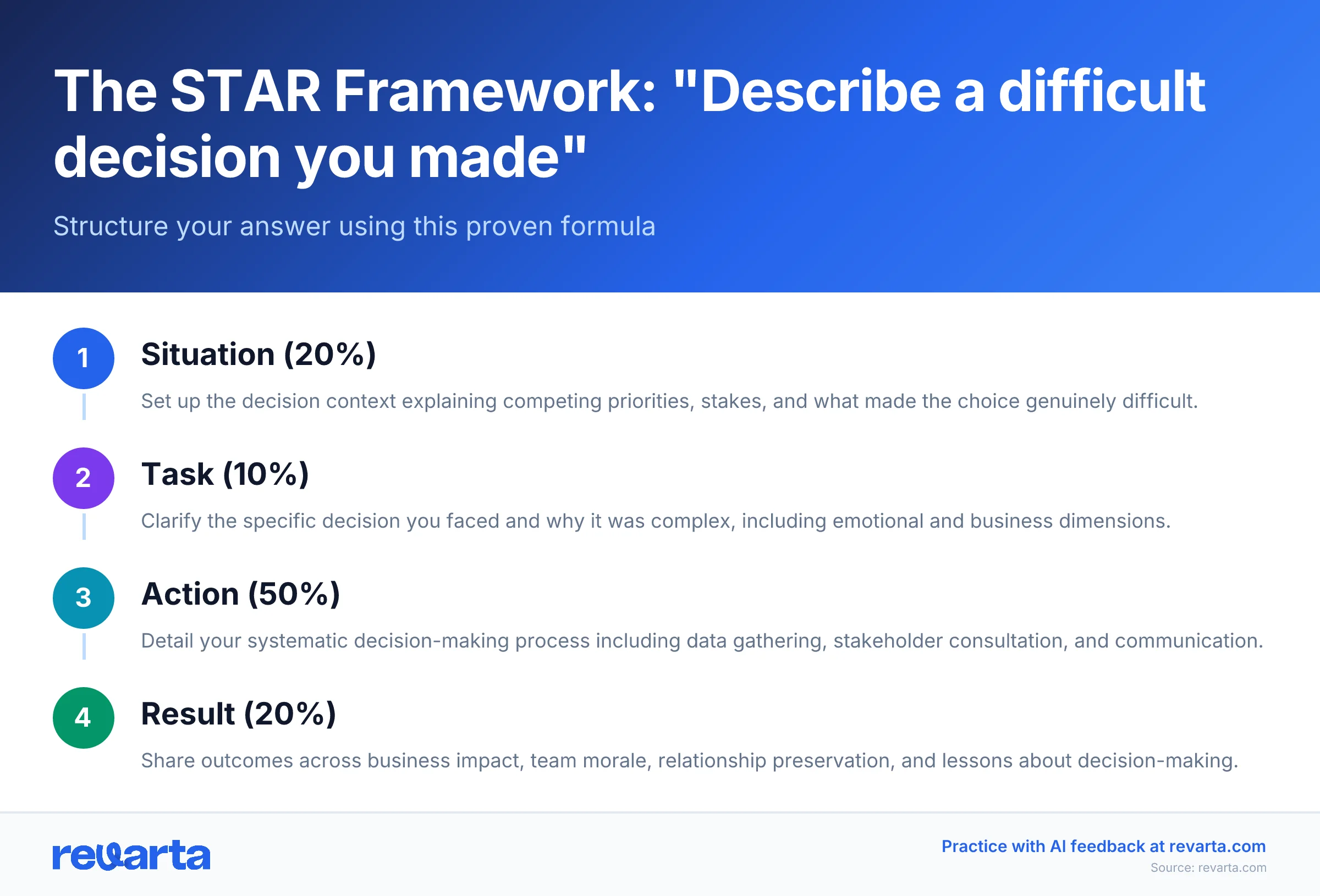
Set up the decision context to establish genuine difficulty:
Example:
"As director of product development, I faced a difficult decision about whether to cancel a major product initiative six months into development. We'd invested $800K in building a new analytics feature that our sales team insisted enterprise customers needed. However, early beta testing revealed that while customers liked the concept, the feature was too complex for non-technical users who represented 80% of our customer base. Usage metrics showed only 12% of beta users engaging with the feature more than once. Meanwhile, our roadmap for simpler features that served broader customer needs was being delayed because engineering resources were dedicated to this analytics project."
Task (10% of your answer)
Clarify what decision you needed to make and why it was difficult:
Example:
"I needed to decide whether to continue investing in this analytics feature despite low engagement, or cancel the project and reallocate resources to features serving broader customer needs. The decision was difficult because: sales leadership strongly opposed cancellation arguing we'd lose enterprise deals, we'd already invested $800K and canceling would mean writing off that investment, the engineering team had worked hard on this and cancellation would be demoralizing, and I'd personally championed this feature initially so canceling meant admitting my judgment was wrong."
Action (50% of your answer)
Detail your decision-making process and the choice you made:
Example:
"I approached this systematically rather than reactively. First, I gathered comprehensive data: I analyzed beta usage in depth, interviewed 15 beta users to understand why engagement was low, surveyed our broader customer base about feature priorities, and modeled the revenue impact of continuing versus canceling.
The data was clear: the feature served a narrow use case well but wouldn't drive adoption or retention for most customers. Revenue modeling showed that features we'd delayed would have 5x more impact on our growth metrics.
However, I also considered non-quantitative factors: How would cancellation affect team morale? What message would it send about our product strategy? How would we handle the sales team's opposition?
I made the decision to cancel the analytics project and reallocate resources to our broader-impact roadmap. But I invested significant effort in how we executed this decision.
I met personally with the engineering team first, acknowledging their excellent work but explaining that strategic fit, not execution quality, drove the cancellation. I framed it as my strategic error in prioritizing this feature, not their failure in building it. I showed them the usage data and customer feedback so they understood the rationale.
I then met with sales leadership, prepared for strong pushback. I presented the data showing limited customer engagement and modeled the revenue impact of alternative features. I acknowledged their concern about enterprise deals but shared that only 2 of our 50 enterprise accounts had actually requested this feature—it was more sales perception than actual demand. I proposed that we build a lightweight version of the analytics feature later if enterprise demand materialized with real pipeline impact.
I also publicly took ownership for the initial decision to pursue this feature. In our company all-hands, I explained the cancellation as correcting my strategic misjudgment based on customer data, not as punishing the team for poor execution. This framing protected the team from blame while demonstrating that we were data-driven enough to change course when evidence warranted it."
Result (20% of your answer)
Share outcomes across multiple dimensions:
Example:
"We reallocated the engineering team to simpler features that served 80% of users. Within three months, we'd shipped two features that drove measurable engagement increases—daily active users grew 18% and customer satisfaction scores improved 12 points.
From a business perspective, the decision proved correct. We didn't lose the enterprise deals sales had worried about—both signed without the analytics feature. Six months later, we did build a lightweight version of analytics based on actual enterprise requests, which took 25% of the resources the original would have required.
Team morale remained strong because of how we handled communication. The engineering lead later told me he appreciated that I'd taken personal accountability and protected the team. We actually had zero attrition from this team in the following year.
Sales leadership, while initially frustrated, came to agree with the decision once they saw engagement data from features we'd prioritized instead. Our VP of Sales acknowledged in a later conversation that his team had been advocating based on assumptions rather than validated customer demand.
This decision taught me critical lessons about sunk cost fallacy—the $800K we'd invested was gone regardless of whether we continued; the question was whether future investment would generate return. I learned the importance of distinguishing between execution quality and strategic fit—the team had built exactly what we'd asked for; the problem was we'd asked for the wrong thing. Most importantly, I learned that how you communicate difficult decisions matters as much as the decision itself. Taking personal accountability while explaining clear rationale maintained trust even when people disagreed with the outcome."