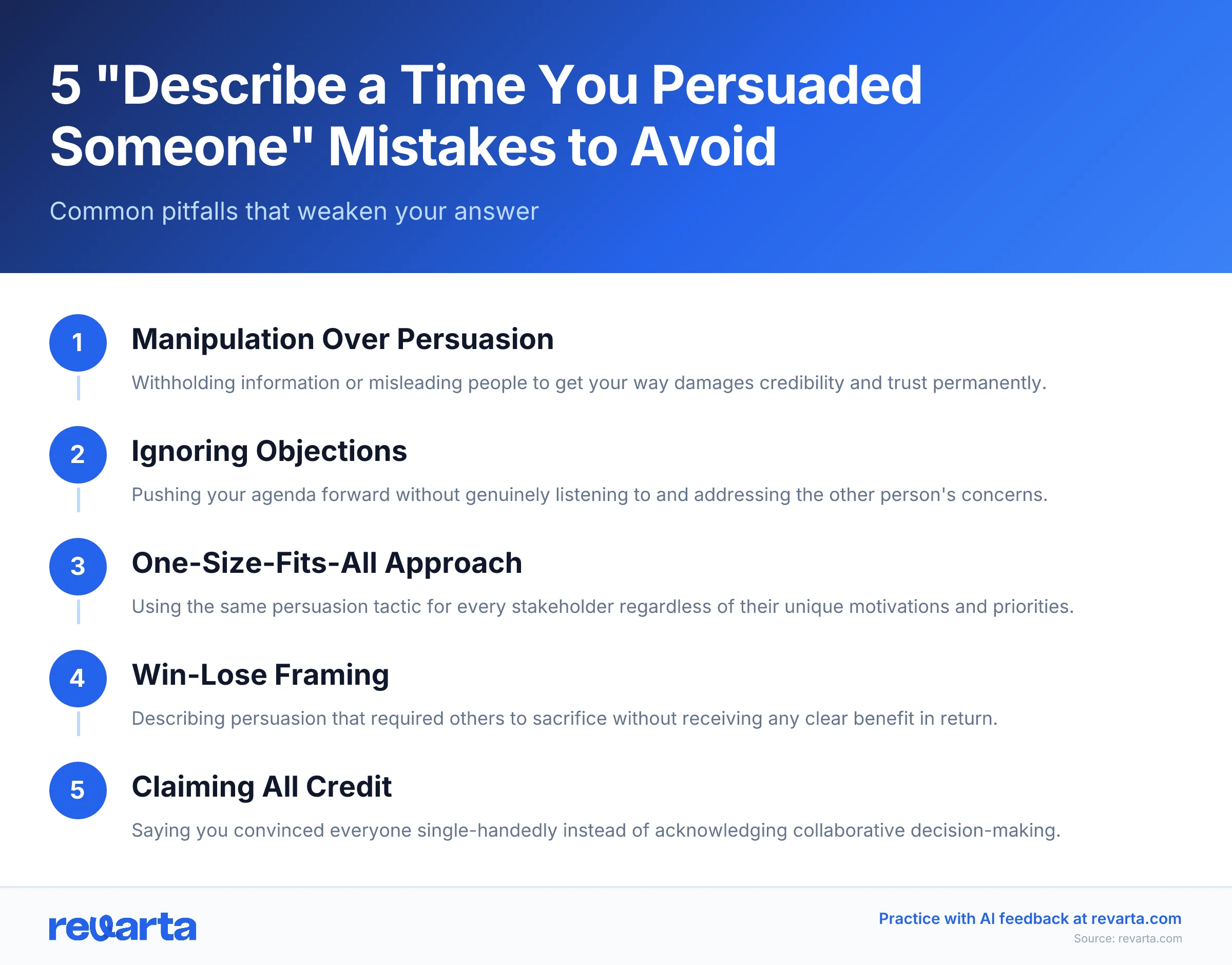
How to Answer "Describe a Time You Persuaded Someone": The Complete Interview Guide (2026)
"Describe a time you persuaded someone" appears in over 75% of interviews for roles requiring influence, leadership, or stakeholder management. This question reveals your ability to influence without formal authority, understanding of others' motivations and concerns, communication effectiveness when facing resistance, strategic approach to building consensus, and capacity to achieve goals through people rather than mandates. Research from Harvard shows that professionals skilled at persuasion achieve 40% more cross-functional project success than those who rely primarily on formal authority.
This comprehensive guide provides 15+ STAR method examples, persuasion frameworks for different resistance types, and strategies for demonstrating ethical influence that creates win-win outcomes.
Why Interviewers Ask About Persuasion
Assessing Influence Without Authority
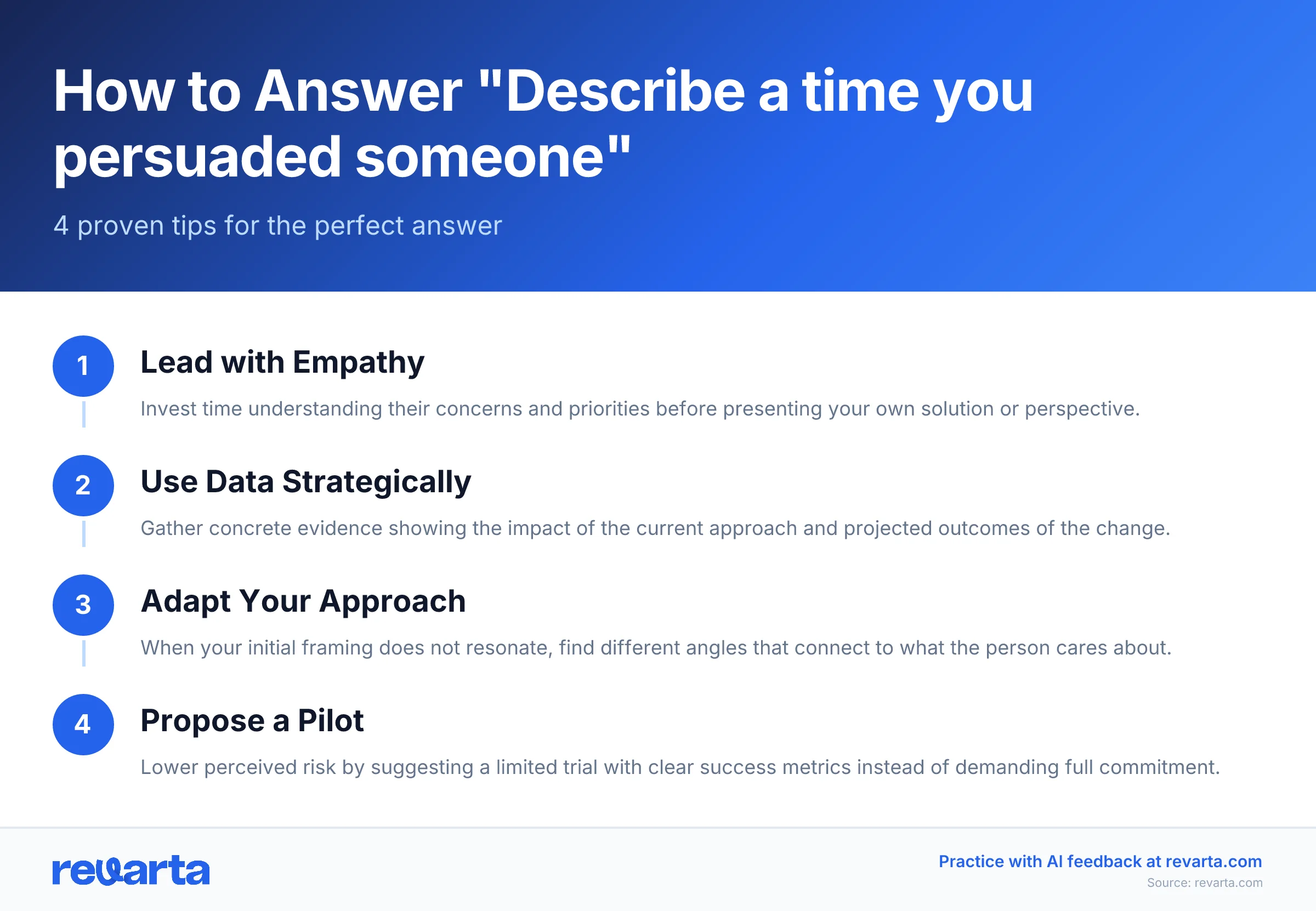
Most important work requires convincing people you don't control. Your response reveals whether you can build credibility through expertise and relationships, understand what motivates different stakeholders, present ideas in terms of others' priorities, and achieve goals when you can't simply direct people.
Evaluating Empathy and Perspective-Taking
Effective persuasion requires understanding others' viewpoints. Interviewers assess whether you listen to understand resistance rather than just overcome it, address underlying concerns rather than surface objections, adapt messaging to different audiences, and find genuine common ground rather than manipulating.
Understanding Communication Effectiveness
Persuasion demonstrates communication excellence. Your story shows whether you communicate complex ideas clearly, present compelling evidence and logic, tell persuasive stories, and adjust communication style based on audience.
Measuring Persistence and Resilience
Persuasion often requires multiple attempts. Interviewers evaluate whether you persist when facing initial resistance, adapt approach when first attempts fail, maintain relationships despite disagreement, and stay professional when persuasion attempts don't succeed.
Gauging Strategic Thinking
Strategic persuasion involves choosing the right approach. Your example reveals whether you identify key stakeholders and decision-makers, sequence persuasion efforts strategically, build coalitions to support your position, and know when to push and when to compromise.
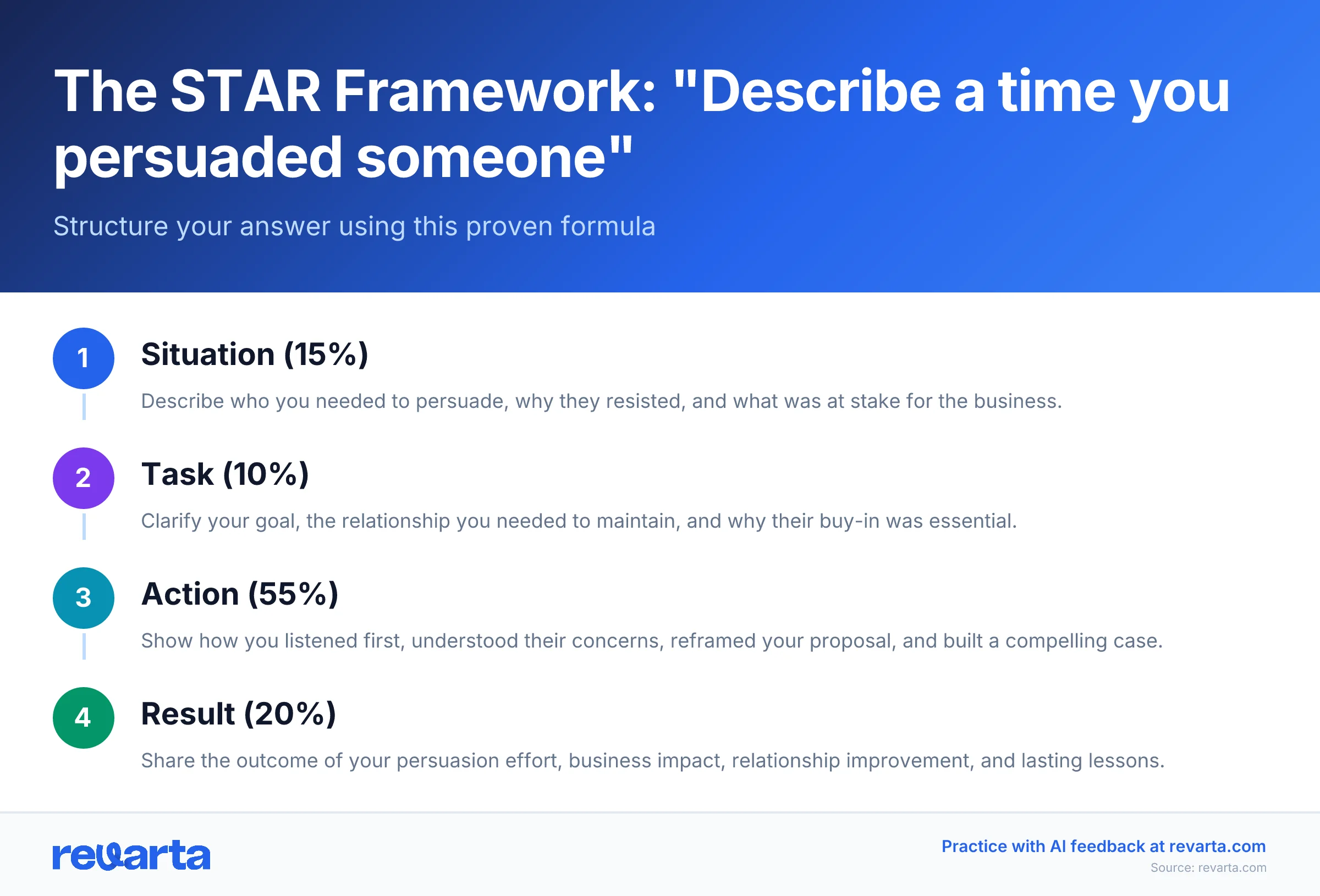
The STAR Method for Persuasion Questions
Situation (15%)
Example:
"As a product manager at SaaS Corp, our engineering team was struggling with mounting technical debt that slowed feature development and caused production issues. I believed we needed to allocate 30% of engineering capacity for two quarters to address this debt systematically. However, our VP of Sales strongly opposed this plan because he had promised major new features to key prospects to close deals by quarter-end. Without his buy-in, I couldn't proceed—he had significant influence with the CEO and could block any resource allocation that affected his pipeline."
Task (10%)
Example:
"I needed to persuade the VP of Sales to support technical debt reduction despite his short-term pipeline concerns, maintain our working relationship even if we disagreed, and find an approach that addressed both his sales needs and our engineering quality needs."
Action (55%)
Example:
"I started by understanding his perspective rather than just pushing my agenda. I scheduled a one-on-one conversation and asked open-ended questions: 'What features are most critical for your Q4 deals?' and 'What concerns do you have about the technical debt proposal?'
He explained that three specific features were blocking major deals representing $2M in annual revenue. His concern was that my proposal would delay these features by months, costing the company significant revenue and potentially his Q4 quota.
I listened without arguing. Instead of defending my proposal, I acknowledged his concerns: 'I understand why you're worried. Missing $2M in revenue would be a serious problem. Let me think about how we can address both the debt and your feature needs.'
Over the next week, I analyzed the technical debt more carefully. I discovered that not all debt was equally problematic—some caused frequent production issues while other debt was more theoretical. I also looked at our feature backlog to understand dependencies.
I developed an alternative proposal: instead of a blanket 30% allocation, we'd prioritize the highest-impact debt reduction (the issues causing production problems affecting existing customers) at 20% capacity. We'd sequence this work to avoid blocking the three critical features the VP needed for his deals.
I created a presentation showing the cost of NOT addressing high-priority debt: average of 15 hours per week spent firefighting production issues, customer satisfaction impact from reliability problems, and opportunity cost of engineering time spent on emergency fixes rather than planned work.
Crucially, I framed debt reduction in terms of HIS priorities: 'This approach will improve system reliability for existing customers, reducing churn risk. It will also free up 15 engineering hours weekly that we can redirect to your feature requests. Overall, we'll deliver your three critical features on schedule while reducing the technical issues that have caused problems for your largest accounts.'
I also brought data showing that our three largest customer escalations in the past quarter were caused by technical debt issues—these were customers the Sales VP personally owned. This made the problem concrete and relevant to him.
I proposed a pilot: one quarter of focused debt reduction at 20% capacity, with clear metrics for tracking impact on production issues and feature velocity. 'If this doesn't deliver the stability and capacity benefits I'm predicting, we can adjust the approach.'
During our discussion, he raised a valid concern: 'How do I know you won't keep expanding this debt work and delaying more features?' I addressed this with transparency: 'Let's create clear exit criteria. Once we've addressed the high-impact debt, we'll return to standard maintenance levels. I'll provide weekly updates on progress and feature impact.'
I also involved engineering leadership to validate my technical assessment, giving the Sales VP confidence this wasn't just my opinion but had broader technical support."
Result (20%)
Example:
"The VP of Sales agreed to the revised proposal. Over the subsequent quarter, we reduced production incidents by 68%, freed up an average of 12 engineering hours weekly, and delivered all three of his critical features on schedule.
The improved system stability led to a 15-point increase in NPS scores among enterprise customers and prevented the churn of two accounts worth $400K annually—both accounts the Sales VP managed personally. When he saw these results, he became one of the strongest advocates for continued technical investment.
Six months later, when I proposed another technical initiative, he supported it immediately, citing the success of the debt reduction work. Our working relationship improved significantly because I had demonstrated that I could balance technical needs with business priorities.
This experience taught me that persuasion isn't about winning arguments—it's about finding solutions that address everyone's legitimate concerns. I learned to lead with understanding before proposing solutions; the time I spent listening to the Sales VP's concerns and analyzing his feature needs was more valuable than any argument I could have made.
I discovered that data and logic aren't enough for persuasion—you need to connect to what people care about personally. Showing the VP how technical debt affected HIS customers and HIS quarterly goals was far more persuasive than abstract quality arguments.
Most importantly, I learned that offering pilots and exit criteria reduces resistance by lowering the perceived risk of trying something new. People are more willing to be persuaded when they have clear ways to change course if things don't work as promised."