How to Answer "Describe a Time You Resolved a Conflict": The Complete Interview Guide (2026)
"Describe a time you resolved a conflict" appears in over 80% of behavioral interviews across all professional levels. This question isn't just about your ability to handle disagreements—it reveals your emotional intelligence, communication skills, problem-solving approach, professionalism under pressure, and capacity to maintain productive relationships despite challenges. Research shows that workplace conflict costs organizations an average of $359 billion annually in lost productivity, making conflict resolution skills among the most valued competencies.
This comprehensive guide provides everything you need to master conflict resolution questions: 15+ detailed STAR method examples for different career stages and industries, proven de-escalation strategies, advanced techniques for demonstrating emotional intelligence, and AI-powered practice tools to perfect your response.
Why Do Interviewers Ask About Conflict Resolution?
Understanding the strategic purpose behind this question transforms your approach from defensive to opportunity-focused. Interviewers use conflict scenarios to evaluate critical workplace competencies:
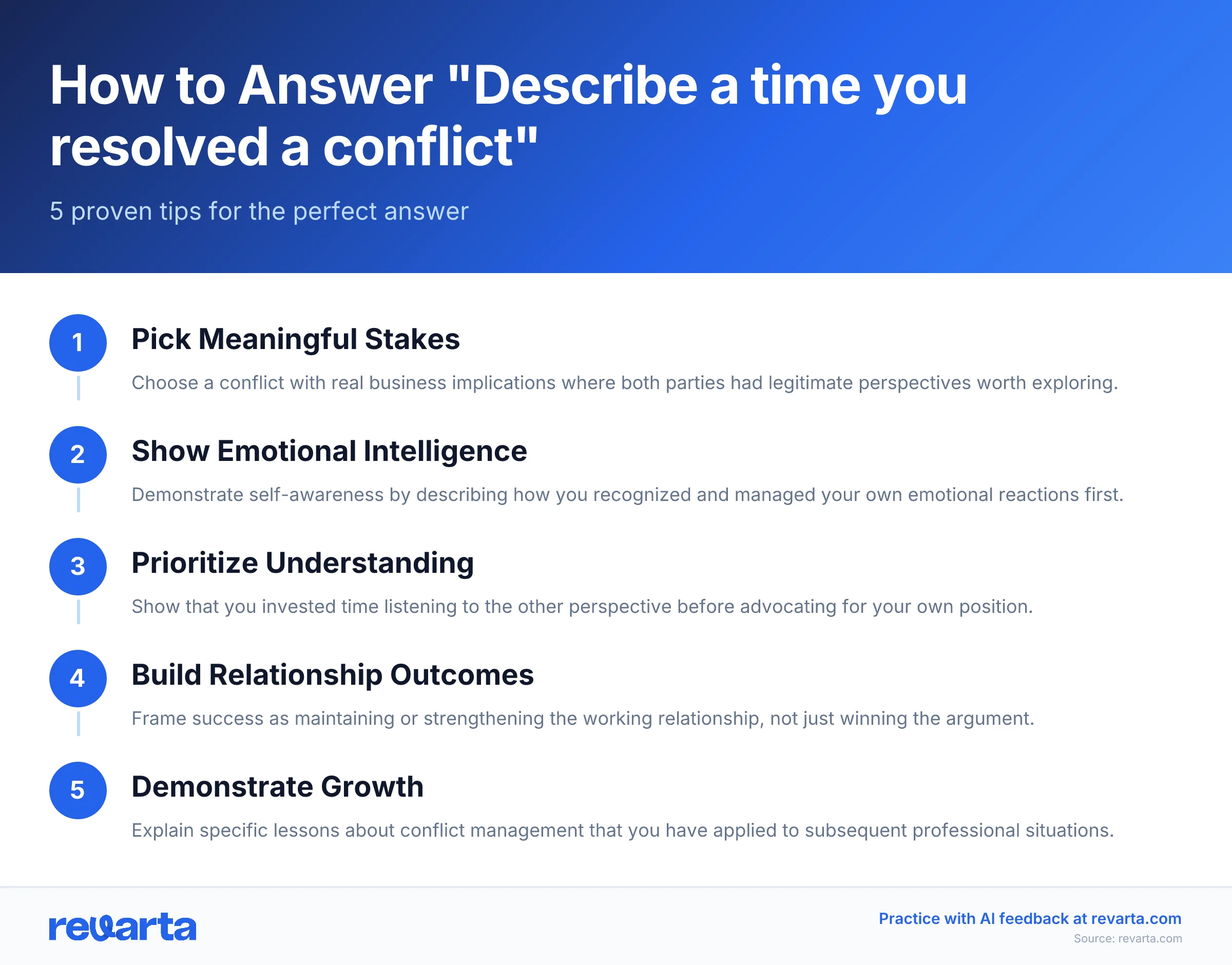
Assessing Emotional Intelligence and Maturity
Conflict situations trigger emotional responses that reveal your self-regulation capabilities. Interviewers want to see that you can remain professional and solution-focused even when frustrated, angry, or feeling attacked. The ability to manage your emotions while recognizing and responding to others' emotions predicts leadership effectiveness and team cohesion.
Your conflict response demonstrates whether you escalate tensions or de-escalate them—a crucial distinction for any role involving collaboration. Candidates who blame others, get defensive, or hold grudges raise immediate red flags about cultural fit and team dynamics.
Evaluating Communication and Influence Skills
Conflict resolution requires articulating your perspective clearly, listening actively to understand others' viewpoints, and finding persuasive ways to reach agreement without formal authority. These communication skills transfer directly to client negotiations, stakeholder management, and cross-functional collaboration.
Interviewers assess whether you can navigate difficult conversations with diplomacy while still advocating for important positions. This balance between assertiveness and collaboration indicates professional maturity.
Understanding Problem-Solving Approach
How you analyze conflict root causes, generate potential solutions, evaluate tradeoffs, and implement resolutions reveals your systematic thinking. Do you address symptoms or underlying issues? Can you find creative win-win solutions or do you see conflict as zero-sum?
Your problem-solving approach during conflict also shows whether you can maintain long-term perspective despite short-term friction—crucial for sustained team effectiveness.
Gauging Cultural Fit and Values Alignment
Your conflict stories expose your values around transparency, respect, accountability, and collaboration. Companies with strong teamwork cultures need people who resolve rather than avoid or inflame conflicts. Organizations emphasizing candor want employees comfortable having tough conversations.
The types of conflicts you choose to share and how you frame them reveal whether your approach to interpersonal challenges aligns with company culture.
Predicting Retention and Team Dynamics
Employees who can't navigate workplace conflict effectively create toxic environments, drive turnover, and decrease team performance. Hiring managers invest heavily in assessing this competency because one person with poor conflict management skills can damage entire teams.
They're evaluating whether you'll contribute to healthy team dynamics or create additional management overhead and interpersonal drama.
What Interviewers Are Really Assessing
Beyond your story's content, interviewers evaluate multiple dimensions of your response:
Ownership vs. Blame: Do you frame conflicts as mutual misunderstandings requiring collaborative solutions, or do you position yourself as righteous victim and the other party as unreasonable villain?
Solution Focus: Do you spend more time describing the problem or the resolution process? Dwelling on conflict details suggests you hold grudges; focusing on solutions demonstrates forward-thinking.
Relationship Preservation: Do you view conflict resolution success as "winning" or as maintaining productive working relationships despite disagreements?
Self-Awareness: Can you acknowledge your contribution to the conflict, even if the other party shares more blame? Inability to see your role suggests limited self-reflection.
Professional Boundaries: Do you handle conflicts directly and appropriately, or do you complain to others, escalate unnecessarily, or avoid addressing issues?
Learning and Growth: Do you demonstrate that conflicts taught you something about communication, perspective-taking, or relationship management?
The STAR Method for Conflict Resolution Questions
The STAR framework (Situation, Task, Action, Result) provides the optimal structure for behavioral conflict questions. Here's how to adapt it specifically for conflict scenarios:
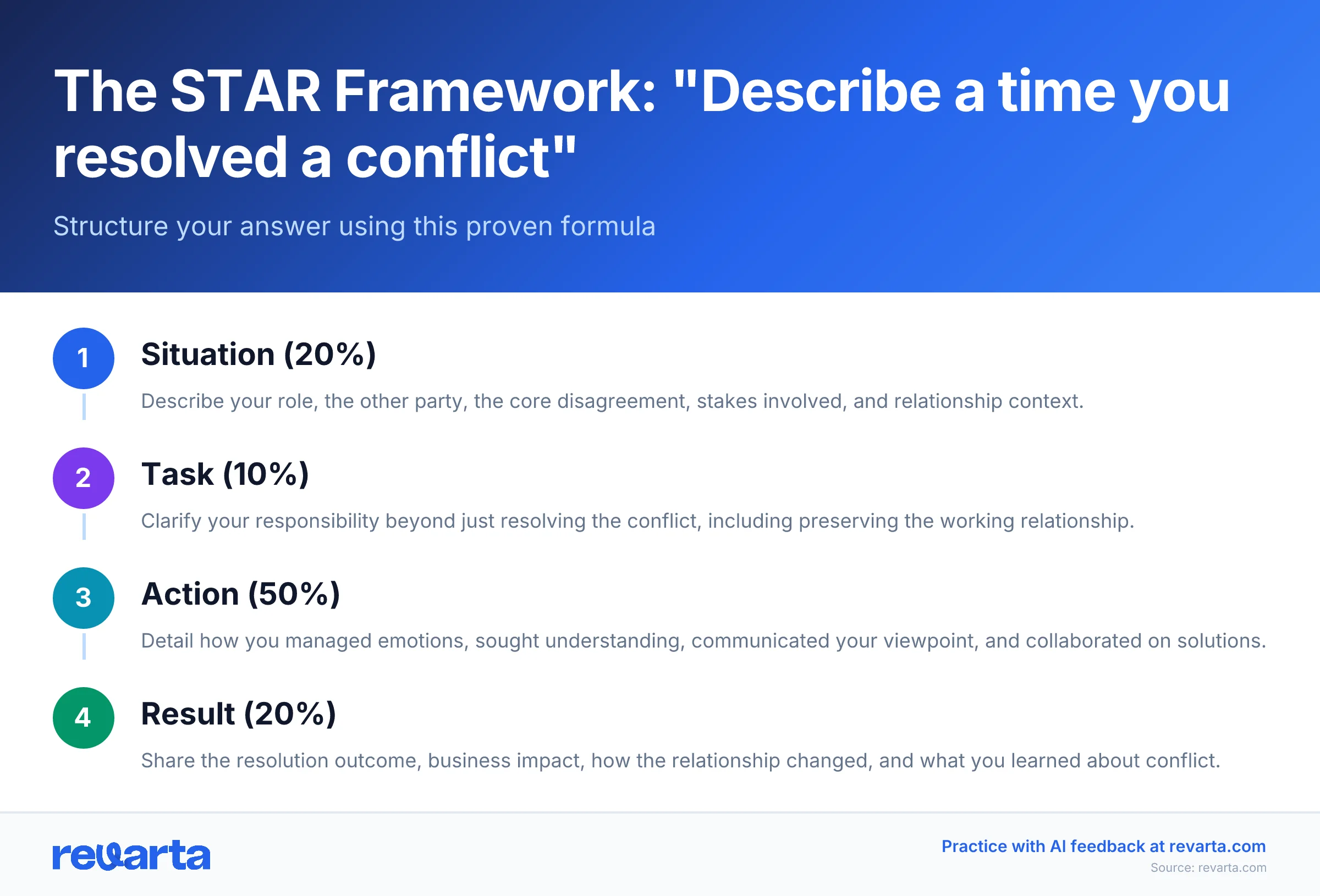
Situation (20% of your answer)
Set up the conflict context concisely. Include:
- Your role and the other party's role
- The core disagreement or tension
- Why the conflict mattered (stakes/consequences)
- Brief context about working relationship
Example:
"In my role as project manager at TechCorp, I had a significant conflict with our senior developer, Mark, about technical architecture decisions for a critical client project. Mark wanted to rebuild our entire backend using new microservices architecture, which I believed would risk our three-month deadline. The client had already postponed twice and made clear they'd switch vendors if we missed another deadline. Mark and I had worked together successfully for two years, so this disagreement was unusual and concerning."
Task (10% of your answer)
Clarify your responsibility in resolving the conflict. What were you trying to achieve beyond just "resolving" it?
Example:
"My responsibility was to make a final decision that balanced technical excellence with business realities, while preserving my collaborative relationship with Mark and maintaining his engagement on the project. I also needed to ensure the team understood the rationale so they'd support whatever direction we chose."
Action (50% of your answer)
This is the most critical section. Detail your specific conflict resolution process:
- Initial Response: How you managed your emotional reaction
- Understanding: Steps you took to understand the other perspective
- Communication: How you expressed your viewpoint and listened to theirs
- Solution Generation: How you collaborated to find resolution
- Implementation: How you ensured agreement and follow-through
Example:
"First, I recognized I was feeling defensive about Mark questioning my judgment, and I knew reacting from that emotion would be counterproductive. I asked for time to think through his proposal rather than dismissing it immediately.
I scheduled a private one-on-one meeting with Mark where I started by acknowledging the technical merits of his microservices proposal and asking him to walk me through his thinking. I used active listening—summarizing his points to confirm understanding—and discovered that his deeper concern was that our current architecture would create technical debt that would haunt us for years. That was a legitimate worry I hadn't fully appreciated.
I then shared my perspective about the deadline risk, but I framed it as a constraint we both needed to solve for rather than a reason to dismiss his concerns. I said, 'You're right that we need to avoid creating problems for our future selves, and I'm equally committed to delivering on time for this client. How do we honor both priorities?'
We brainstormed together and Mark proposed a hybrid approach: keep the current architecture for launch but build it in a way that would allow phased migration to microservices post-launch. We sketched out a technical plan that satisfied his quality standards while meeting the deadline. I appreciated that he'd found a creative solution and told him so explicitly.
I documented our decision and the rationale in our project channel so the whole team understood both the immediate plan and the future direction. I also made sure to publicly credit Mark in our next team meeting for elevating our thinking about long-term architecture."
Result (20% of your answer)
Share multiple levels of outcomes:
- Immediate resolution: Was the specific conflict resolved?
- Business impact: What results came from the solution you agreed on?
- Relationship outcome: How did the conflict affect your working relationship?
- Lessons learned: What did you take away about conflict resolution?
Example:
"We implemented Mark's hybrid approach and delivered the project two weeks ahead of our deadline—our first early delivery for that client, which led to expanding our contract. The code quality remained high and we successfully migrated to microservices over the following six months without disrupting operations.
More importantly, my relationship with Mark actually strengthened through this conflict. He told me later that he appreciated that I'd genuinely listened rather than just pulling rank, and I appreciated his willingness to find creative solutions. We collaborated even more effectively on subsequent projects because we'd established that we could disagree constructively.
This experience reinforced the importance of separating my ego from my ideas and viewing conflicts as opportunities to find better solutions through diverse perspectives. It also taught me that rushing to resolve conflicts often means missing the underlying concerns that, when addressed, lead to superior outcomes."
15+ Detailed STAR Examples
Entry-Level Professional Examples
Recent Graduate - Marketing Coordinator
Situation:
"During my internship at BrandCo, I was assigned to work with Sarah, a fellow intern, on developing social media content for a product launch. We had very different approaches—I preferred data-driven content based on A/B testing results from previous campaigns, while Sarah favored creative, trend-driven content based on her design background. Our first few collaborations were tense because we'd each create content independently and then argue about which direction to pursue. With only three weeks until launch and no approved content, our manager expressed concern about whether we could deliver quality work together."
Task:
"I needed to find a way to work productively with Sarah, combine our different strengths rather than having them conflict, and deliver excellent content on deadline. As someone newer to the industry, I also wanted to demonstrate that I could collaborate effectively even with people who had different working styles."
Action:
"I reflected on why our approaches conflicted and realized we were both operating from valid but incomplete perspectives—neither data nor creativity alone makes great content. I scheduled coffee with Sarah outside the office to discuss our working relationship without the pressure of an immediate deadline.
I started by acknowledging what I appreciated about her creative abilities and admitted that my data focus sometimes led to safe, unexciting content. I shared that I felt she sometimes dismissed data insights too quickly, but I framed it as wanting to understand her perspective better. Sarah opened up that she felt I was trying to constrain her creativity and that her previous successes came from trusting her instincts.
We talked about how to integrate both approaches—using data to identify what topics and formats performed well, then using her creative skills to make that content stand out. We agreed to a process: I'd analyze past performance data and share 2-3 themes with highest potential, then she'd create multiple creative concepts for each theme, and we'd collaborate on refining the strongest options.
We also established communication norms—we'd share work-in-progress early for feedback rather than presenting finished work to defend. We committed to saying 'yes, and' instead of 'no, but' when building on each other's ideas."
Result:
"Our next three weeks were dramatically more productive and even enjoyable. The content we created together for the launch outperformed the company's previous product launches by 34% in engagement and 28% in click-through rates—our manager specifically noted it was the best intern-produced work she'd seen.
Sarah and I both received return offers partly based on our demonstrated ability to collaborate effectively. We still work together occasionally in our current full-time roles and maintain a great professional relationship. This experience taught me early in my career that conflict often signals an opportunity to find better solutions by integrating different perspectives rather than choosing between them. It also showed me the value of addressing interpersonal friction directly and early before it becomes entrenched."
Career Changer - From Hospitality to Project Management
Situation:
"In my first corporate role as a junior project manager after 10 years in restaurant management, I had a conflict with a senior stakeholder, Lisa, from the legal department. I was managing a website redesign project and needed legal approval for our updated terms and conditions. I'd submitted the documents for review with a two-week deadline, which I thought was generous. Lisa didn't respond for 10 days, then sent extensive feedback that would require another round of revisions and review, pushing us past our launch date.
I was frustrated because I'd built in buffer time that she'd consumed with her delayed response, and I felt she was being unnecessarily detailed about minor word choices. I sent what I now realize was a tersely-worded email emphasizing that we were 'blocked by legal' and couldn't launch on time—copying her manager. She responded defensively, pointing out that I hadn't flagged the request as urgent and that legal review inherently takes time for quality. The tension escalated and our project sponsor asked me to resolve it."
Task:
"I needed to repair the relationship I'd damaged with my accusatory email, understand why the legal process worked the way it did, get the approval we needed, and ensure future collaborations went more smoothly. As someone new to corporate environment, I also needed to demonstrate I could adapt to different working cultures and processes."
Action:
"I first acknowledged to myself that I'd made a mistake by publicly blaming Lisa and involving her manager before discussing the issue with her directly. That approach would have been appropriate in restaurant crisis management but wasn't right for this context.
I went to Lisa's office and apologized genuinely for my email. I explained that I was new to corporate project management and had reacted from my hospitality background where urgency is communicated forcefully. I acknowledged that my approach had been unprofessional and counterproductive.
I asked if she'd be willing to help me understand the legal review process better so I could plan more effectively in the future. Lisa appreciated the apology and explained that legal had been understaffed, that terms and conditions required careful review because liability exposure, and that my request had come through normal channels without priority flagging.
She shared that if I'd reached out proactively at the one-week mark to check on status and emphasize timing constraints, she could have prioritized accordingly. She also explained that some of her detailed feedback prevented potential legal exposure that I hadn't recognized as risky.
I thanked her for the education and asked if we could develop a better process for future projects. Together we created a simple protocol: for time-sensitive legal reviews, I'd flag as 'Priority' in the subject line and include target review date and launch implications. Lisa would acknowledge receipt within 24 hours with realistic timeline and flag any concerns early. We'd have a midpoint check-in for complex reviews."
Result:
"Lisa expedited the final review and we launched just three days late rather than the two weeks I'd feared. More importantly, I established a positive working relationship with the legal team that benefited multiple future projects. Lisa became an ally who helped me navigate other corporate processes and actually advocated for my promotion later.
This conflict taught me that corporate collaboration requires more proactive communication and stakeholder management than my hospitality background. It also reinforced that apologizing and asking for help is stronger than defending your position when you've made a mistake. I now build stakeholder relationships early in projects and invest time understanding different departments' processes and constraints—that upfront investment prevents downstream conflicts."
Mid-Career Professional Examples
Product Manager - B2B SaaS
Situation:
"As product manager for our enterprise SaaS platform, I had an escalating conflict with our VP of Sales, Robert, about feature prioritization. Robert insisted we build specific customization features that his largest prospect demanded as a condition for a $1.2M deal. My product roadmap research showed these features would only serve this single customer and would delay our mobile app by 2-3 months—a capability that our customer research indicated would impact 70% of our user base and had been our most-requested feature for six months.
Robert argued that revenue was the priority and that losing this enterprise deal would affect company growth targets. I believed we'd be mortgaging our product strategy for short-term revenue and setting a dangerous precedent of building one-off features for individual prospects. Our previous three meetings about this had grown increasingly tense, with Robert accusing me of being 'too academic' and not understanding business realities, while I felt he was prioritizing short-term commission over long-term product health. Our CEO asked us to reach agreement because the decision was delaying both initiatives."
Task:
"I needed to find a solution that honored both immediate revenue needs and long-term product strategy, maintain a productive working relationship with Robert who I collaborated with constantly, and demonstrate leadership by resolving this without escalating to our CEO for a tie-breaking decision."
Action:
"I realized that our conflict had become positional—we were both defending our proposed solutions rather than exploring the underlying problem. I suggested to Robert that we start over by aligning on what success looked like for the company, rather than debating features.
I proposed a working session where we'd map out scenarios and implications. Robert agreed but was skeptical. In the meeting, I started by acknowledging that his $1.2M deal mattered enormously and that I hadn't fully appreciated the pressure he was under to hit quarterly targets. I asked him to walk me through not just this deal, but his overall pipeline and how losing this deal would affect his other negotiations.
Robert shared that he had two other significant prospects who hadn't mentioned these specific features, but they'd asked when our mobile app would launch. That was revealing—the mobile app might actually help his pipeline more than the custom features. I then shared my data about mobile app demand and explained my concern that building custom features would set expectations we couldn't meet for other prospects.
We reframed the question from 'Which features should we build?' to 'How do we close this $1.2M deal without compromising our product strategy or setting unsustainable precedents?' Together we brainstormed alternatives: Could we offer professional services to build client-specific integrations outside our core platform? Could we include this customization in a future enterprise tier with appropriate pricing? Could we offer a phased approach where we delivered part of their request quickly while they waited for the full mobile app?
Robert leveraged his relationship with the prospect to explore options and discovered they were primarily concerned about integration with their legacy systems—something we could address through our API and professional services without custom platform features. We proposed a solution: build the mobile app on schedule, offer discounted professional services for their integration needs, and include early beta access to the mobile app as a sweetener.
I also committed to Robert that for future enterprise deals, I'd join sales calls earlier to understand requirements and explore creative solutions before they became deal-breakers."
Result:
"The prospect accepted our proposal and signed a $1.3M deal—actually larger than the original because of the professional services component. We launched the mobile app on schedule, which helped Robert close one of his other major prospects who had been waiting for that capability.
Our working relationship transformed from adversarial to highly collaborative. Robert started involving me in enterprise sales conversations much earlier, which helped us close deals while protecting product strategy. We jointly presented this case study at our company's quarterly meeting as an example of cross-functional problem-solving.
This conflict taught me that most disagreements aren't actually about the surface issue—Robert and I both wanted company success, we were just optimizing for different timeframes and metrics. It reinforced the power of stepping back from positional bargaining to explore underlying interests and creative solutions. I now apply this reframing technique proactively when I sense conflicts emerging."
Engineering Manager - Technology Company
Situation:
"I managed a team of eight engineers, and two of my senior developers, Priya and Jake, had a significant conflict that was affecting team dynamics. Priya believed Jake wasn't pulling his weight—he'd miss sprint commitments, arrive late to stand-ups, and seemed disengaged. Jake felt Priya was micromanaging him and creating a hostile environment with passive-aggressive comments in code reviews.
The tension came to a head when Priya publicly called out Jake in our sprint retrospective for 'consistently under-delivering' and Jake responded by saying Priya's 'perfectionism and control issues' made collaboration impossible. Several other team members looked uncomfortable, and one person messaged me privately that the team atmosphere had become toxic. Our sprint velocity had dropped 30% over the previous month, partially because people were avoiding collaborating with either Priya or Jake."
Task:
"As their manager, I needed to address this conflict before it further damaged team culture and productivity. I had to understand what was really happening, help both employees feel heard and respected, resolve the interpersonal issues, and re-establish team norms around professional conduct and feedback."
Action:
"I immediately addressed the public nature of their conflict in the retrospective, acknowledging that we had some team dynamics to work on and that I'd be discussing this with individuals privately. I scheduled separate one-on-ones with Priya and Jake for the next day.
In my conversation with Priya, I asked her to walk me through specific examples of Jake's underperformance. I learned that Jake had missed commitments on three occasions over the past month and that his code quality had declined. Priya was frustrated because she'd tried to help him but felt he dismissed her feedback. I validated that those performance issues needed to be addressed, but I also gave Priya direct feedback that public criticism was unacceptable regardless of performance problems, and that her code review comments had crossed from constructive to dismissive.
In my meeting with Jake, I approached it as genuinely curious about his perspective. He shared that his mother had been diagnosed with cancer six weeks ago and he'd been struggling emotionally and supporting his family. He'd been too proud to ask for accommodations but was barely holding it together. He felt Priya's increased scrutiny during this period felt like harassment rather than help, and he'd withdrawn further in response.
I thanked Jake for trusting me with this information and apologized that I hadn't checked in proactively when I'd noticed changes in his performance. We discussed FMLA options, flexible scheduling, and reducing his sprint commitments temporarily. I assured him we'd support him through this difficult time but also explained that I needed him to communicate proactively when he needed help rather than missing commitments silently.
I then brought Priya and Jake together for a mediated conversation. I established ground rules: focus on future collaboration, use 'I' statements, listen to understand, and assume positive intent. I shared (with Jake's permission) that he was dealing with a family health crisis that had affected his work, without disclosing details. Priya's demeanor immediately softened—she'd assumed his performance issues reflected lack of care about the team.
Jake apologized for his defensive response and his lack of communication about his struggles. Priya apologized for her public criticism and acknowledged that her delivery of feedback had been harsh. They agreed on clearer communication norms: Jake would proactively update if his personal situation affected commitments, and Priya would give feedback privately and assume good faith.
I also addressed this with the full team, reinforcing our values around psychological safety, professional feedback, and supporting each other through difficult times without disclosing Jake's private situation."
Result:
"Jake took two weeks of FMLA leave to support his mother through initial treatment, and when he returned on a flexible schedule with reduced sprint commitments, his engagement and code quality improved to his previous high standards. Priya became more empathetic in her feedback approach across the board, which several team members later told me improved team culture.
Our sprint velocity recovered and actually exceeded previous levels because the team wasn't navigating around conflict. Six months later, Jake's mother recovered, he returned to full capacity, and he and Priya had developed a strong professional relationship based on mutual respect.
This conflict taught me the critical importance of proactive management—if I'd been having regular, meaningful one-on-ones with Jake, I would have known about his family situation before it impacted his work and team relationships. It also reinforced that most interpersonal conflicts have context that isn't visible on the surface, and approaching people with curiosity rather than judgment uncovers paths to resolution. I now invest much more heavily in relationship-building and creating psychological safety so team members feel comfortable sharing challenges before they escalate."
Senior Professional Examples
Director of Operations - Healthcare
Situation:
"As Director of Operations for a regional hospital network, I had a serious conflict with the Chief Medical Officer, Dr. Patterson, about implementing a new scheduling system for nursing staff. I'd championed this system to reduce staffing costs by optimizing shift scheduling—our data showed we could save $2.4M annually while maintaining coverage.
Dr. Patterson opposed the system because the algorithm-driven scheduling would reduce nurses' ability to request specific shifts, which she believed would hurt retention in a tight labor market. Our first implementation attempt failed when Dr. Patterson instructed department chiefs to bypass the new system, which cost us $180K in implementation costs and embarrassed me in front of our board. The conflict escalated when I sent a memo to all department heads reinforcing that the new system was mandatory per our CFO—which Dr. Patterson viewed as undermining her authority with her medical staff."
Task:
"I needed to repair a damaged relationship with a peer executive whose cooperation was essential for hospital operations, understand her legitimate concerns without abandoning needed cost savings, and find an implementation approach that addressed both financial and employee retention priorities. As someone who'd positioned this as a pure win without adequate stakeholder engagement, I also needed to rebuild credibility that I'd lost through a failed implementation."
Action:
"I recognized that I'd approached this initiative from a purely operational/financial lens without adequately involving clinical leadership or considering the human impact on our nursing staff. That was a significant blind spot that had created this conflict.
I requested a private meeting with Dr. Patterson and opened by acknowledging that I'd made mistakes in how I'd approached this initiative. I said directly, 'I should have involved you from the beginning rather than presenting a finished plan. I was so focused on the financial benefits that I didn't adequately consider the impact on nursing satisfaction and retention, which I know you think about constantly. That was short-sighted, and the memo I sent to department heads was disrespectful to you and your relationship with medical staff. I apologize.'
Dr. Patterson appreciated the apology but was still skeptical. She shared that she'd seen too many administrative initiatives that looked good on spreadsheets but damaged staff morale, and that nursing turnover would cost far more than the savings I'd projected. She had data showing that hospitals with poor nurse satisfaction had higher patient mortality and complication rates—the stakes were much higher than just cost savings.
I asked if she'd be willing to work with me to redesign the implementation in a way that achieved financial goals while protecting nursing satisfaction. She agreed cautiously. We assembled a joint committee of operational staff, nurse managers, and department chiefs to review the scheduling system together.
Through this collaborative process, we discovered several modifications: the algorithm could optimize while still honoring seniority-based shift preferences, nurses could trade shifts peer-to-peer within the system's coverage constraints, and we could phase in the new system by department with feedback loops rather than forcing immediate compliance.
We also agreed on success metrics that included both cost savings and nursing satisfaction/retention measures—if satisfaction scores declined, we'd pause and reassess. I publicly credited Dr. Patterson with elevating our thinking and ensuring we balanced financial and quality considerations."
Result:
"The modified system implemented successfully across all departments over six months. We achieved $1.9M in annual savings—less than my original projection but still substantial—while nursing satisfaction scores actually improved by 8% because the new system reduced last-minute scheduling changes that nurses hated. Turnover decreased by 12% in the following year.
More importantly, Dr. Patterson and I established a strong working relationship based on mutual respect. She became an advocate for operational improvements when she trusted the process included clinical perspective, and I became much more effective by involving clinical leadership early in operational initiatives.
This conflict was a humbling lesson about the limits of data-driven decision-making without stakeholder engagement and human factors consideration. It taught me that the best solutions emerge from bringing together different expertise and perspectives from the beginning, not retrofitting clinical input into operational plans. I now use cross-functional design teams for major initiatives rather than presenting finished plans for approval."
Industry-Specific Examples
Account Manager - Advertising Agency
Situation:
"I was managing a major retail client account worth $800K annually when our creative director, Marcus, presented a bold, unconventional campaign concept that the client explicitly rejected in our presentation. The client wanted something 'safer and more proven,' and I communicated that feedback to Marcus.
Marcus was frustrated because he believed the client was making a mistake and that our job as an agency was to push them toward better creative, not just execute safe ideas. He scheduled a direct call with the client without informing me—his account manager—to 'make a stronger case' for his vision. The client was confused about getting contacted by multiple agency team members with conflicting messages and called me to complain that our agency wasn't aligned. Marcus and I had a heated argument where he accused me of being too deferential to clients and I told him he'd undermined my client relationship and violated professional protocol."
Task:
"I needed to repair the client relationship that Marcus's end-run had confused, address Marcus's violation of account management boundaries, understand his perspective about creative advocacy, and establish clear protocols for our working relationship going forward. I also wanted to preserve Marcus's creative passion while channeling it appropriately."
Action:
"I first focused on immediate client damage control. I called our client contact and apologized for the confusion, acknowledging that we should have been more aligned before reaching out. I explained that Marcus was passionate about the work but that I should have managed our internal process better to prevent mixed messages. I asked for another meeting where we could present revised creative that balanced bold thinking with their comfort level.
Then I scheduled an in-person meeting with Marcus to address our conflict directly. I started by acknowledging that I shared his frustration when clients reject creative work we believe in—I validated his passion as an asset. But I also explained clearly that account management exists to manage client relationships strategically, and that going around me to clients directly would damage trust and make it harder for me to advocate for creative ideas.
I asked Marcus to help me understand his perspective about when we should accept client feedback versus push back. He explained that he felt I gave up on good ideas too easily and that great creative requires educating clients, not just serving their initial reactions. That was a fair critique—I had become somewhat risk-averse about challenging client feedback.
We discussed developing a protocol: when we had creative we believed in strongly that clients rejected, we'd debrief together to understand the client's underlying concerns, revise the work to address those concerns while maintaining creative integrity, and I'd set up a follow-up presentation rather than immediately abandoning ideas. Marcus would trust me to manage client communication strategy, and I'd commit to fighting harder for creative when appropriate.
We agreed that I'd give Marcus more context about client politics and constraints so he could understand why certain approaches wouldn't work, and he'd give me more insight into why specific creative approaches were important so I could advocate more effectively.
For the immediate situation, Marcus and I collaborated on a revised campaign that incorporated elements of his bold concept but addressed the client's underlying concerns about brand consistency and risk. We presented it together as a united team."
Result:
"The client loved the revised campaign and actually said it struck the perfect balance of fresh thinking and strategic alignment. The campaign won a regional advertising award and led to the client expanding their contract by $200K annually.
Marcus and I developed an excellent working relationship built on mutual respect for each other's expertise. Our collaborative approach to creative development and client management became a model for other account teams at our agency. I won more pitches because Marcus's creative work stood out, and his ideas reached market more effectively because of my client relationship management.
This conflict taught me the importance of establishing clear working protocols in cross-functional relationships before conflicts emerge, and the value of genuinely understanding collaborators' perspectives even when their approach seems wrong initially. It also showed me that the best outcomes often come from integrating different viewpoints rather than choosing between them."
Common Variations of This Question
Interviewers explore conflict resolution through different phrasings to gain comprehensive understanding. Prepare for these variations:
Direct Variations
- "Tell me about a time you disagreed with a colleague"
- "Describe a workplace conflict and how you handled it"
- "Give me an example of a time you had a difficult conversation"
- "Tell me about a time you had to work with someone you didn't get along with"
- "Describe a situation where you had to manage a disagreement"
Specific Context Variations
- "Tell me about a time you disagreed with your manager"
- "Describe a conflict with a client and how you resolved it"
- "Give me an example of a time you had a conflict with a team member on a project"
- "Tell me about a time you had to deliver difficult feedback that created conflict"
Outcome-Focused Variations
- "Describe a time you turned a negative relationship into a positive one"
- "Tell me about a professional relationship that started poorly but improved"
- "Give me an example of resolving a conflict that benefited both parties"
Response Strategy
For all variations, use the STAR framework with emphasis on:
- Your emotional regulation and professionalism
- Your genuine effort to understand the other perspective
- Your focus on finding solutions rather than winning
- The relationship outcome, not just task resolution
- What you learned about conflict management
Choose examples where you can demonstrate emotional intelligence, mature communication, and win-win problem-solving.
Advanced Strategies and Pro Tips
Choosing the Right Example
Avoid: Trivial disagreements about where to have lunch or minimal conflicts with no stakes
Seek: Meaningful conflicts involving different priorities, values, or approaches with business implications
Avoid: Conflicts where you were clearly 100% right and the other person was unreasonable
Seek: Conflicts where both parties had legitimate perspectives and the resolution integrated different viewpoints
Avoid: Conflicts that you never fully resolved or that ended with one party leaving the company
Seek: Conflicts that led to stronger relationships, better outcomes, or important learning
Avoid: Conflicts with subordinates where you simply used authority to impose your decision
Seek: Conflicts with peers or superiors where you had to use influence, not power
Demonstrating Emotional Intelligence
The strongest conflict answers showcase multiple EQ competencies:
Self-Awareness: "I recognized I was feeling defensive, which told me I needed to step back before responding"
Self-Regulation: "I drafted a detailed email response but didn't send it—I knew I needed to have this conversation face-to-face after I'd processed my emotions"
Empathy: "I realized that what seemed like unreasonable stubbornness on his part was actually deep concern about his team's workload"
Social Skills: "I suggested we have coffee offsite where we could talk more informally without workplace pressure"
Showing Relationship-Building Skills
Frame conflicts as relationship opportunities:
"In retrospect, this conflict was valuable because it forced us to have conversations about working styles and communication preferences that we'd been avoiding. Those clarifying discussions made us much more effective collaborators going forward."
Balancing Assertiveness and Collaboration
Show you can advocate for important positions while remaining open to different approaches:
"I made clear that I believed the data supported a different direction, but I also acknowledged I might be missing context he had. I suggested we both do additional analysis and reconvene rather than making an immediate decision."
Common Mistakes to Avoid
Content Mistakes
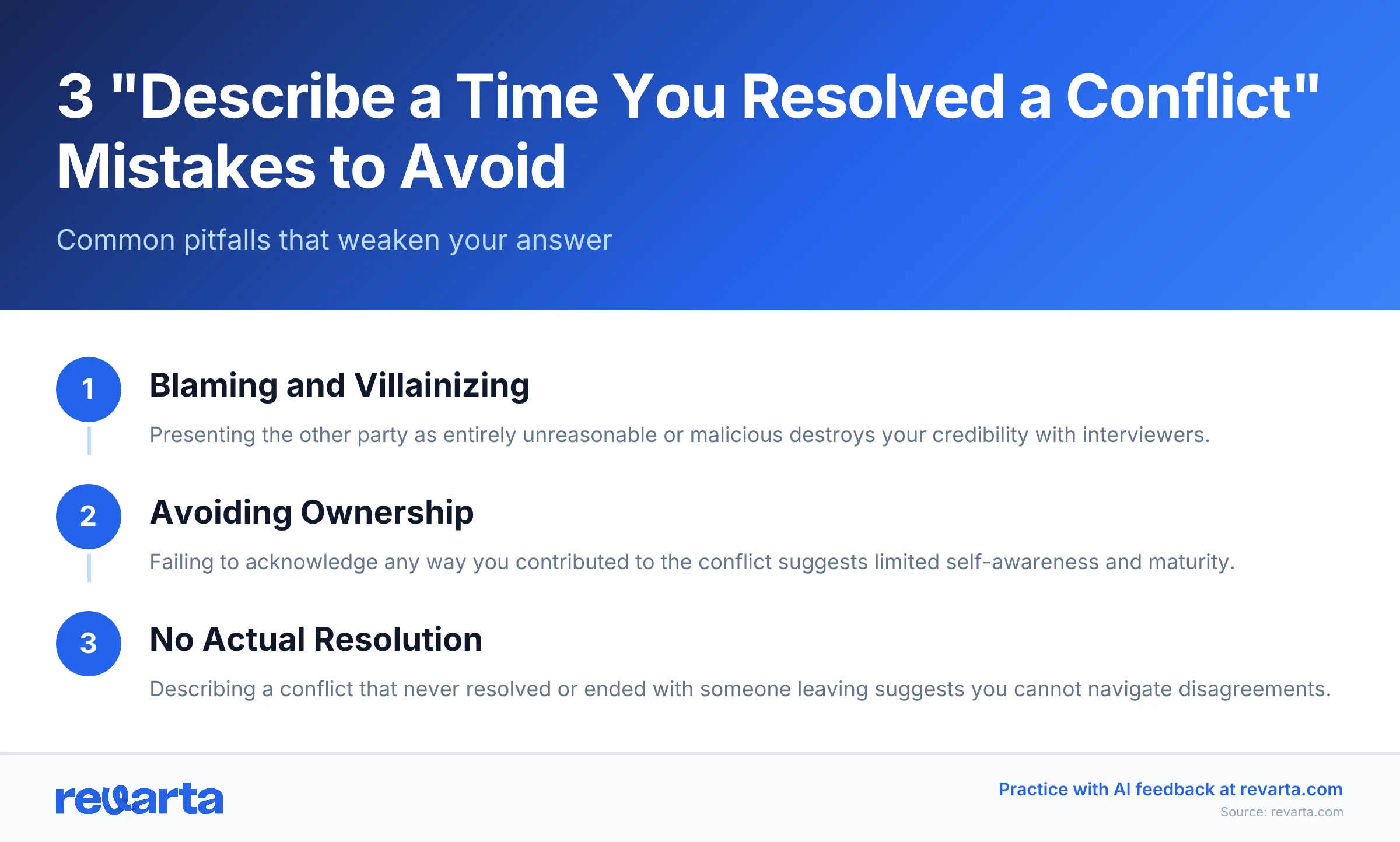
Blaming and Villainizing: Presenting the other party as entirely unreasonable, incompetent, or malicious destroys your credibility. Even when someone behaved poorly, frame it neutrally.
Avoiding Ownership: Failing to acknowledge any way you contributed to the conflict or could have handled it better suggests limited self-awareness.
Sharing Inappropriate Conflicts: Discussing conflicts about discrimination, harassment, or other serious HR issues isn't appropriate for behavioral interviews and raises red flags.
No Actual Resolution: Describing a conflict that never truly resolved or ended with someone leaving suggests you can't actually navigate difficult situations successfully.
Focusing Only on Being Right: Emphasizing that you were correct and they were wrong misses the point—interviewers want to see relationship management, not intellectual superiority.
Structure Mistakes
Spending Too Long on Problem Description: Dwelling on all the details of what went wrong suggests you hold grudges. Focus on resolution process.
Skipping the Relationship Outcome: Don't just share that the task got completed—explain what happened to the working relationship and what you learned.
Vague Action Steps: "We talked and worked it out" doesn't demonstrate your actual conflict resolution process. Be specific about your communication strategies.
Delivery Mistakes
Emotional Tone When Describing Conflict: If you still sound angry or bitter when describing past conflicts, you haven't actually resolved them psychologically.
Defensive Body Language: Crossed arms or aggressive gestures when describing conflict suggest you get emotionally activated easily.
Smiling or Laughing About Serious Conflicts: Inappropriate affect when discussing workplace tensions suggests you don't take professional relationships seriously.
Follow-Up Questions to Prepare For
Your conflict answer often triggers deeper exploration:
About the Specific Situation
- "What would you do differently if you faced that situation again?"
- "How did this conflict affect the project outcome?"
- "What did you learn about yourself from this conflict?"
- "How did others on the team react to this conflict?"
About Your Conflict Approach
- "How do you typically handle disagreements with authority figures?"
- "What's your approach when you strongly believe you're right but others disagree?"
- "How do you know when to compromise versus stand firm?"
- "Tell me about a time you were wrong in a conflict"
About Relationship Dynamics
- "How is your relationship with that person today?"
- "What did this experience teach you about working with difficult people?"
- "How do you prevent conflicts from escalating?"
Response Strategies
- Demonstrate growth and self-reflection
- Show ability to maintain perspective and learn from challenges
- Emphasize relationship preservation alongside task completion
- Acknowledge complexity without defensiveness
Industry-Specific Considerations
Technology Sector
Emphasize conflicts around:
- Technical architecture decisions and competing approaches
- Speed vs. quality tradeoffs
- Data-driven decisions vs. creative intuition
- Cross-functional tensions (product, engineering, design)
Example phrase: "As engineers, we're trained to advocate for technical excellence, but I learned to balance that with business constraints and to find creative solutions that serve both priorities."
Healthcare Industry
Focus on conflicts involving:
- Patient care approaches and clinical judgment
- Resource constraints vs. quality of care
- Interdisciplinary team dynamics
- Administrative vs. clinical priorities
Example phrase: "In healthcare, conflicts often involve competing valid priorities—cost control vs. patient care, efficiency vs. thoroughness. I approach these by keeping patient outcomes as the ultimate decision criterion."
Sales and Business Development
Highlight conflicts about:
- Client management approaches
- Pricing and concessions
- Territory and account ownership
- Commission and credit disputes
Example phrase: "Sales environments are naturally competitive, but the best outcomes come from collaborative problem-solving. I focus on expanding value rather than fighting over fixed resources."
Education and Non-Profit
Emphasize conflicts around:
- Resource allocation with limited budgets
- Different philosophies about program delivery
- Stakeholder management with diverse constituencies
- Balancing mission idealism with operational realities
Example phrase: "Mission-driven work attracts passionate people with strong opinions. I've learned to channel that passion into constructive debate that strengthens our programs rather than divides our team."
Final Preparation Checklist
Before Every Interview
✅ Prepare 3-4 conflict examples from different contexts (peer, manager, client, cross-functional)
✅ Structure each using STAR framework with emphasis on resolution process
✅ Identify what each conflict taught you about yourself
✅ Practice describing conflicts neutrally without blame or defensiveness
✅ Prepare relationship outcome details (what happened to working relationship)
✅ Review follow-up questions and prepare honest, reflective answers
✅ Practice delivering with calm, professional tone
During the Interview
✅ Choose an example with meaningful stakes and genuine resolution
✅ Spend most of your answer on Actions and Results, not Situation
✅ Demonstrate emotional intelligence through specific self-awareness examples
✅ Frame the other party's perspective fairly and respectfully
✅ Emphasize learning and relationship outcomes, not just task completion
Conclusion
Mastering conflict resolution questions requires genuine self-reflection about how you handle interpersonal challenges, strategic selection of examples that demonstrate emotional intelligence and professional maturity, and practiced delivery using the STAR framework. The strongest answers show that you view conflicts as opportunities for finding better solutions and building stronger relationships rather than battles to be won.
Your conflict stories reveal your character, emotional intelligence, and professional judgment more than almost any other interview question. Invest time in selecting examples where you can honestly demonstrate self-awareness, empathy, collaborative problem-solving, and relationship-building alongside task resolution.
Start practicing today with Revarta's AI interview coach to perfect your conflict resolution answers and receive personalized feedback on demonstrating emotional intelligence authentically.
Practice conflict resolution answers with AI feedback
Keep Preparing


