How to Answer "Describe Delegating Responsibilities": The Complete Interview Guide (2026)
"Describe a time you delegated responsibilities" appears in over 80% of management and leadership interviews. This question reveals your ability to multiply effectiveness through others, trust team members with important work, balance control with development, match work to individual capabilities, and develop people through challenging assignments. Research from Gallup shows that managers who delegate effectively achieve 33% higher team productivity and 28% better employee engagement than those who don't delegate well.
This comprehensive guide provides 15+ STAR method examples, delegation frameworks for different scenarios, and strategies for demonstrating how you empower others while maintaining accountability.
Why Interviewers Ask About Delegation
Assessing Leadership Scalability
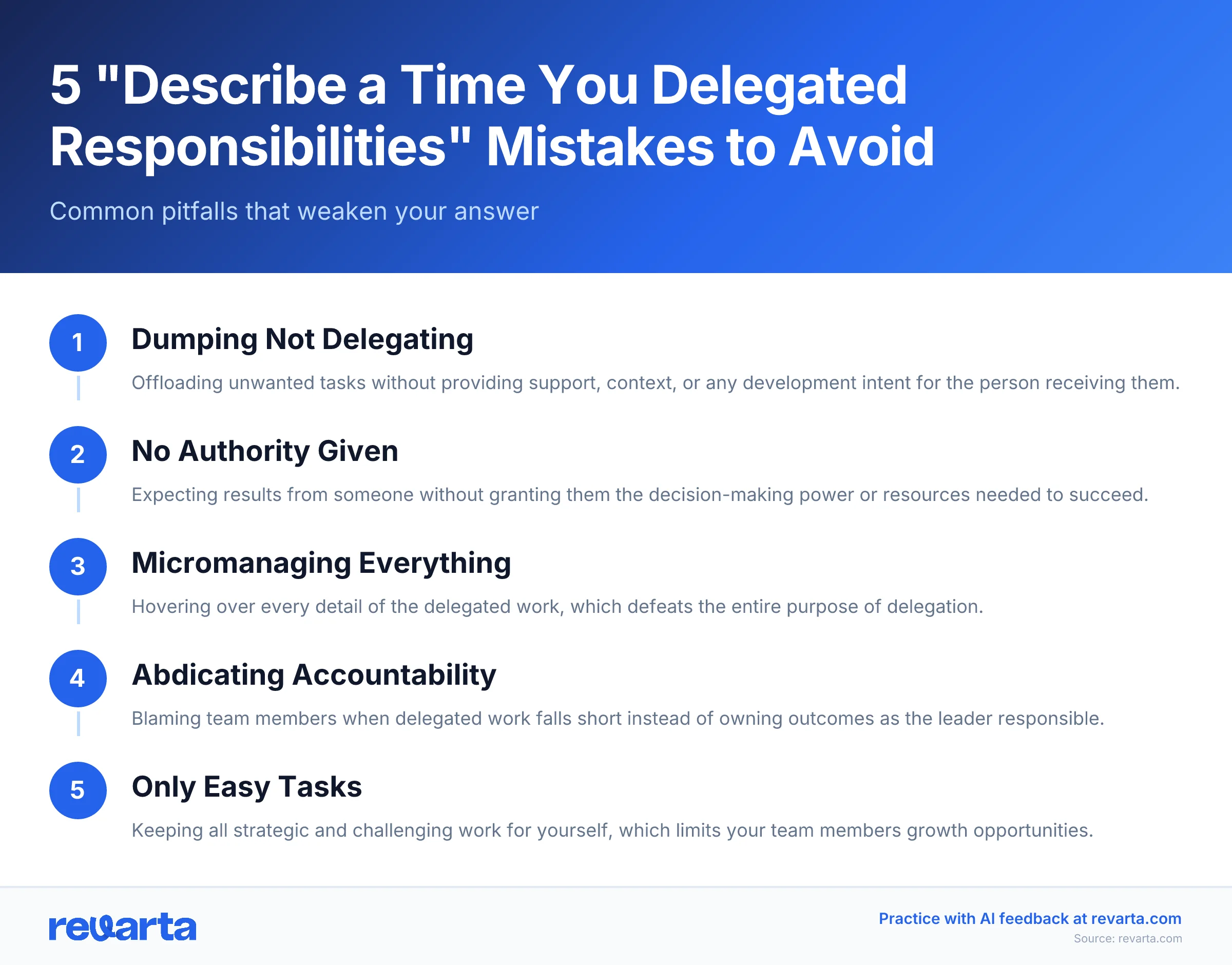
Leaders who can't delegate can't scale their impact. Your response reveals whether you can multiply your effectiveness through your team, focus on high-value work only you can do, build team capability systematically, and grow beyond individual contributor mentality.
Evaluating Trust and Team Development
Delegation requires trusting others with important work. Interviewers assess whether you trust team members with meaningful responsibilities, view delegation as development opportunity not just offloading, provide support without micromanaging, and allow people to grow through challenging assignments.
Understanding Risk Management
Delegation involves managed risk. Your story shows whether you match task complexity to capability levels, provide appropriate guidance and resources, maintain oversight without controlling, and intervene appropriately when needed.
Measuring Coaching Capability
Effective delegation includes coaching. Interviewers evaluate whether you clarify expectations and success criteria clearly, check understanding before people begin, provide feedback throughout the process, and use delegation as teaching opportunities.
Gauging Outcome Accountability
Delegation doesn't mean abdication of responsibility. Your example reveals whether you maintain ultimate accountability for outcomes, create appropriate check-in points, adjust level of involvement based on results, and own outcomes whether delegation succeeds or fails.
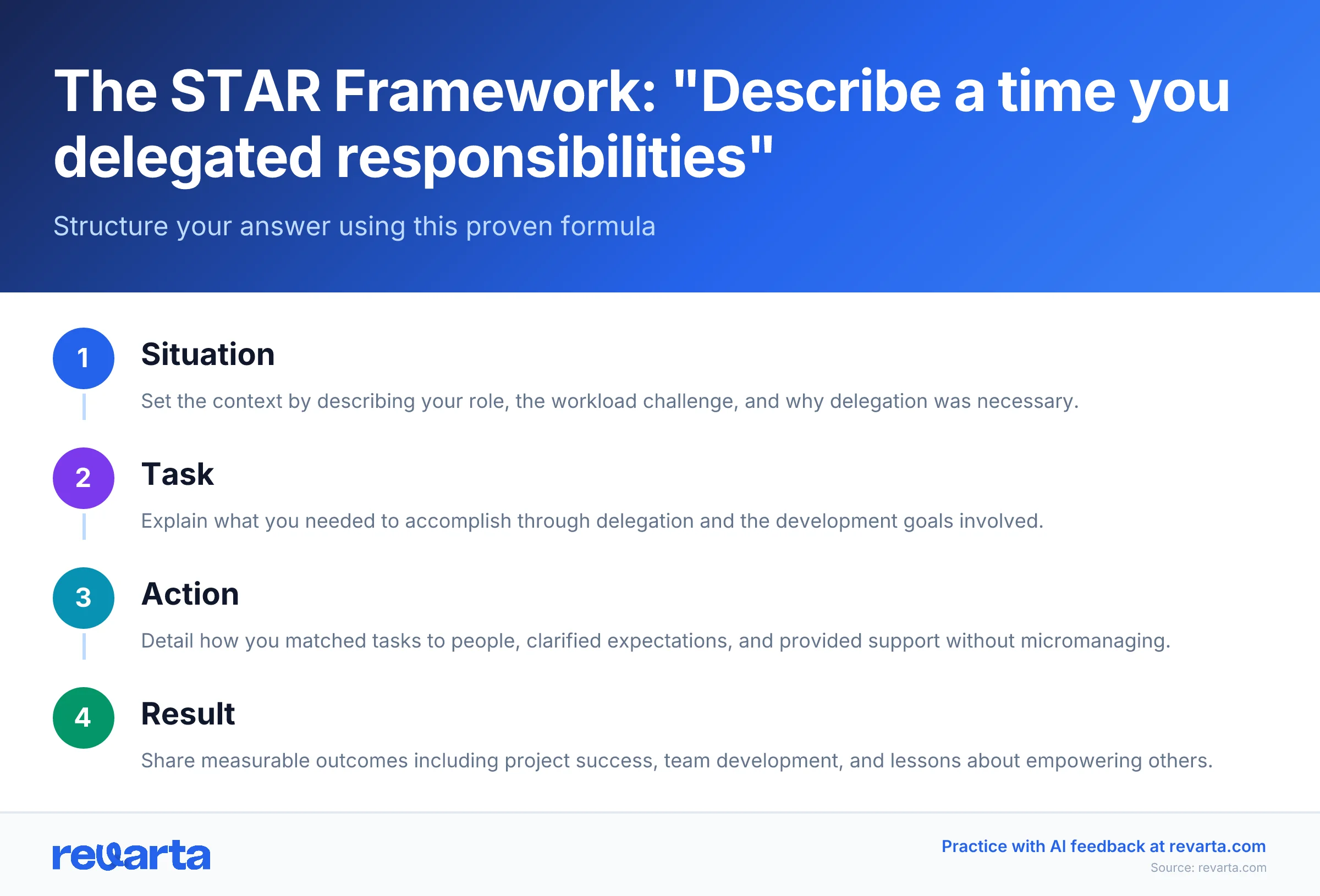
The STAR Method for Delegation Questions
Situation (15%)
Example:
"As marketing director at TechCorp, I was leading a critical product launch campaign requiring coordination of content creation, social media, paid advertising, PR, and event management. Our timeline was compressed—eight weeks instead of the usual twelve—because engineering had accelerated the product release. I was also simultaneously managing two other active campaigns and preparing a quarterly board presentation. I couldn't execute all the launch work personally and meet my other responsibilities."
Task (10%)
Example:
"I needed to successfully execute the product launch campaign on an accelerated timeline, develop my team's capabilities through meaningful ownership, maintain quality standards despite delegating, and ensure I was focusing my time on the highest-value strategic work only I could do."
Action (55%)
Example:
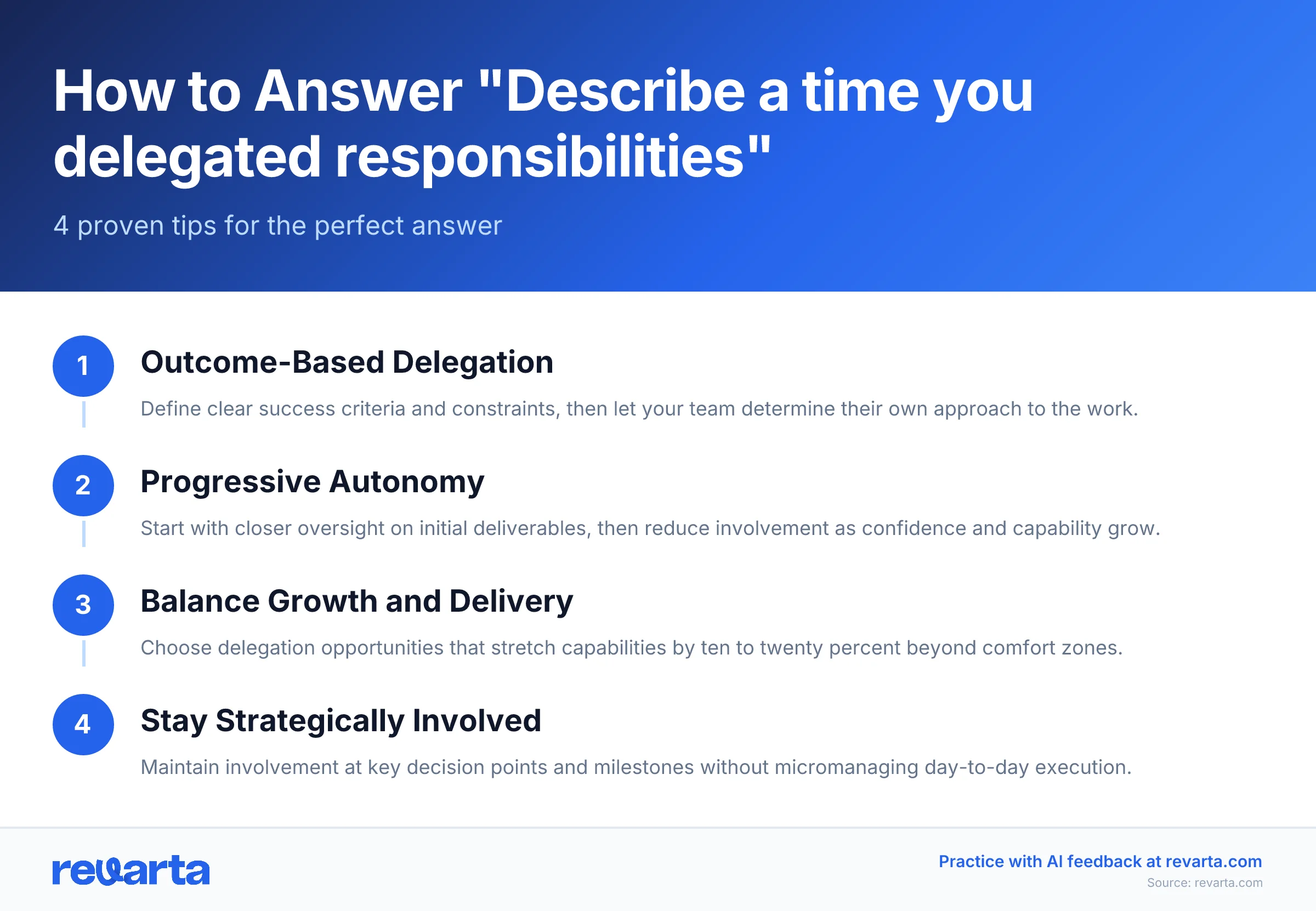
"I started by analyzing all the launch activities and categorizing them by strategic importance and complexity. I identified which work truly required my direct involvement—executive stakeholder management, overall campaign strategy, and board presentation—versus work that others could own with appropriate support.
For the delegatable work, I considered each team member's current capabilities, developmental goals, and workload capacity. I had a senior content manager who was technically strong but hadn't led campaign-level work. I had a social media specialist who was creative but needed experience with strategic planning. I had a junior PR coordinator eager for more responsibility.
Rather than just assigning tasks, I delegated meaningful ownership. I sat down individually with each person and explained the delegation as an opportunity: 'Sarah, I'd like you to own all content strategy and execution for this launch. This is your chance to demonstrate campaign leadership. Here's what success looks like...'
For Sarah (senior content manager), I delegated content stream ownership: strategy, creation, and delivery. Instead of dictating her approach, I clarified outcomes: 'We need launch content that positions the product's differentiation clearly, engages our technical audience, and supports the sales team. I trust you to determine the specific content mix and formats. I'll review your strategy before you begin execution, and we'll have weekly check-ins.'
I made sure she had everything needed to succeed: access to product team for technical information, budget authority up to $15K for freelancers, and decision-making power for content formats and channels.
For the social media specialist, I delegated social strategy with more structure and support. We co-created the initial strategy, I reviewed major content before posting during the first two weeks, then shifted to monitoring outcomes rather than reviewing content as his confidence grew.
For the PR coordinator, I delegated specific tactical activities—media list development, release drafting, journalist outreach—with clear templates and examples, providing closer oversight given less experience.
I was explicit about my role: 'I'm here for strategic guidance and obstacle removal, not to micromanage execution. Bring me decisions where you need input or approval. Keep me informed of progress and any issues. Otherwise, I trust you to execute your plan.'
I created lightweight check-in rhythms: weekly one-on-ones to discuss progress and remove barriers, and milestone reviews at key decision points. I made sure to review work at logical stages—strategy before execution, draft deliverables before final—rather than constant over-the-shoulder monitoring.
When Sarah made a content choice I wouldn't have made but that was still strategically sound, I let it stand. When the social specialist created content that was creative but off-brand, I provided coaching: 'I appreciate the creativity here. Let's talk about how to maintain brand voice while being innovative.'
I also protected them from interference. When an executive tried to bypass Sarah and give me direct feedback on content, I redirected: 'Sarah is leading content for this launch. Please work with her directly. She has my full confidence and authority.'"
Result (20%)
Example:
"The product launch exceeded all metrics: we generated 12,000 qualified leads (target was 8,000), achieved 85% message pull-through in media coverage (measured by key message inclusion), and social engagement was 2.5x our typical product launches.
More importantly, the delegation developed my team significantly. Sarah successfully led campaign work and was promoted to campaign director six months later. The social specialist gained confidence and strategic thinking skills. The PR coordinator demonstrated capability that led to bigger responsibilities.
My board presentation was well-prepared because I had protected time to focus on it rather than execution details. I was able to be strategic and available for unexpected issues because I wasn't buried in tactical work.
Post-campaign feedback showed the team felt trusted and valued. Sarah told me: 'Having real ownership made me raise my game. I was more invested than if I was just executing your detailed instructions.'
This experience taught me that delegation isn't about offloading work—it's about multiplying impact through others. The campaign quality wasn't lower because I delegated; in some areas it was actually better because team members brought fresh perspectives and creativity I wouldn't have.
I learned that clarity about outcomes matters more than prescribing process. When I clearly defined success criteria but let people own the 'how,' they delivered excellent results while developing their own judgment.
Most importantly, I discovered that appropriate delegation actually increases my accountability rather than reducing it. By staying strategically involved through check-ins and milestone reviews while avoiding micromanagement, I maintained responsibility for outcomes while empowering the team."