How to Answer "Describe Handling Competing Priorities": The Complete Interview Guide (2026)
"Describe a time you handled competing priorities" appears in over 90% of professional interviews. This question reveals your ability to make strategic tradeoff decisions, assess relative importance and urgency systematically, communicate constraints and choices to stakeholders, maintain productivity under pressure, and avoid becoming paralyzed when everything feels urgent. Research from McKinsey shows that professionals who excel at prioritization deliver 25% more high-impact work than peers with similar skills but weaker prioritization abilities.
This comprehensive guide provides 15+ STAR method examples, prioritization frameworks for complex situations, and strategies for demonstrating decisive judgment when facing multiple urgent demands.
Why Interviewers Ask About Competing Priorities
Assessing Strategic Thinking
Everything can't be top priority. Your response reveals whether you can distinguish truly urgent from merely loud, evaluate long-term impact versus short-term pressure, make tradeoff decisions aligned with objectives, and resist pressure to treat all demands equally.
Evaluating Decision-Making Under Pressure
Competing priorities create stress and uncertainty. Interviewers assess whether you make clear decisions despite incomplete information, maintain calm judgment when pressure increases, avoid analysis paralysis when time is limited, and take ownership of prioritization choices.
Understanding Stakeholder Management
Multiple priorities often mean multiple stakeholders. Your story shows whether you communicate tradeoffs transparently to affected parties, negotiate expectations when resources are constrained, manage up effectively when priorities conflict, and maintain relationships while saying no.
Measuring Organizational Awareness
Effective prioritization requires understanding business context. Interviewers evaluate whether you align priorities with organizational objectives, recognize strategic importance beyond immediate urgency, understand revenue, customer, and operational impacts, and make decisions considering broader ecosystem.
Gauging Execution Excellence
Prioritization isn't just deciding—it's delivering. Your example reveals whether you follow through on priority decisions consistently, adapt plans when priorities shift, maintain quality despite competing demands, and achieve results rather than just staying busy.
The STAR Method for Competing Priorities Questions
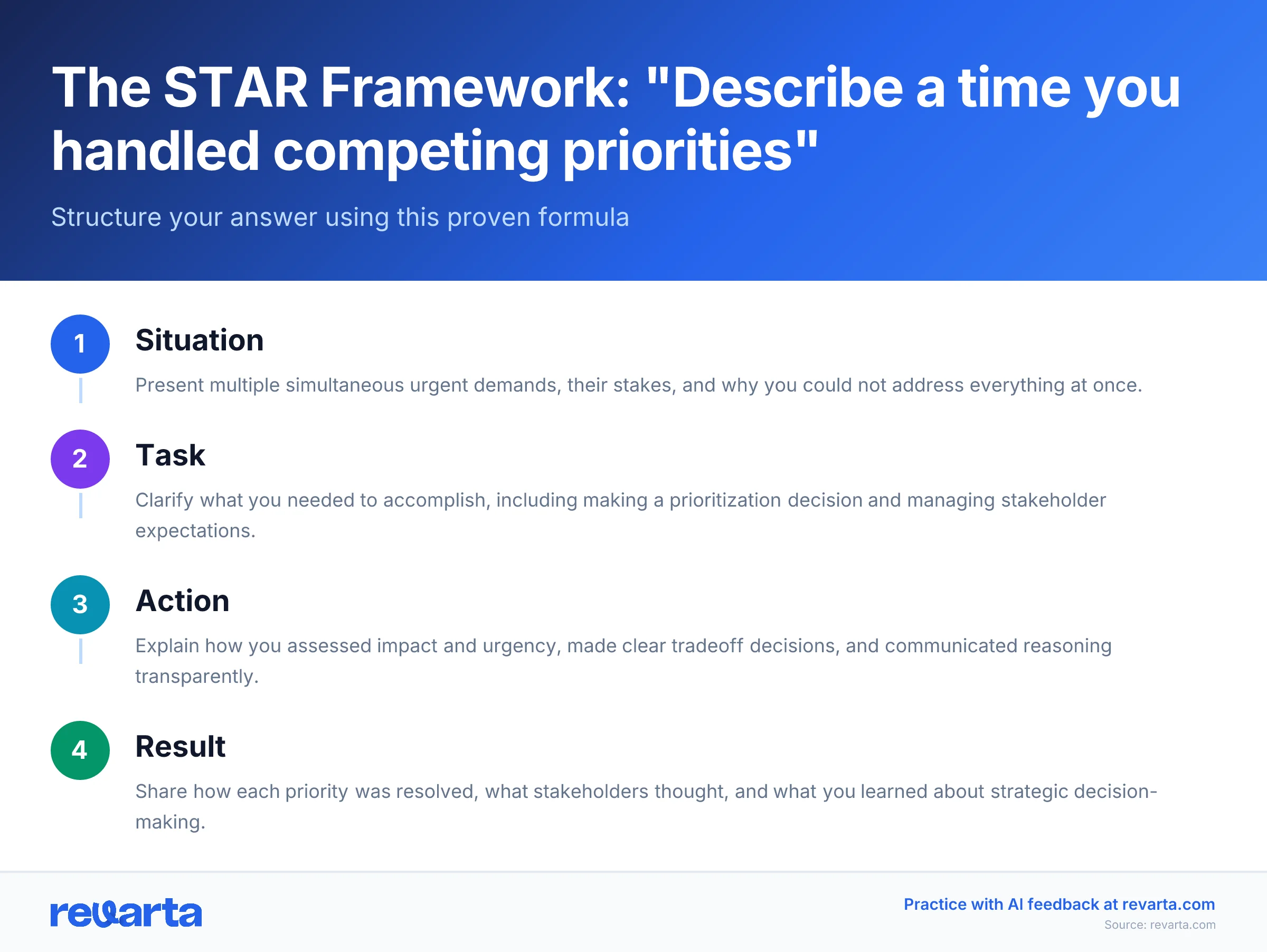
Situation (15%)
Example:
"As product manager for our SaaS platform, I faced three simultaneous critical demands during Q4: a major enterprise customer was threatening to churn unless we delivered a specific integration by month-end (affecting $400K annual revenue), our engineering team had discovered a security vulnerability requiring immediate patching (affecting all 50,000 users), and the executive team needed a comprehensive product roadmap presentation for our board meeting in two weeks (affecting funding decisions for next year). I had one engineering team of six people who couldn't work on all three priorities simultaneously."
Task (10%)
Example:
"I needed to make a clear prioritization decision among three legitimately urgent priorities, communicate my decision and rationale to affected stakeholders, and execute effectively on the top priorities while managing expectations on what would be delayed."
Action (55%)
Example:
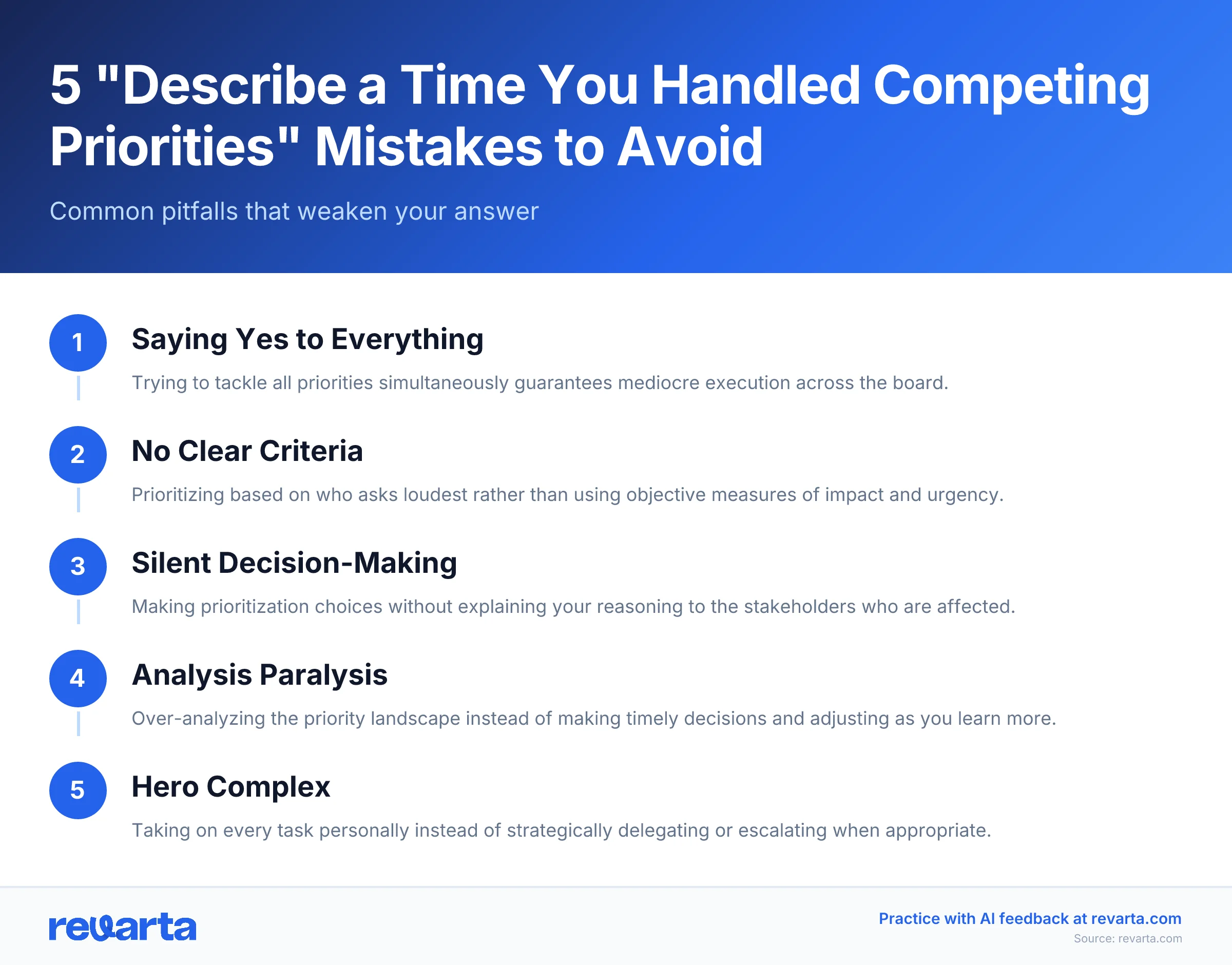
"I started by resisting my instinct to say 'yes, we'll do all three immediately.' That path would guarantee suboptimal execution on everything. I needed to make hard choices systematically rather than emotionally.
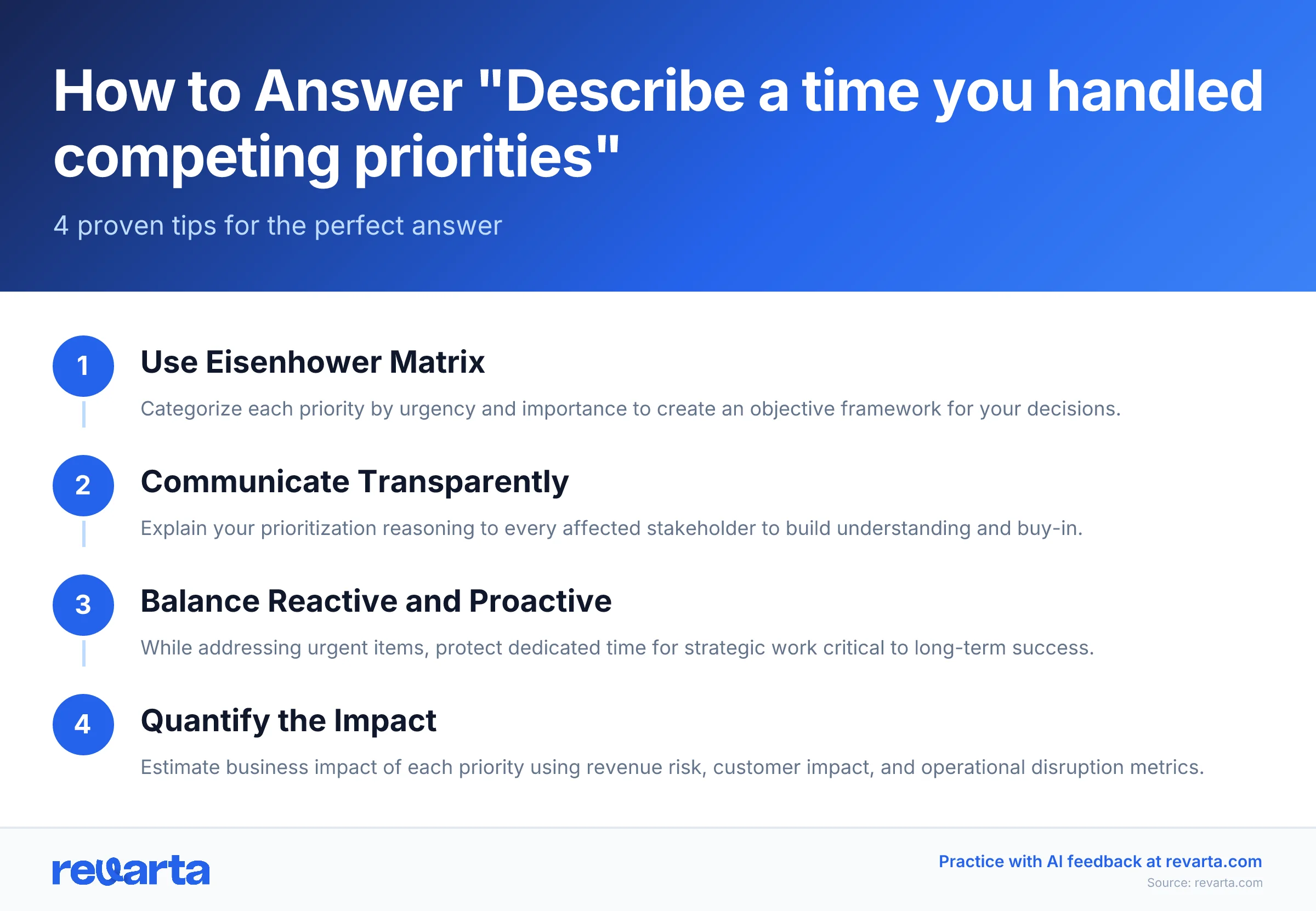
Assess Impact and Urgency: I evaluated each priority across multiple dimensions:
Security vulnerability: High urgency (exploit risk), high impact (all users), non-negotiable (regulatory/safety). Timeline: Must fix within 3 days per security protocol.
Customer integration: High urgency (churn threat), moderate impact (one customer, though valuable), some flexibility (customer relationship allows negotiation).
Board roadmap: Moderate urgency (two weeks out), high strategic impact (affects funding), flexible timeline (board meeting could be moved if necessary).
Analyze Tradeoffs: I mapped resource requirements: Security patch needed 3 engineers for 2-3 days. Customer integration needed 4 engineers for 3 weeks. Board roadmap needed me full-time for one week plus product design support.
Make Clear Decision: Based on this analysis, my prioritization was:
- Security vulnerability (immediate)
- Customer integration (after security patch)
- Board roadmap (parallel where possible, delay if necessary)
Communicate Transparently: I didn't just announce my decision—I explained my reasoning to each stakeholder:
To the security team: 'Security takes immediate priority. I'm allocating three engineers starting now to patch the vulnerability within our three-day protocol.'
To the customer success team managing the at-risk customer: 'I understand the urgency of the churn risk. Here's my plan: our security vulnerability requires three days of immediate attention for safety and compliance reasons. Starting Monday, we'll shift four engineers to the integration work. This means we'll deliver by the 18th instead of the 15th—three days later than the customer's preference. I need you to communicate this delay to the customer with context about why we're prioritizing security for all customers first. If they're still threatening to leave over a three-day delay, escalate to me and I'll get on a call personally.'
To the executive team about the board deck: 'The board presentation will be ready, but I'm asking to delay our internal review by two days to ensure we properly address the security issue and customer integration kick-off. If the board date is inflexible, I can deliver a draft by Wednesday for your review, but the quality will be lower than if I have until Friday. What's your preference?'
Execute Ruthlessly: I protected the prioritized work from interruption. When other requests came in during the critical week, I said: 'I'm heads-down on our Q4 priorities through Friday. Can this wait until next week, or does it need to escalate to [my manager]?'
I also made myself available to unblock the security work: 'I'm in back-to-back meetings, but if you're blocked on the security patch, Slack me and I'll step out immediately.'
Adapt When Priorities Shifted: Midway through the security patch, we discovered the fix was more complex than anticipated—four days instead of three. I immediately reassessed: this pushed the customer integration start by one day. I proactively called the customer success manager: 'The security patch is taking one extra day. This delays the integration delivery to the 19th. How critical is this extra day for the customer relationship?'
Track and Report: I sent daily updates to stakeholders on progress against priorities. This transparency built trust that I was executing according to plan rather than reacting chaotically."
Result (20%)
Example:
"We successfully addressed all three priorities with one minor timeline adjustment:
Security vulnerability was patched in four days (one day over protocol, which security leadership approved given complexity). No security incidents occurred, and we maintained regulatory compliance.
Customer integration was delivered on the 19th—four days later than the customer's initial request but acceptable given the explanation. The customer renewed their contract. The customer success manager later told me: 'Your clear communication about the security prioritization actually impressed the customer. They appreciated that we take security seriously.'
Board presentation was delivered with the requested two-day delay, which the executive team accommodated. The board approved our funding request.
This experience taught me that saying 'yes' to everything is actually saying 'no' to excellence. By making clear prioritization choices, I ensured we executed each priority well rather than poorly executing multiple priorities simultaneously.
I learned that stakeholders can handle 'no' or 'not now' far better than they can handle 'yes' followed by poor execution or missed commitments. When I explained my reasoning transparently, stakeholders understood and often agreed with my prioritization.
Most importantly, I discovered that my job as a leader isn't to avoid disappointing anyone—it's to make strategic choices that optimize for overall organizational success. The customer success manager wanted immediate attention for their at-risk customer, but they ultimately valued the integrity of my decision-making process and the quality of our eventual execution."