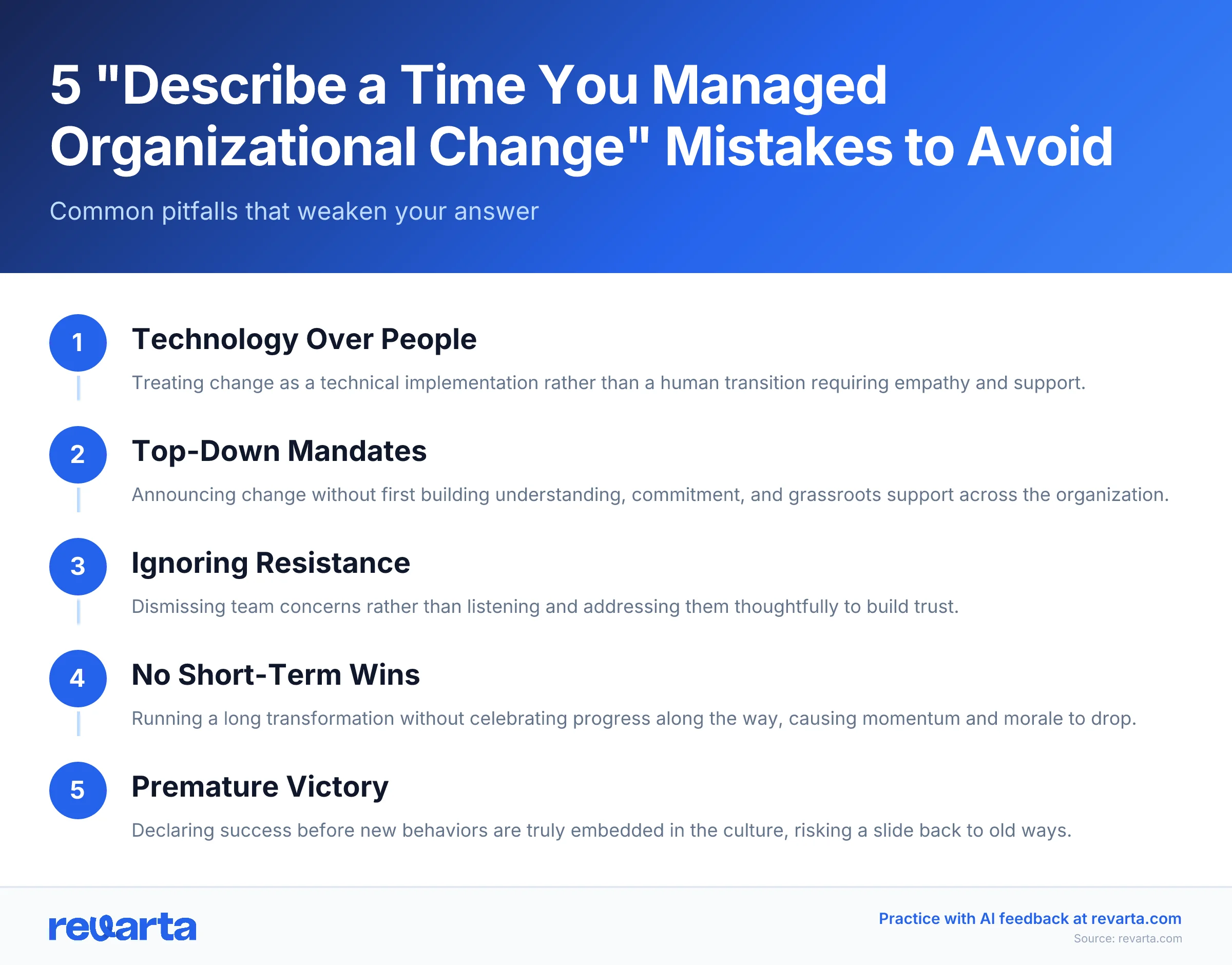
How to Answer "Describe Managing Organizational Change": The Complete Interview Guide (2026)
"Describe a time you managed organizational change" appears in over 85% of leadership and management interviews. This question reveals your ability to lead people through uncertainty and transition, communicate vision and rationale for change effectively, anticipate and address resistance systematically, maintain productivity during transformation, and achieve sustainable adoption rather than temporary compliance. Research from Prosci shows that projects with excellent change management are 6x more likely to meet objectives than those with poor change management.
This comprehensive guide provides 15+ STAR method examples, change management frameworks for different transformation types, and strategies for demonstrating how you lead organizations through successful transitions.
Why Interviewers Ask About Managing Change
Assessing Change Leadership
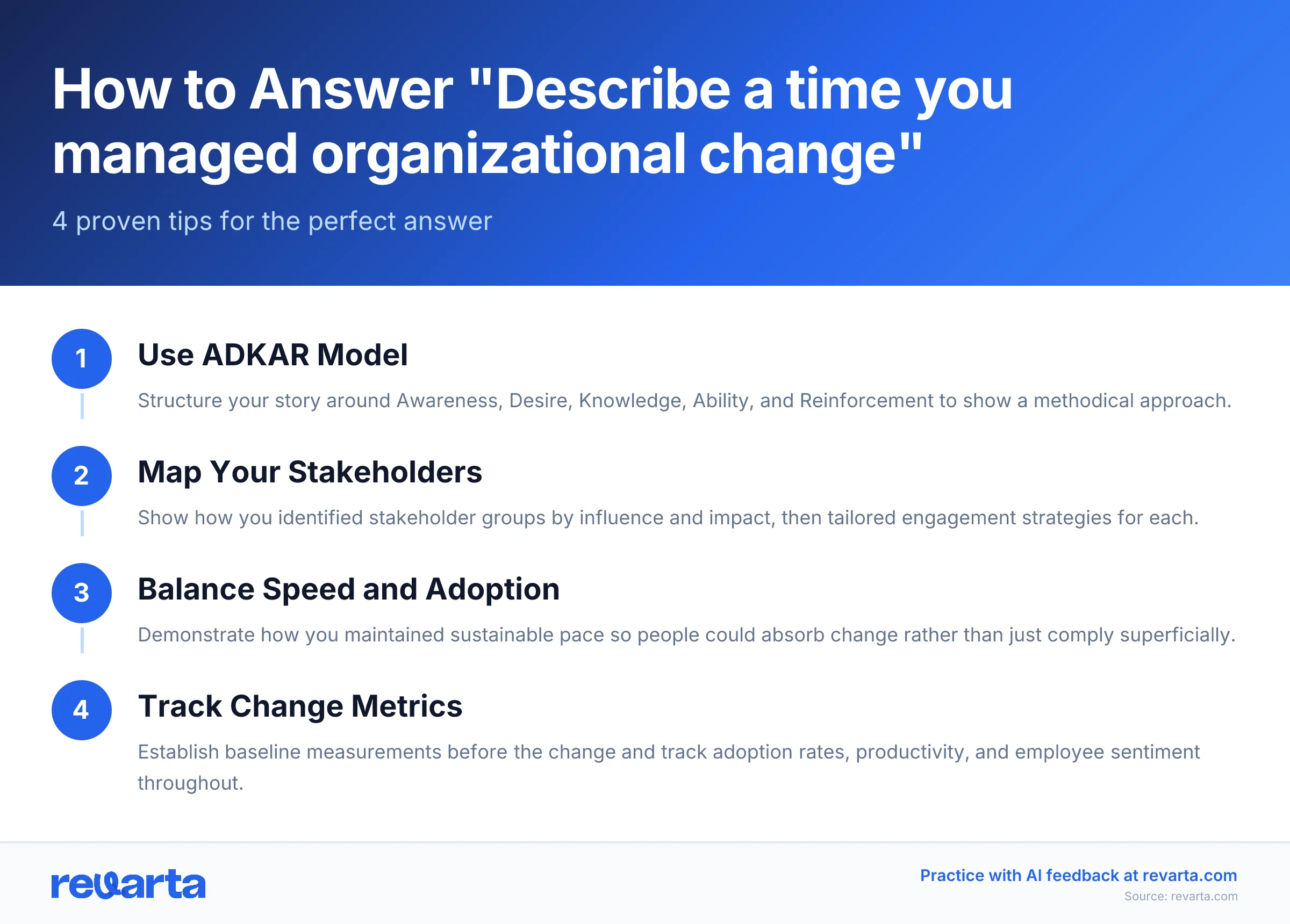
Change is constant in modern organizations. Your response reveals whether you can create compelling vision for why change is necessary, build coalition of supporters across organization, address concerns with empathy while maintaining momentum, and lead through resistance without abandoning objectives.
Evaluating Communication Excellence
Change requires exceptional communication. Interviewers assess whether you tailor messages to different audiences and concerns, communicate consistently throughout transformation, listen to feedback and adjust approach, and maintain transparency about challenges and progress.
Understanding Stakeholder Management
Successful change involves many stakeholders. Your story shows whether you identify and engage key influencers early, address concerns of different stakeholder groups, build grassroots support while securing executive sponsorship, and manage political dynamics of organizational change.
Measuring Resilience and Persistence
Change initiatives face setbacks. Interviewers evaluate whether you maintain commitment through resistance and obstacles, adapt tactics while staying true to objectives, recover from implementation challenges, and persist through the "valley of despair" common in change curves.
Gauging Systems Thinking
Effective change considers ripple effects. Your example reveals whether you anticipate downstream impacts of changes, address interconnected processes and systems, plan for unintended consequences, and think holistically about organizational implications.
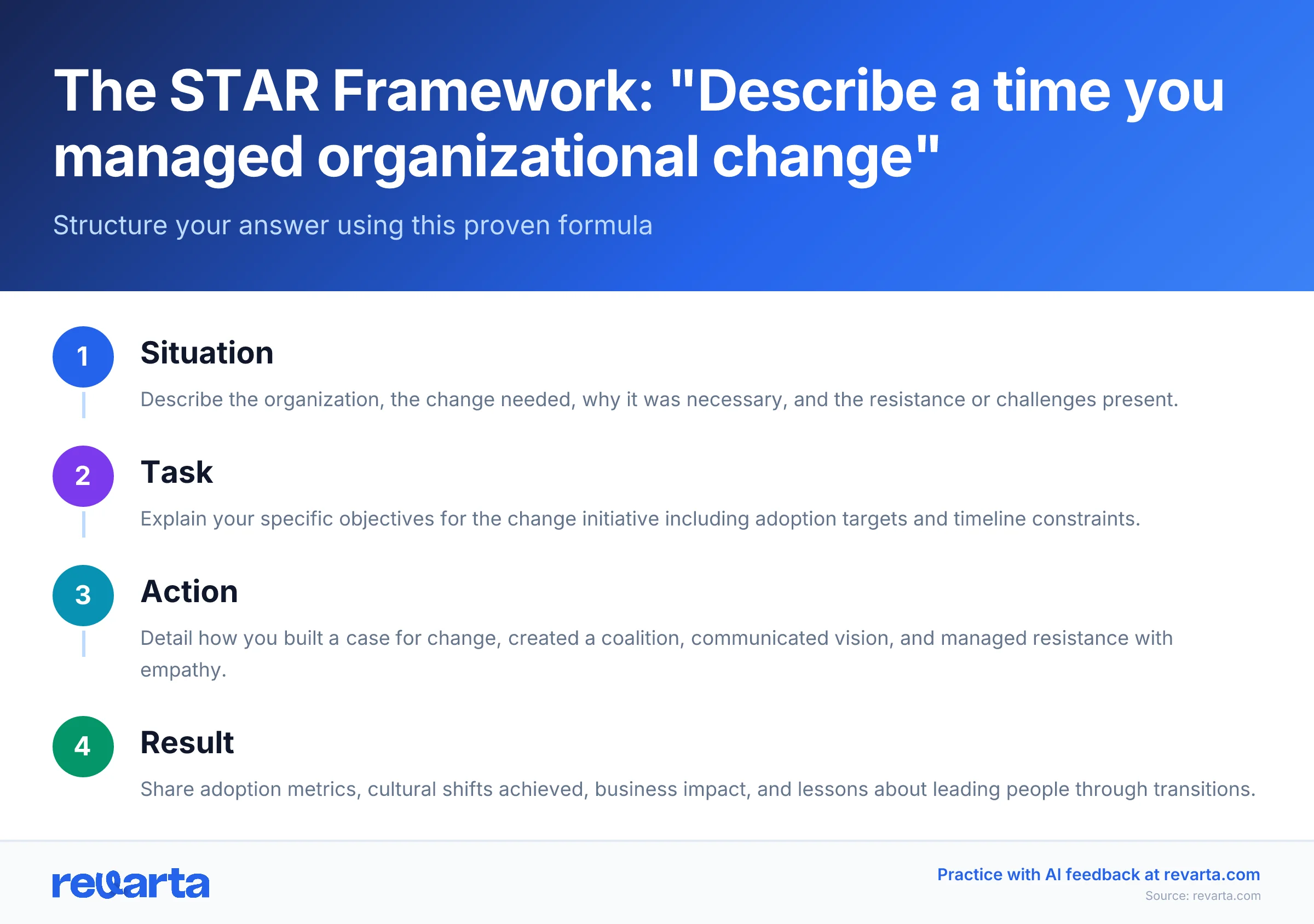
The STAR Method for Change Management Questions
Situation (15%)
Example:
"As operations director at HealthCare Regional, I led a major transformation of our patient intake and scheduling system. For 15 years, we had used paper-based scheduling with phone calls for appointments. Our patient satisfaction scores for scheduling were declining, we were losing patients to competitors with online booking, and our administrative costs were 30% higher than industry benchmarks. The board mandated digital transformation, but our staff—average tenure 12 years—had deep resistance to technology change. Previous IT implementations had failed due to poor adoption, creating skepticism about new systems."
Task (10%)
Example:
"I needed to transition 200+ staff members across 12 clinic locations from paper-based to digital scheduling, maintain patient care quality during the transition, overcome historical resistance and skepticism about technology, and achieve 90%+ system adoption within six months."
Action (55%)
Example:
"I knew from past failures that simply mandating new technology wouldn't work. I needed comprehensive change management, not just technical implementation.
Building the Case for Change: I started by creating urgency through data, not just assertions. I shared patient satisfaction scores showing scheduling frustration, data on patient defection to competitors offering online booking, and analysis of administrative cost inefficiencies. I involved frontline staff in identifying pain points with the current system: 'What frustrates you most about our current scheduling process?' This created ownership of problems before proposing solutions.
Creating a Guiding Coalition: I identified informal leaders across locations—respected staff members who others followed. I didn't just select managers; I chose people with credibility and influence. I met with each individually: 'I need your help making this transformation successful. You understand what staff need and what will actually work.' I formed a change champion network of 25 people across all locations who would advocate for the change and provide feedback on implementation.
Developing Vision and Strategy: Rather than just implementing technology, I articulated a vision: 'We're creating a patient experience where scheduling is convenient, not frustrating, and freeing our staff from administrative burden so they can focus on patient care.' I connected the change to values staff already held—excellent patient care and professional satisfaction.
Communicating for Buy-In: I used multiple communication channels and frequencies. I held town halls at every location explaining the why, what, and how. I created weekly email updates. I established office hours where anyone could ask questions. Critically, I didn't just communicate—I listened. When staff raised concerns, I addressed them: 'You're worried this will slow down your workflow. Let me show you how we're designing the process to actually save time...'
Empowering Action: I didn't mandate adoption all at once. We piloted at one location with volunteer early adopters. This created proof points and success stories. I removed obstacles: staff worried about technology skills, so I provided extensive hands-on training—not just manuals, but practice sessions with trainers available for individual help. I allocated 20% more staffing during the transition month so people had time to learn without patient care suffering.
Creating Short-Term Wins: After the first successful location went live, I celebrated publicly and shared specific wins: 'Online booking is now 40% of appointments at Location A, reducing phone volume significantly. Staff report spending 30 fewer minutes daily on scheduling logistics.' I had early adopter staff share their experiences with other locations: 'I was nervous too, but here's what I learned...'
Consolidating Gains: When we encountered issues—and we did—I was transparent and responsive. When the system had a technical glitch causing appointment conflicts, I didn't minimize it. I acknowledged: 'This is frustrating and not acceptable. Here's what we're doing to fix it, and here's our backup process until it's resolved.' This honesty maintained trust through difficulties.
Anchoring Changes in Culture: After technical adoption, I worked to make the change permanent. We updated job descriptions, revised workflows officially, and tied performance metrics to the new system. I recognized and rewarded adoption leaders. Six months in, I shared impact data: patient satisfaction scores up 28 points, administrative costs down 22%, staff overtime reduced 35%.
Throughout, I was visible and accessible. I spent time at each location during implementation weeks, helping with problems, encouraging staff, and demonstrating my commitment. When resistance emerged—and it did—I met it with empathy: 'I understand this is difficult. Change is uncomfortable. Tell me specifically what's not working, and let's problem-solve together.'"
Result (20%)
Example:
"Within six months, we achieved 94% system adoption across all locations. Patient satisfaction scores for scheduling increased from 67 to 89. Online booking grew to 65% of appointments, reducing phone volume 58% and allowing staff to focus on more complex patient needs. Administrative costs decreased by $450K annually.
More importantly, staff attitudes shifted. Initial resistance transformed into pride—staff now showed off the system to patients. Employee satisfaction scores in the 'tools and resources' category increased 32 points. Several staff members who initially resisted most strongly became system advocates.
The cultural shift was most significant. The organization moved from 'we've always done it this way' to 'how can we improve this?' We subsequently implemented two other major process changes with much faster adoption because staff had experienced successful change.
This experience taught me that change management is 20% technical and 80% human. The technology implementation was straightforward; managing fears, resistance, and learning curves was the real work. I learned that resistance isn't defiance—it's usually fear of incompetence or loss of control. Addressing those fears with empathy, training, and support converts resistors into adopters.
I discovered the power of small wins. The pilot location created proof that the change was possible and beneficial. Staff trust what they see working for their peers more than what leaders promise.
Most importantly, I learned that my job as a change leader was to remove obstacles and provide support, not to mandate compliance. When I focused on enabling success rather than enforcing adoption, people chose to change because it genuinely helped them do their jobs better."