How to Answer "Describe Receiving Constructive Feedback": The Complete Interview Guide (2026)
"Describe a time you received constructive feedback" appears in over 85% of behavioral interviews across all levels. This question reveals your emotional intelligence, ability to accept criticism without defensiveness, capacity for self-reflection and growth, openness to coaching and development, and professional maturity when receiving negative input. Research from Stanford shows that professionals who actively seek and implement feedback advance 2.3x faster than those who avoid or resist constructive criticism.
This comprehensive guide provides 15+ STAR method examples, frameworks for demonstrating coachability, and strategies for showing how feedback catalyzes professional growth.
Why Interviewers Ask About Receiving Feedback
Assessing Emotional Intelligence
Organizations need people who can receive criticism without becoming defensive or emotional. Your response reveals whether you listen to feedback without interrupting, separate critique from personal attack, manage emotional reactions professionally, and appreciate feedback as a gift rather than threat.
Evaluating Growth Mindset
Fixed mindset individuals view feedback as judgment; growth mindset professionals see it as development opportunity. Interviewers assess whether you view abilities as improvable rather than static, seek feedback proactively rather than avoiding it, implement suggestions rather than just acknowledging them, and view challenges as learning opportunities.
Understanding Self-Awareness
Feedback acceptance requires accurate self-perception. Your story shows whether you recognize your own blind spots, understand how others perceive your work, accurately assess your strengths and weaknesses, and maintain realistic self-evaluation.
Measuring Coachability
The best employees are coachable, not defensive. Interviewers evaluate whether you implement coaching and guidance, adapt based on others' expertise, improve performance based on input, and accelerate development through mentorship.
Gauging Professional Maturity
How you handle criticism reveals professional maturity. Your example reveals whether you maintain composure when criticized, respond professionally to difficult feedback, avoid blame or excuses, and take ownership of improvement.
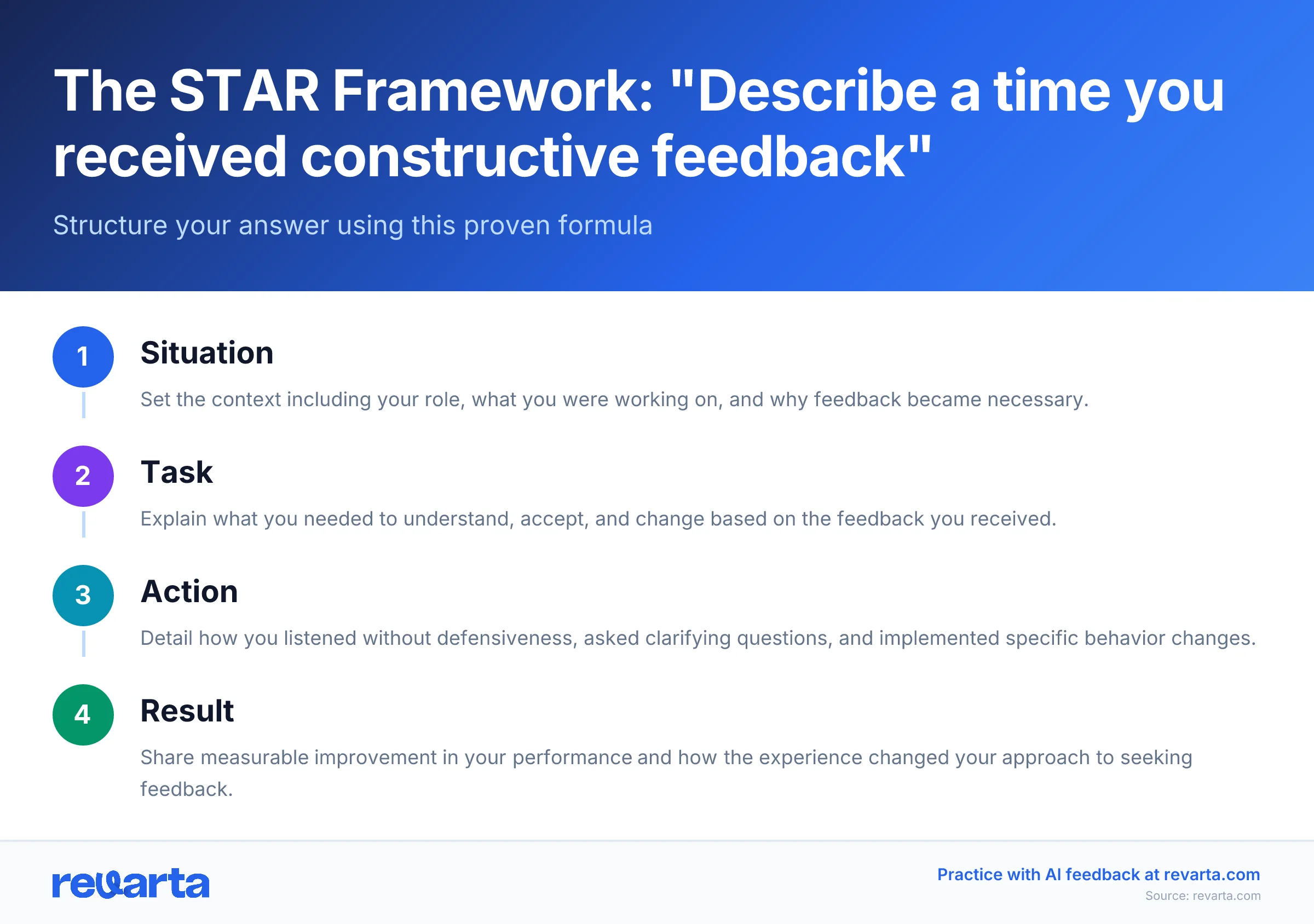
The STAR Method for Feedback Questions
Situation (15%)
Example:
"During my first quarter as a sales account executive at TechCorp, I consistently met my activity metrics—calls made, emails sent, demos scheduled—but my conversion rates were significantly below team averages. I was closing deals at 12% while the team averaged 22%. My manager scheduled a feedback session to discuss my performance."
Task (10%)
Example:
"I needed to understand why my conversion rates were low despite high activity, receive my manager's feedback openly without becoming defensive, identify specific behaviors to change, and improve my close rate to at least meet team averages within the next quarter."
Action (55%)
Example:
"When my manager sat down with me, my initial internal reaction was defensive—I wanted to explain that I was working hard and hitting activity goals. But I consciously chose to listen first rather than justify.
My manager shared specific feedback: she had listened to several of my sales calls and noticed I was rushing through discovery to get to the demo, failing to uncover real pain points. Without understanding customer problems deeply, my solutions felt generic rather than compelling.
This was hard to hear because I pride myself on being thorough, but I listened without interrupting. I asked clarifying questions: 'Can you give me an example of where I rushed discovery?' and 'What does effective discovery sound like?'
She played recordings of two calls—one of mine and one from our top performer. The contrast was striking. I asked surface-level questions and moved quickly to features. The top performer asked follow-up questions, explored implications, and really understood the business impact before ever mentioning our product.
I thanked her for the specific feedback and asked for ongoing coaching. We agreed I would: record all discovery calls for self-review, spend a minimum of 20 minutes in discovery before any product discussion, develop a discovery question framework, and have her listen to two calls weekly for feedback.
Over the next month, I completely changed my approach. I created a discovery question template with follow-up prompts. I practiced asking 'why' and 'tell me more about that' instead of moving to solutions. I listened to my call recordings critically—which was uncomfortable but revealing.
I also asked my manager to shadow three of my calls and provide immediate feedback afterward. Her real-time coaching was invaluable: 'You asked a great question there but moved on too quickly' or 'That's where you should have explored deeper.'
The first few weeks were frustrating—my demos decreased because discovery took longer, and I worried about activity metrics. But my manager encouraged me to trust the process."
Result (20%)
Example:
"Within two months, my close rate increased from 12% to 19%. By the end of the quarter, I was at 24%—above team average. More importantly, the deals I closed were 30% larger on average because I was solving real, well-understood problems.
My manager highlighted my improvement in our team meeting, specifically noting my receptiveness to feedback and commitment to implementation. This led to me being asked to share my discovery framework with newer sales reps.
This experience fundamentally changed how I view feedback. I learned that defensiveness prevents learning—my initial instinct to justify activity metrics would have kept me stuck at low performance. I discovered that specific, actionable feedback is far more valuable than generic praise.
Most importantly, I developed a practice of seeking feedback proactively rather than waiting for formal reviews. I now ask after major presentations: 'What's one thing I could have done better?' This habit has accelerated my development far more than any training program.
The feedback also taught me that effort and activity aren't the same as effectiveness—working hard on the wrong things produces poor results. Now I regularly ask myself: 'Am I being busy or being effective?'"