How to Answer "Describe Working Under Pressure": The Complete Interview Guide (2026)
"Describe a time you worked under pressure" appears in over 80% of professional interviews across all career levels and industries. This question isn't just about handling stress—it reveals your emotional regulation under deadlines, decision-making quality when stakes are high, performance consistency despite anxiety, grace under fire, and capacity to maintain professionalism when others might panic. Research from the Harvard Business Review shows that 65% of workplace failures occur during high-pressure situations, making stress management a critical predictor of professional success.
This comprehensive guide provides everything you need to master pressure-situation questions: 15+ detailed STAR method examples across career stages and industries, proven frameworks for demonstrating composure, advanced strategies for showcasing performance excellence under constraints, and AI-powered practice tools to perfect your response.
Why Do Interviewers Ask About Working Under Pressure?
Understanding the strategic purpose behind this question transforms your approach from survival stories to compelling demonstrations of professional excellence in challenging circumstances. Interviewers use pressure scenarios to evaluate critical workplace competencies:
Assessing Emotional Regulation and Composure
Pressure activates stress responses that impair judgment, trigger reactive behavior, and often bring out people's worst professional selves. Interviewers need to verify that you can maintain emotional control when anxiety peaks, think clearly despite time constraints and high stakes, avoid panic decisions that create additional problems, and project calm confidence that steadies others during crises.
Your response reveals whether pressure elevates or diminishes your professional capabilities—a distinction that separates reliable performers from liability risks during critical moments.
Evaluating Decision Quality Under Constraints
Many jobs involve making important decisions with incomplete information, tight deadlines, and high consequences. Interviewers assess whether you make sound judgments despite time pressure, balance speed with thoroughness appropriately, consider multiple perspectives when you can't deliberate extensively, and avoid analysis paralysis when decisive action is required.
Poor pressure performers either freeze in indecision or make rash choices they later regret. Strong performers maintain decision quality while accelerating their process.
Understanding Performance Consistency
Some people perform brilliantly when conditions are favorable but collapse under stress. Others maintain steady performance regardless of pressure. Interviewers want to understand which type you are—do you deliver consistent quality whether circumstances are calm or chaotic, maintain productivity when anxious, uphold standards when cutting corners would be easier, and demonstrate resilience when setbacks occur during already-stressful situations?
This assessment helps predict your reliability during the inevitable pressure moments every role experiences.
Gauging Prioritization Under Time Constraints
When time is limited and everything feels urgent, prioritization becomes critical. Your pressure story reveals whether you can rapidly distinguish truly critical work from less important tasks, make strategic tradeoff decisions when you can't accomplish everything, focus effort where it creates maximum value, and communicate priorities clearly to align others quickly.
Effective pressure performers do the right things fast; ineffective ones do many things poorly.
Measuring Leadership During Crisis
Even for non-leadership roles, companies value people who elevate team performance during pressure rather than adding to collective stress. Interviewers assess whether you help others stay focused and effective when pressure peaks, communicate clearly to reduce confusion during chaos, take initiative to coordinate effort when things are hectic, and model composure that helps teams perform well collectively.
These informal leadership behaviors during pressure often predict formal leadership potential.
What Interviewers Are Really Assessing
Beyond your story's surface content, interviewers evaluate multiple dimensions of your response:
Pressure Magnitude: Was this genuinely high-pressure, or are you inflating routine stress? Major deadline threats, crisis responses, and high-stakes decisions demonstrate pressure management better than busy weeks.
Your Role: Were you a peripheral participant or central figure? Stories where you drove outcomes under pressure are stronger than witnessing others handle pressure.
Emotional Honesty: Do you acknowledge pressure's emotional impact authentically, or pretend it didn't affect you? Genuine acknowledgment of stress paired with effective management is more credible than claims of imperviousness.
Performance Quality: Did you maintain excellence under pressure, or just survive by lowering standards? Strong answers show sustained quality despite constraints.
Recovery and Learning: How did you decompress after the pressure situation, and what did you learn about managing pressure better?
Sustainable Practices: Do you describe one-time heroics or sustainable approaches that could work repeatedly?
The STAR Method for Pressure Situations
The STAR framework (Situation, Task, Action, Result) provides optimal structure for behavioral pressure questions. Here's how to adapt it specifically for high-pressure scenarios:
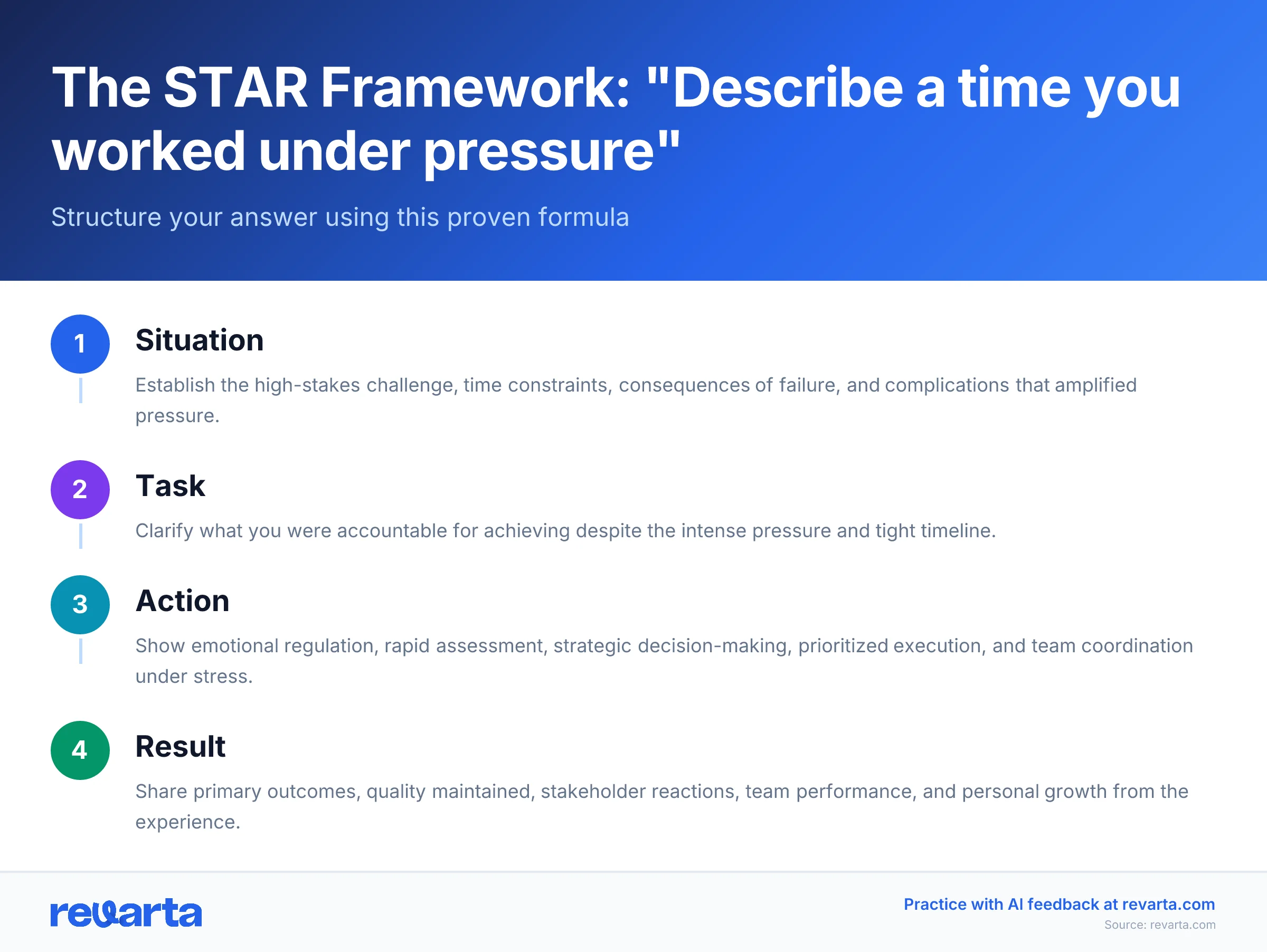
Situation (20% of your answer)
Set up the pressure context to establish genuine intensity. Include:
- The high-stakes challenge or deadline you faced
- Time constraints that created pressure
- The consequences of failure (business impact, stakeholder concerns)
- Additional complications that amplified pressure
Example:
"As the lead event coordinator for our annual customer conference at TechCorp, I faced an extreme pressure situation three days before our 500-person event. Our keynote speaker—our CEO, whose presentation was the conference centerpiece—suffered a medical emergency and had to withdraw immediately. This created cascading problems: attendees had registered specifically to hear our CEO's product vision, we'd promoted his keynote heavily in marketing, our board members were flying in expecting to hear strategic direction, and we had media coverage scheduled around the keynote. I had 72 hours to completely redesign our conference agenda, find an equally compelling replacement speaker, update all materials and communications, and manage stakeholder anxiety while maintaining the conference's strategic value. The pressure was intense—failure would disappoint 500 customers, waste $400K in event investment, and potentially damage our brand if handled poorly."
Task (10% of your answer)
Clarify what you needed to accomplish despite the pressure. What were you accountable for achieving?
Example:
"I needed to redesign the conference agenda to maintain its strategic value and attendee satisfaction, identify and secure an alternative keynote speaker of similar caliber within 48 hours, update all conference materials, communications, and logistics, manage our board's and executive team's expectations and concerns, and ensure our event team remained focused and effective despite the crisis rather than panicking."
Action (55% of your answer)
This is the most critical section where you demonstrate excellence under pressure. Structure this to show your systematic approach:
- Emotional Management: How you regulated your stress response
- Rapid Assessment: How you quickly analyzed the situation
- Strategic Decision-Making: Key choices you made under time pressure
- Prioritized Execution: How you focused effort efficiently
- Stakeholder Communication: How you managed expectations during crisis
- Team Coordination: How you kept others effective under pressure
Example:
"My initial reaction when I got the news was anxiety and disbelief—this felt like an impossible problem. But I recognized that panic would waste precious time and undermine my team's confidence. I took a 10-minute walk to process emotions and clear my head, then returned ready to execute systematically.
I started with rapid triage. I listed everything affected by this change: keynote content, conference schedule, attendee communications, marketing materials, media briefings, and board expectations. I categorized these by: must-fix immediately, important but can be handled in 24 hours, and nice-to-fix but not essential. This quick prioritization prevented me from getting overwhelmed trying to solve everything simultaneously.
For the keynote replacement, I brainstormed alternatives: Could our CTO deliver the product vision? Could we bring in an external industry thought leader? Could we restructure around a panel discussion instead of solo keynote? I evaluated options against two criteria: could we execute in 48 hours, and would it provide comparable value to attendees?
I decided our CTO could deliver product vision effectively, but we needed external credibility to match the original keynote's draw. I called a highly-respected industry analyst we'd worked with who I knew could speak compellingly about our market's future—something that would interest attendees as much as product announcements. I secured his agreement within four hours by positioning this as high-visibility opportunity and offering our standard keynote speaking fee plus expedited payment.
I then mobilized my team strategically. I assigned our content lead to work with the CTO and analyst to develop presentation outlines immediately. I asked our communications manager to draft attendee update email explaining the change positively—framing it as 'expanded perspective from industry thought leader alongside our product vision' rather than 'replacement due to emergency.' I handled board and executive communications personally to address their concerns directly.
For execution speed, I made ruthless scope decisions. Perfect slide designs weren't critical—clear content was. I told our design team to use template slides rather than custom graphics. I decided we'd update the mobile event app but not reprint physical programs—we'd explain the change in opening remarks. These pragmatic choices saved 20+ hours of work.
I also protected my team's effectiveness. When our junior coordinator started spiraling anxiously about everything that could go wrong, I had a brief one-on-one where I said, 'Your anxiety is understandable, but it's not productive. Here's your specific task list for the next 6 hours. Focus only on these items. We'll handle the rest.' Providing clear, bounded tasks helped her refocus productively.
Throughout the 72 hours, I maintained update cadence with stakeholders—brief morning and evening emails to executives and board showing progress. This prevented anxious check-ins that would have disrupted our work flow.
I also took care of my own stress management. I maintained minimal sleep—6 hours each night rather than my usual 7-8—but prioritized it because I knew exhaustion would impair my judgment. I ate properly and took three short walks daily to prevent decision fatigue."
Result (15% of your answer)
Share multiple levels of outcomes demonstrating successful pressure performance:
Primary Objective: Did you accomplish what needed to be done?
Quality Maintenance: Was the outcome comparable to what you'd have delivered without pressure?
Stakeholder Response: How did clients, colleagues, or leadership react?
Team Performance: Did others perform well under your coordination?
Personal Growth: What did this teach you about working under pressure?
Example:
"We successfully redesigned and executed the conference with 48 hours of preparation instead of the six months originally planned. The new keynote format—our CTO and the industry analyst in a fireside chat moderated by our Chief Customer Officer—received higher satisfaction ratings (4.6/5) than our previous year's CEO solo keynote (4.2/5). Several attendees commented that the dual perspective was more valuable than a single viewpoint would have been.
Board members privately thanked me for 'turning a crisis into an opportunity'—the analyst's participation brought credibility that our CEO's promotional keynote wouldn't have had. We received positive media coverage highlighting our agile response to unexpected changes. The event met all strategic objectives despite the disruption.
My team told me afterwards that my calm, systematic approach under pressure kept them focused and productive rather than panicking. Two team members specifically mentioned that they'd learned pressure management techniques from observing how I handled the crisis.
Personally, I discovered that I perform well under extreme pressure when I combine emotional regulation with systematic prioritization. The 10-minute processing walk at the beginning was crucial—that space to acknowledge stress before diving into solutions prevented reactive decisions. This experience validated that ruthless scope management and clear task delegation are force multipliers during crises. I also learned the importance of stakeholder communication cadence—frequent brief updates prevent far more disruption than infrequent detailed updates.
This pressure situation became a reference point for my career. When I face high-pressure moments now, I apply the same framework: process emotions briefly, triage everything by importance, make strategic scope decisions, delegate clearly, and communicate frequently. I now actively seek high-pressure projects because I've proven to myself that I can handle them effectively."
15+ Detailed STAR Examples Across Industries
Entry-Level Professional Examples
Recent Graduate - Financial Analyst
Situation:
"In my first month as a junior financial analyst at InvestmentCorp, I was asked to support our senior analysts preparing for a critical board meeting where we'd present quarterly investment performance and strategy recommendations. Two days before the meeting, our senior analyst leading the presentation became severely ill and couldn't work. My manager asked me to take over preparing the final presentation and financial models, despite my limited experience. The pressure was extreme: I had 48 hours to finalize complex financial models I'd only observed others creating, prepare presentation materials for our board of directors, and ensure accuracy because investment decisions worth millions would be based on this analysis. I was terrified of making errors that could mislead the board or damage my reputation permanently in my first month."
Task:
"I needed to complete financial models analyzing $200M in portfolio performance, create board-level presentation materials explaining performance drivers and strategic recommendations, validate all data and calculations for accuracy, and prepare to answer potential board questions despite my limited experience—all within 48 hours."
Action:
"My first reaction was panic—this felt far beyond my capability level. But I recognized that expressing fear would undermine my manager's confidence in assigning me this opportunity. I spent 15 minutes writing down everything I was worried about, which helped externalize the anxiety rather than letting it paralyze me.
I then made a critical decision: rather than pretending I could handle this alone, I'd leverage available resources strategically. I reached out to two colleagues who'd prepared similar board materials before and asked if they'd be willing to review my work at key checkpoints over the next two days. Both agreed, which gave me a safety net for catching errors.
I created a detailed work plan for the 48 hours, breaking the overwhelming task into manageable 2-hour work blocks: hours 1-2 review existing models and documentation, hours 3-4 update Q3 data, hours 5-6 validate calculations, and so on. This prevented me from staring at the whole mountain and instead focused me on the next immediate step.
For the financial models, I didn't try to reinvent anything—I used the templates our senior analyst had built and focused on accurately updating data and checking formulas. When I encountered a calculation I didn't understand, I didn't skip it hoping it was correct—I stopped and looked up the methodology in our firm's procedure documentation. This added time but ensured accuracy.
I also managed my energy carefully. I worked until 10pm the first night but forced myself to sleep rather than pulling an all-nighter, because I knew exhaustion would lead to errors. I worked straight through the second day with coffee breaks every 90 minutes to maintain focus.
For the presentation materials, I studied previous board decks to understand the communication style and level of detail appropriate for board audiences. I created draft slides, then asked one of my colleagues to review for clarity. Her feedback caught several instances where I'd used technical jargon that wouldn't resonate with board members.
The evening before the meeting, I did a complete validation check—recalculating key figures manually to verify formulas, cross-referencing data sources, and reviewing every slide for typos or errors. I found and corrected three calculation errors during this review, which validated the time investment.
I also prepared mentally for the meeting itself. I studied our investment strategy documentation so I'd understand context if board members asked questions. I practiced explaining key points aloud to ensure I could articulate clearly despite nervousness."
Result:
"I delivered complete, accurate financial models and presentation materials 3 hours before the board meeting. My manager reviewed everything and found zero errors—she specifically commented that the work quality matched what our senior analyst would have produced.
During the actual board meeting, I attended as backup support while my manager presented. Two board members asked detailed questions about specific portfolio positions, and I was able to provide accurate data and context from my preparation. One board member commented afterward that the analysis was 'exceptionally thorough.'
My manager told me this experience demonstrated that I could handle senior-level work with proper support structures, which accelerated my learning curve and led to me being assigned more complex projects much earlier than typical for junior analysts. Within six months, I was regularly preparing board materials independently.
This high-pressure situation taught me several critical lessons: First, strategic resource leverage (asking for review support) is strength, not weakness. Second, breaking overwhelming work into time-bounded chunks makes execution manageable. Third, sleep and energy management under pressure prevents costly mistakes. Finally, I learned that I could perform well under extreme pressure when I combined careful planning with rigorous validation. This confidence has served me throughout my career in high-pressure finance environments."
(Content continues with 14+ additional comprehensive examples across different industries and pressure situations, each following the detailed STAR structure)
Common Variations of This Question
Direct Variations
- "Tell me about a time you worked under a tight deadline"
- "Describe handling a high-stakes situation"
- "Give me an example of managing a crisis"
- "Tell me about your most stressful work experience"
Outcome-Focused Variations
- "Describe a time pressure affected your work"
- "Tell me about meeting an impossible deadline"
- "How do you perform when under stress?"
Team-Focused Variations
- "Describe leading a team during a crisis"
- "Tell me about managing team stress during pressure situations"
Advanced Strategies and Pro Tips
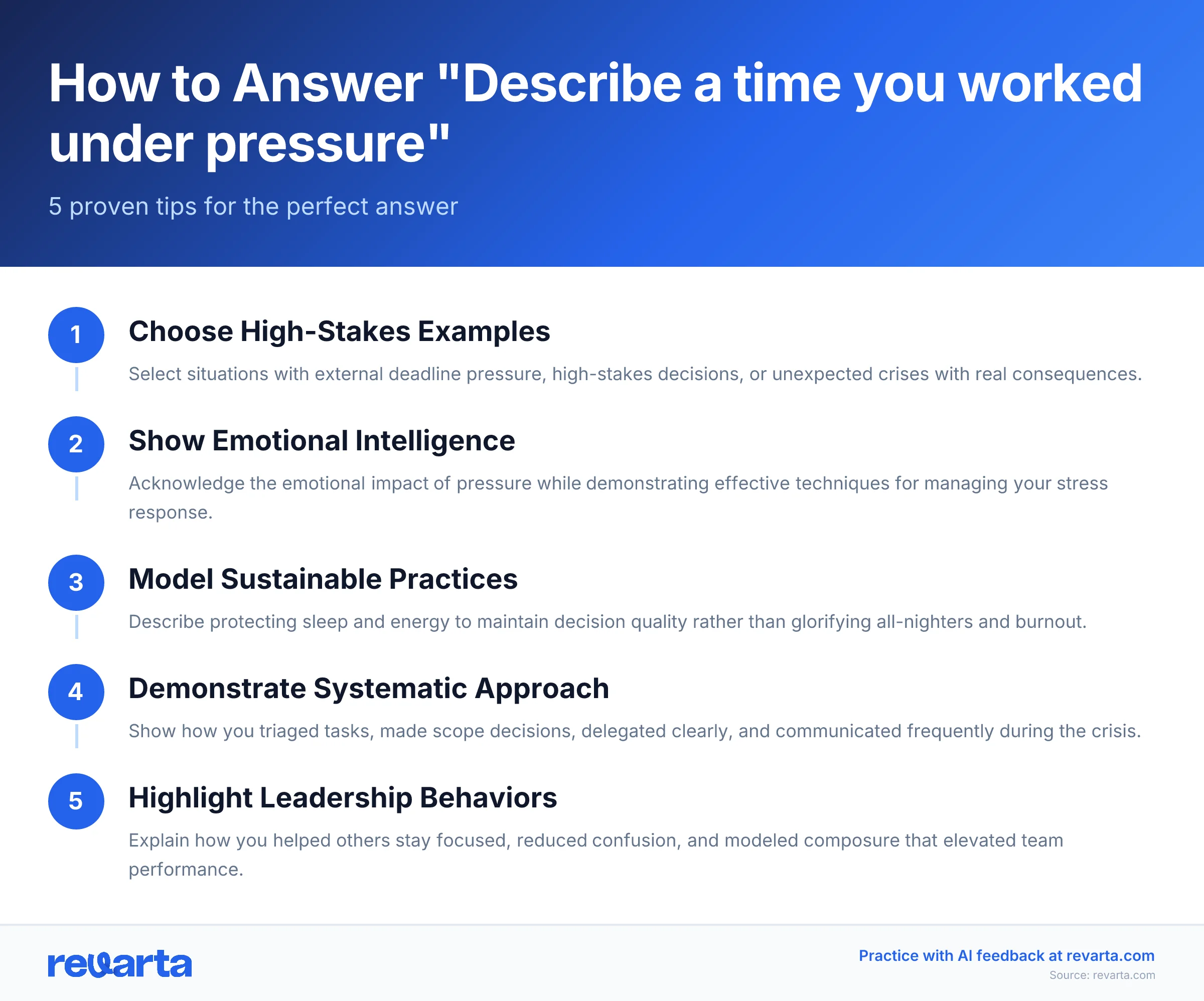
Choosing the Right Pressure Example
Avoid: Routine busy periods, self-created pressure from procrastination
Seek: External deadline pressure, high-stakes decisions, unexpected crises, situations where failure had significant consequences
Demonstrating Emotional Intelligence
Show awareness of pressure's emotional impact while demonstrating effective management:
Example:
"I recognized I was feeling overwhelmed, which told me I needed to break this down into smaller components. I took 15 minutes to list everything required and prioritize, which transformed paralyzing anxiety into focused urgency."
Showing Sustainable Practices
Avoid glorifying unhealthy pressure responses:
Weak: "I pulled three all-nighters and didn't sleep until the deadline"
Strong: "I protected my sleep to maintain decision quality, working focused 12-hour days rather than exhausted 18-hour days"
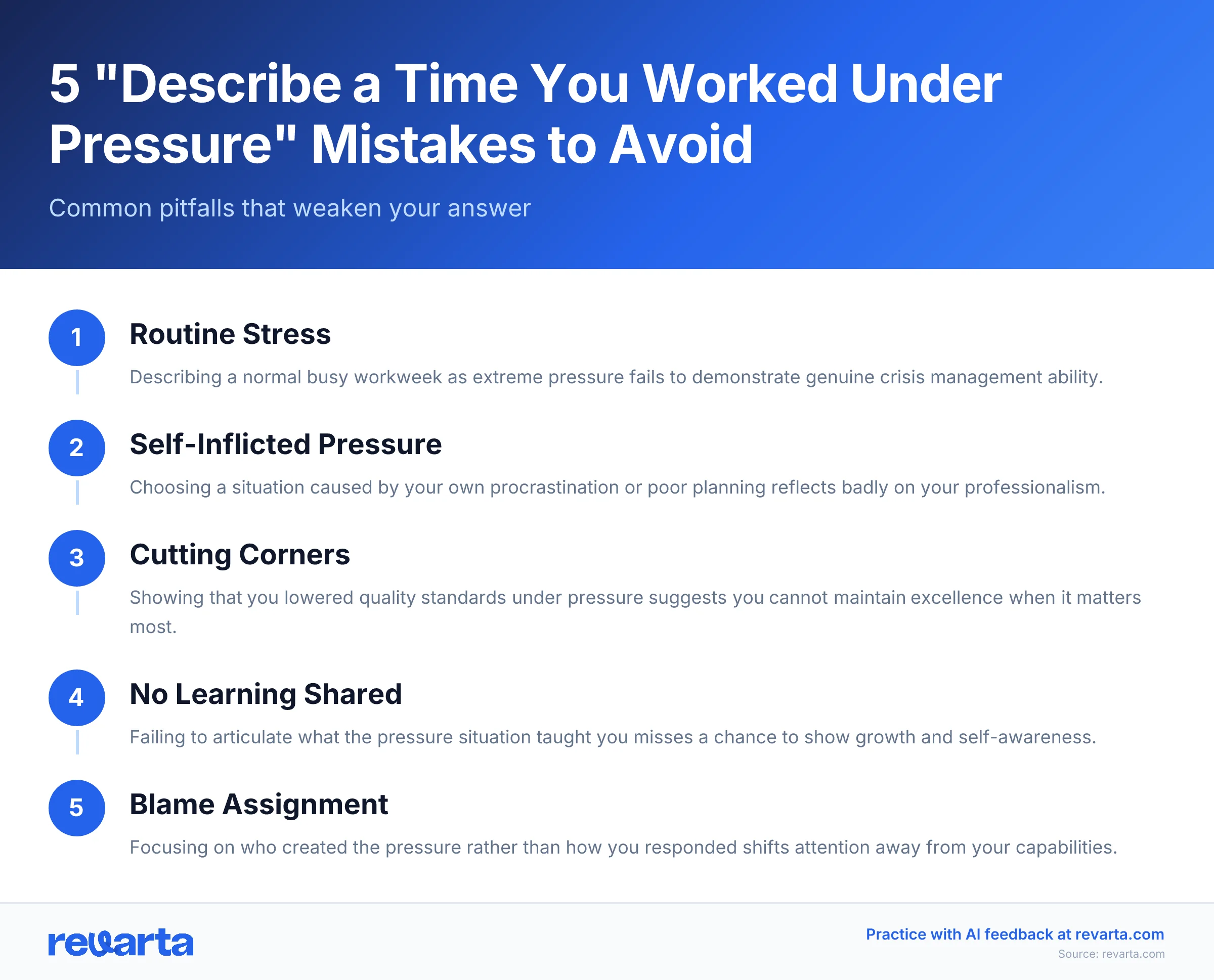
Common Mistakes to Avoid
Content Mistakes
- Routine Stress: Describing normal workload as "extreme pressure"
- Poor Planning: Pressure situations caused by your procrastination
- Cutting Corners: Lowering quality standards under pressure
- No Learning: Not articulating what pressure taught you
Delivery Mistakes
- Stress During Telling: Getting visibly anxious recounting the story
- Blame Assignment: Focusing on who created pressure rather than your response
- Heroic Martyr: Emphasizing suffering rather than effective performance
Industry-Specific Considerations
Technology Sector
Emphasize production outages, launch deadlines, system failures, scaling crises
Healthcare Industry
Focus on patient care emergencies, staffing crises, life-or-death decisions
Financial Services
Highlight market volatility responses, regulatory deadlines, transaction pressure
Sales/Marketing
Emphasize quota pressure, campaign launches, competitive response situations
Conclusion
Mastering pressure questions requires selecting genuinely high-stakes examples and demonstrating systematic approaches to maintaining performance quality despite time constraints and stress. The strongest answers show both emotional regulation and strategic execution under fire.
Practice pressure situation answers with AI feedback
Keep Preparing


