How to Answer "How Do You Handle Multiple Priorities?": The Complete Interview Guide (2026)
"How do you handle multiple priorities?" appears in 80% of professional interviews across all career levels. This question reveals your prioritization judgment, ability to work under pressure, organizational systems, decision-making under competing demands, and capacity to deliver results when everything seems urgent. Research shows that professionals who excel at prioritization are 2.5x more productive and experience 40% less stress than those who struggle with competing demands.
This comprehensive guide provides 15+ STAR method examples, proven prioritization frameworks, and strategies for demonstrating systematic judgment under pressure.
Why Interviewers Ask About Multiple Priorities
Assessing Strategic Prioritization
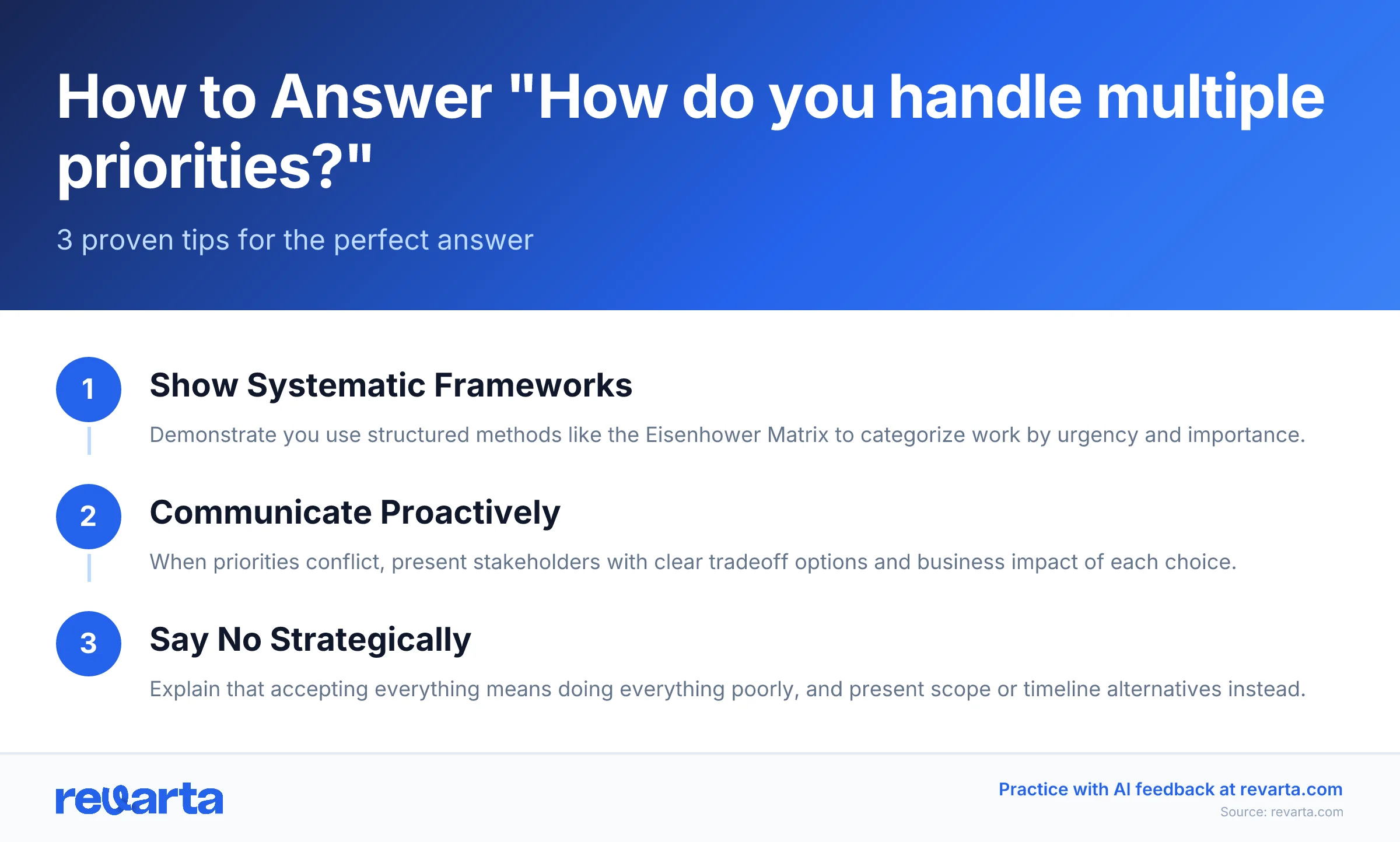
Organizations need people who distinguish between urgent and important, not those who treat everything equally. Your response reveals whether you can identify highest-impact work, make intelligent tradeoff decisions, align priorities with business goals, and say no to lower-value demands when necessary.
Evaluating Stress Management
Multiple competing priorities create pressure that reveals true capabilities. Interviewers assess whether you maintain quality under pressure, stay organized when overwhelmed, think clearly despite anxiety, and perform consistently regardless of workload complexity.
Understanding Organizational Systems
Systematic prioritizers have frameworks; reactive ones operate chaotically. Your story shows whether you have established organizational methods, use tools and systems effectively, track commitments reliably, and optimize approaches based on what works.
Measuring Stakeholder Management
Multiple priorities often mean multiple stakeholders with competing needs. Interviewers evaluate whether you communicate capacity constraints proactively, negotiate deadlines and scope effectively, set realistic expectations, and maintain relationships despite saying no sometimes.
Gauging Adaptability
Priorities shift constantly in dynamic environments. Your example reveals whether you adapt quickly when priorities change, maintain effectiveness amid uncertainty, reprioritize without resentment, and stay productive despite changing demands.
The STAR Method for Multiple Priorities
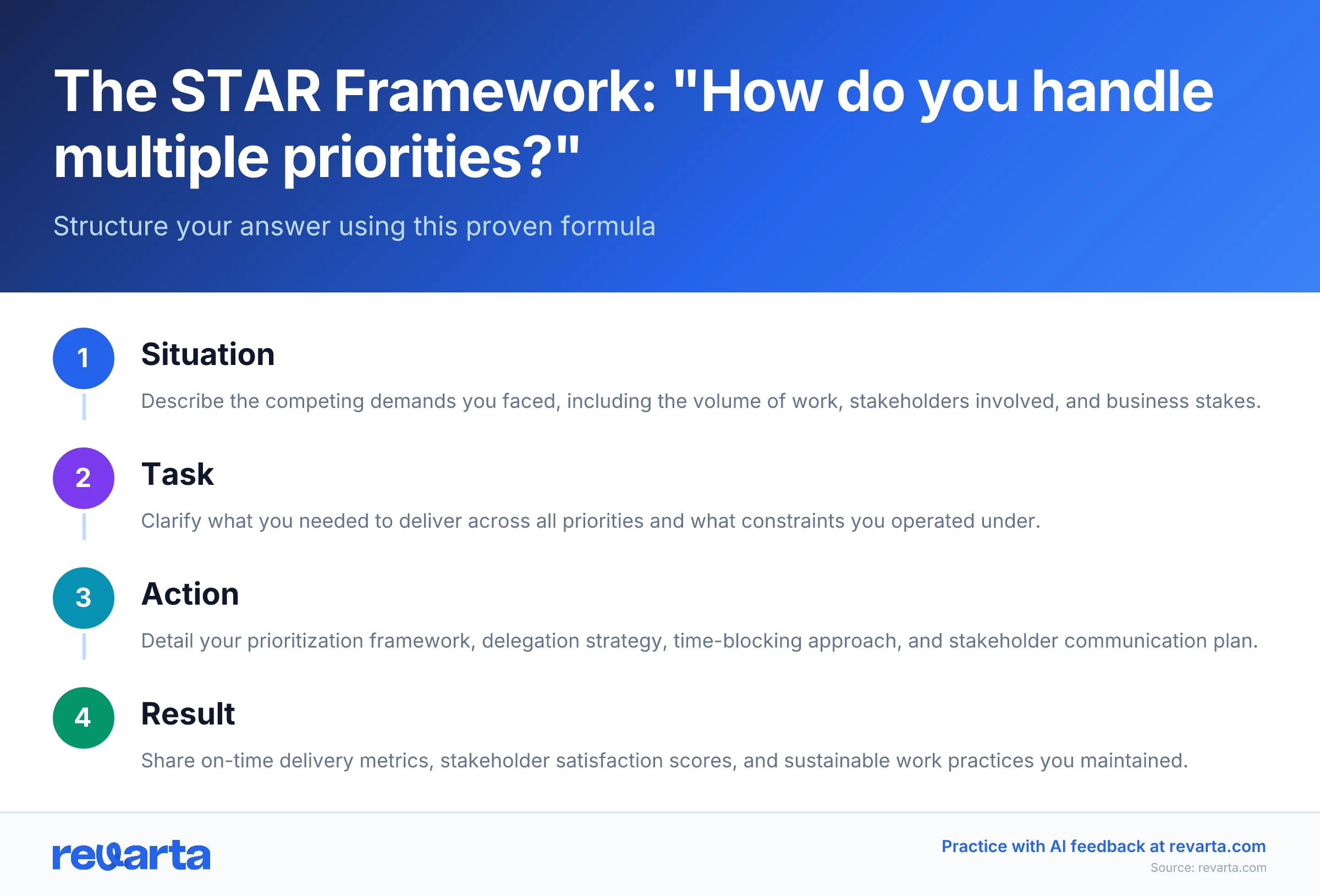
Situation (20%)
Example:
"As a senior project manager, I simultaneously managed four major client implementations with overlapping timelines. Each client had executives expecting weekly updates, engineering teams requiring daily coordination, and deliverables due throughout each month. In addition, I had ongoing responsibilities: budget management, team performance reviews, and strategic planning. During Q3, all four projects hit critical phases simultaneously while I was also preparing our annual capacity planning presentation for executive leadership."
Task (10%)
Example:
"I needed to deliver all project milestones on schedule, maintain quality across all initiatives, keep multiple stakeholder groups informed and satisfied, complete my ongoing managerial responsibilities, and prepare a strategic presentation—all without working unsustainable hours or burning out my team."
Action (50%)
Example:
"I started by mapping all commitments visually on a priority matrix, categorizing by urgency and business impact. This revealed that three projects had critical deliverables within two weeks while the fourth was actually ahead of schedule.
I made strategic decisions about where to focus: I allocated 60% of my time to the three critical projects, 20% to routine management, 15% to strategic planning, and 5% to the ahead-schedule project. I communicated this prioritization to all stakeholders, explaining my reasoning.
For the critical projects, I implemented daily 15-minute standup calls with each team to identify blockers quickly without lengthy meetings consuming my schedule. I batched similar work—all budget reviews on Fridays, all client updates on Tuesdays—to minimize context switching.
I also delegated strategically. I asked my most experienced team lead to handle day-to-day coordination for the ahead-schedule project, with my involvement only for major decisions. I involved my deputy in performance review preparation, providing guidance but not doing all the work myself.
When a new 'urgent' request came from sales for a customer demo, I evaluated it against existing priorities and determined it was important but not critical. I negotiated a two-week timeline instead of the requested one week, which allowed me to maintain focus on my highest-priority commitments.
I protected my own sustainability by maintaining clear working hour boundaries. I didn't work weekends, but I was highly focused during work hours—turning off Slack notifications during focused work blocks and limiting email checking to three times daily.
I also implemented a 'priority check-in' every Monday morning where I reassessed all priorities based on new information and adjusted my weekly plan accordingly."
Result (20%)
Example:
"All four projects delivered on schedule with zero missed deadlines. Client satisfaction scores averaged 4.7/5 across all implementations. My strategic planning presentation was well-received by executive leadership and influenced our hiring plan for the following year.
My team reported in feedback surveys that despite the heavy workload period, they felt well-supported and clear about priorities. We had zero turnover during or after this intense period.
Personally, I maintained sustainable work hours—averaging 45 hours weekly during this peak period versus the 60+ hours I would have worked previously using reactive approaches.
This experience validated several prioritization principles: visual priority mapping prevents critical items from being missed, strategic delegation multiplies effectiveness without requiring more hours, batching similar work reduces cognitive load, and proactive stakeholder communication about priorities prevents far more problems than it creates.
I've since codified this approach into a prioritization framework I teach to junior project managers: map all priorities visually, categorize by impact and urgency, make explicit allocation decisions, communicate priorities proactively, delegate strategically, and reassess weekly."