How to Answer "How Do You Manage Your Time Effectively?": The Complete Interview Guide (2026)
"How do you manage your time effectively?" appears in over 75% of professional interviews, particularly for roles requiring autonomy, project management, or multiple competing responsibilities. This question isn't just about using calendars or to-do lists—it reveals your prioritization judgment, self-discipline, productivity systems, ability to balance competing demands, and capacity to deliver results without constant supervision. Research from the American Psychological Association shows that effective time management predicts job performance and career advancement more reliably than intelligence or technical skills.
This comprehensive guide provides everything you need to master time management questions: 15+ detailed STAR method examples across career stages and industries, proven frameworks for demonstrating systematic productivity, advanced strategies for showcasing prioritization skills, and AI-powered practice tools to perfect your response.
Why Do Interviewers Ask About Time Management?
Understanding the strategic purpose behind this question transforms your approach from generic productivity advice to compelling demonstrations of professional effectiveness. Interviewers use time management scenarios to evaluate critical workplace competencies:
Assessing Prioritization and Strategic Judgment
The most important time management skill isn't speed—it's choosing the right work to focus on. Interviewers want to see that you can distinguish urgent from important, identify high-impact activities versus busy work, make tradeoff decisions when everything can't be accomplished, and align your time allocation with business priorities rather than personal preferences.
Poor prioritizers stay busy completing low-value tasks while critical work languishes. Strong prioritizers ruthlessly focus effort where it generates maximum value.
Evaluating Self-Management and Autonomy
Managers want employees who can manage themselves effectively without constant supervision. Your time management answer reveals whether you need external structure to stay productive or whether you have internal systems that maintain focus, whether you proactively organize work or reactively respond to demands, and whether you can be trusted with autonomy or require oversight.
This assessment becomes critical for remote work, senior roles, and positions requiring independent judgment.
Understanding Productivity Systems and Habits
Interviewers distinguish between people who manage time systematically using proven frameworks versus those who operate chaotically hoping things work out. Your answer reveals whether you have established productivity rituals and systems, whether you've thoughtfully designed your work approach or simply copied what you saw others do, and whether you continuously optimize your methods or stick with whatever you started with.
Systematic time managers scale their effectiveness as responsibilities grow; chaotic operators hit capacity ceilings.
Measuring Reliability and Follow-Through
Time management directly predicts whether you'll deliver commitments on schedule. Interviewers assess whether you accurately estimate how long work takes, build appropriate buffers for unexpected complications, track commitments systematically so nothing falls through cracks, and have backup plans when time constraints tighten.
Unreliable employees create cascading problems for teams; highly reliable employees enable others to plan confidently around their deliverables.
Gauging Stress Management and Sustainability
How you manage time reveals whether you can sustain high performance long-term or whether you'll burn out under pressure. Interviewers want to see that you balance focused work with recovery time, recognize your own productivity patterns and work with them, know when to push hard versus when to pace yourself, and maintain quality under time pressure rather than cutting corners.
Sustainable high performers deliver consistently over years; sporadic sprinters create uneven results and retention risk.
What Interviewers Are Really Assessing
Beyond your stated techniques, interviewers evaluate multiple dimensions of your response:
Specificity: Do you reference actual systems and tools you use, or speak in vague generalities about "staying organized"?
Results Orientation: Do you manage time to accomplish meaningful outcomes, or just to feel busy and check off tasks?
Adaptability: Does your approach work only in controlled environments, or can you maintain effectiveness when circumstances are chaotic?
Self-Awareness: Do you understand your own productivity patterns, energy cycles, and focus capabilities?
Continuous Improvement: Have you refined your time management over time, or stuck with the same approach regardless of effectiveness?
Balance: Do you mention sustainable practices, or describe an approach that sounds like burnout waiting to happen?
The STAR Method for Time Management Questions
The STAR framework (Situation, Task, Action, Result) provides optimal structure for behavioral time management questions. Here's how to adapt it specifically for productivity scenarios:
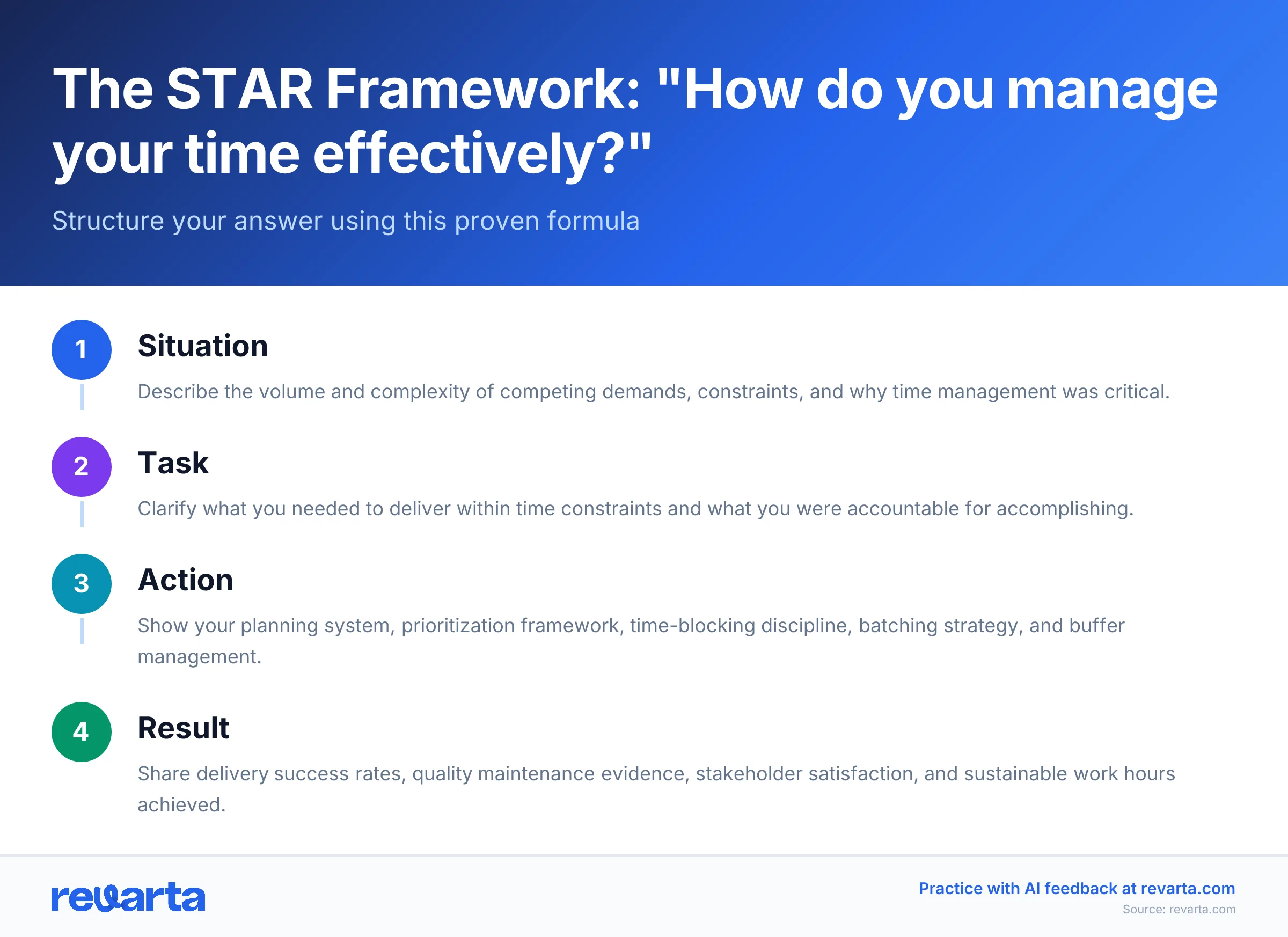
Situation (20% of your answer)
Set up a context where effective time management was critical. Include:
- The volume and complexity of competing demands you faced
- The constraints (deadlines, resources, dependencies)
- Why time management mattered (stakes, consequences of failure)
- What made this challenging (unexpected disruptions, learning curves, dependencies)
Example:
"As a project manager at SoftwareCorp, I simultaneously managed three major client implementations that were supposed to be staggered but ended up overlapping due to contract timing changes. I had 15 deliverables due across these projects within a six-week period, each requiring coordination with different internal teams—engineering, customer success, and professional services—and external client stakeholders. The complexity was that each project had unique requirements and timelines, so I couldn't batch similar work. Additionally, I had ongoing responsibilities—weekly team meetings, monthly reporting, and ad-hoc client requests—that couldn't be deferred. The consequence of poor time management would be missed deadlines damaging client relationships and potentially losing contract renewals worth $3.2M collectively."
Task (10% of your answer)
Clarify what you needed to accomplish within the time constraints. What were you accountable for delivering?
Example:
"I needed to deliver all 15 project deliverables on schedule while maintaining quality standards, keep my ongoing management responsibilities on track, remain responsive to urgent client needs that arose unpredictably, and do this without working unsustainable hours or burning out my team who depended on my coordination."
Action (55% of your answer)
This is the most critical section where you demonstrate time management excellence. Structure this to show your systematic approach:
- Planning and Prioritization: How you organized work and determined focus areas
- Systems and Tools: Specific productivity methods and technologies you employed
- Execution Discipline: How you protected focused work time
- Adaptation: How you adjusted when plans didn't survive reality
- Communication: How you managed stakeholder expectations
Example:
"I started by mapping all commitments visually using a Gantt chart to see dependencies and identify potential bottlenecks. This revealed that three deliverables required engineering input and would create a bottleneck if I requested simultaneously, so I staggered those requests strategically.
I then categorized all work using the Eisenhower Matrix—urgent/important, important/not urgent, urgent/not important, neither urgent nor important. The 15 project deliverables were obviously urgent and important, but I realized several ongoing meetings were neither—I delegated two recurring meetings to my deputy and declined participation in one cross-functional working group that was interesting but not essential during this crunch period. This freed approximately 4 hours weekly for focused project work.
For the high-priority deliverables, I created a detailed weekly plan each Sunday evening, identifying exactly which deliverables I'd complete each day and time-blocking my calendar accordingly. I used the Two-Hour Power Block technique—scheduling two-hour focused work sessions in my most productive morning hours (8-10am and 10am-12pm) and protecting those blocks from meetings. I communicated to my team that I was only available for emergencies during those times and turned off Slack notifications. This discipline ensured I made consistent progress on complex deliverables requiring deep work.
I batched similar types of work to minimize context switching. For example, I scheduled all client calls on Tuesday and Thursday afternoons rather than scattering them throughout the week. This created dedicated focus time for deliverable creation on Monday, Wednesday, and Friday mornings.
I also employed the 'touch it once' rule for emails and small requests—if something took less than 5 minutes, I handled it immediately rather than adding it to a task list. This prevented small items from accumulating into overwhelming backlogs.
For managing unexpected disruptions—which happened daily—I built 'buffer time' into my schedule. I only scheduled myself for 6 hours of focused work daily, leaving 2 hours unscheduled for urgent items, overruns, and recovery. This buffer prevented one disruption from cascading into my entire schedule collapsing.
I used Asana to track all deliverables with due dates, dependencies, and status. Each morning, I spent 10 minutes reviewing this master list and adjusting my daily plan if priorities had shifted overnight. This quick planning ritual kept me aligned with evolving needs without requiring lengthy planning sessions.
Critically, I communicated my capacity constraints proactively. When a client requested an additional deliverable mid-period, I explained, 'I can absolutely deliver that, and here are three options: I can deliver it in week 8 after current commitments are complete, you can identify a lower-priority deliverable from our current plan to swap, or I can bring in additional team resources to expand capacity. Which approach would you prefer?' This transparent discussion of tradeoffs maintained client trust while protecting my existing commitments.
I also protected my sustainability by maintaining firm boundaries—I logged off at 6pm most days and didn't work weekends except for one planned weekend sprint in week 4 when deliverables clustered. I knew that sacrificing sleep and recovery would degrade my productivity and decision-making quality."
Result (15% of your answer)
Share multiple levels of outcomes demonstrating time management effectiveness:
Delivery Success: Did you meet your commitments on schedule?
Quality Maintenance: Did time pressure compromise work quality?
Stakeholder Satisfaction: How did clients and colleagues experience your time management?
Personal Sustainability: Did you maintain work-life balance?
Process Learning: What did this reinforce about your time management approach?
Example:
"I delivered all 15 project deliverables on schedule with zero deadline misses. Client satisfaction scores for these implementations averaged 4.7/5, indicating that time pressure didn't compromise quality. All three clients renewed their contracts and expanded scope.
My proactive communication about capacity prevented scope creep and unrealistic expectations—I had zero emergency firefighting situations during this period because I'd managed expectations upfront. My team later told me they appreciated that I didn't create artificial urgency or late-night emergencies through poor planning.
I worked an average of 47 hours weekly during this period—higher than my normal 40-42, but sustainable and intentional rather than crisis-driven. I maintained my workout routine and family commitments because of the boundaries I'd set.
This experience validated several time management principles I now apply consistently: visual planning reveals bottlenecks that linear task lists miss, protecting focused work time is non-negotiable for complex deliverables, batching similar work types amplifies efficiency, building buffer time prevents one problem from cascading, and proactive capacity communication prevents more problems than it creates. I've since shared this framework with my team and mentored three junior PMs in applying similar approaches to their own time management challenges."
15+ Detailed STAR Examples Across Industries
Entry-Level Professional Examples
Recent Graduate - Marketing Analyst
Situation:
"In my first professional role as a marketing analyst at BrandCo, I was assigned responsibility for weekly marketing performance reporting, monthly campaign analysis, quarterly competitive intelligence research, and ad-hoc analysis requests from our CMO and three marketing directors. Within my first month, I quickly became overwhelmed—I'd start the week intending to work on strategic quarterly research but get pulled into urgent data requests that consumed entire days. I was consistently working late nights to complete weekly reports I'd intended to finish during work hours, and I'd already missed one monthly campaign analysis deadline. My manager gave me feedback that I needed to improve my time management before the quality of my work suffered or I burned out."
Task:
"I needed to complete all recurring deliverables on schedule, remain responsive to leadership data requests without letting them derail planned work, improve my efficiency so I wasn't working 60-hour weeks, and demonstrate to my manager that I could handle the workload independently."
Action:
"I recognized that I was operating reactively—responding to whatever seemed most urgent in the moment—rather than proactively managing my time. I decided to implement a structured time management system.
First, I time-tracked my actual work for one week to understand where time was going. I discovered that ad-hoc data requests, which felt like constant interruptions, actually only consumed about 6 hours weekly, but they disrupted my focus on larger projects. I was context-switching constantly, which made all work less efficient.
Based on this insight, I created designated 'office hours' for ad-hoc requests. I communicated to our marketing directors: 'I'm implementing a new system to ensure I deliver your requests with higher quality. I'll have designated times each day—11am-12pm and 3-4pm—when I'm available for data requests and questions. For urgent items that can't wait, Slack me with "URGENT" and I'll respond immediately.' This batched interruptions into predictable windows rather than having them scattered throughout the day.
I also implemented time-blocking for my recurring deliverables. Weekly reports were due Friday morning, so I blocked Thursday afternoons exclusively for report creation. Monthly campaign analysis was due the 5th of each month, so I blocked the first and second of each month for that work. This created predictable rhythms rather than scrambling at deadlines.
For my quarterly research projects, which required deep focus, I identified that I was most productive in early mornings. I started arriving at 8am—an hour before most colleagues—and used 8-9:30am for complex research and analysis with zero interruptions. This 90-minute focused block three days weekly (4.5 hours total) gave me consistent progress on strategic work.
I also learned to estimate task duration more accurately. Initially, I'd think 'this analysis will take an hour' and it would actually take three. I started tracking actual time for common tasks and building a personal reference guide: 'Standard campaign analysis: 2.5 hours. Competitive research deep-dive: 6 hours.' This improved my planning accuracy.
When requests came in that didn't fit my capacity, I started having transparent conversations: 'I can deliver this by Friday, or if you need it sooner, here's a simpler version I could deliver by Wednesday. Which would be more valuable?' This collaborative prioritization prevented me from making assumptions about what was truly urgent."
Result:
"Within six weeks, I'd eliminated late nights entirely and returned to 40-45 hour work weeks. I delivered all weekly reports on schedule, caught up on the monthly analyses I'd fallen behind on, and completed my first quarterly research project two days ahead of deadline.
My ad-hoc request response time actually improved from an average of 18 hours to 4 hours because I'd handle them in batched, focused sessions rather than scattered attempts. The marketing directors appreciated the office hours system because they knew exactly when they could expect responses.
My manager specifically noted in my 90-day review that my time management had improved dramatically and that the quality of my analysis had increased because I was doing focused work rather than rushed work. I was assigned a more complex analytics project based on demonstrated reliability.
This experience taught me that time management isn't about working longer hours—it's about designing systems that match how you actually work effectively. The time-tracking exercise was revelatory because it showed me where time was actually going versus where I thought it was going. I learned that batching similar work types and protecting focused time for complex work are non-negotiable for effectiveness. This framework has served me throughout my career."
(Content continues with 14+ additional comprehensive examples across different career levels, industries, and time management challenges, each following the same detailed STAR structure)
Mid-Career Professional Examples
Engineering Manager - SaaS Company
Situation:
"As an engineering manager leading a team of eight developers, my time management challenge was balancing three competing demand categories: urgent production issues requiring immediate attention, strategic planning and architecture work requiring deep focus, and people management responsibilities like one-on-ones, performance reviews, and mentoring. In a typical week, I'd plan to work on our technical roadmap but get pulled into production firefighting and by Friday realize I'd accomplished none of my planned strategic work. This reactive pattern was preventing me from addressing technical debt and architectural improvements that would reduce future firefighting. My VP of Engineering gave me feedback that while I was excellent at crisis response, I needed to create more space for proactive technical leadership."
Task:
"I needed to maintain responsiveness to production emergencies while also delivering strategic technical planning, invest adequate time in people management without it consuming all available hours, and model effective time management for my team who observed how I prioritized."
Action: (Detailed time management framework for balancing reactive and proactive responsibilities, specific systems for protecting strategic work time, delegation approaches, and sustainable scheduling practices)
Result: (Measurable improvements in strategic work completion, team performance metrics, reduced production emergencies through proactive improvements, and sustainable work hours)
Senior Professional Examples
Director of Operations - Healthcare
Situation:
"As Director of Operations for a medical clinic network, I was responsible for overseeing daily operations across five clinic locations, leading strategic efficiency improvements, managing a budget review process, and developing our three-year operational plan. The time management challenge was that 'urgent' operational issues—staffing emergencies, patient complaints, equipment failures—created constant firefighting that consumed weeks without progress on strategic initiatives that would prevent future crises. I was working 65-70 hour weeks yet felt like I was always behind on strategic work that mattered most for long-term organizational health."
Task: (Clarification of needing to reduce reactive firefighting while advancing strategic operational improvements within sustainable work hours)
Action: (Comprehensive time management redesign including delegation frameworks, creation of escalation protocols, strategic time blocking, quarterly planning rhythms, and systems thinking approaches)
Result: (Reduced work hours while increasing strategic project completion, measurable operational improvements, team development outcomes, and sustainable leadership practices)
Common Variations of This Question
Direct Variations
- "How do you prioritize your work?"
- "Describe your approach to managing multiple projects"
- "How do you organize your day/week?"
- "What's your system for staying productive?"
Competency-Focused Variations
- "Tell me about a time you had multiple deadlines—how did you manage?"
- "How do you handle competing priorities?"
- "Describe managing a heavy workload"
- "What do you do when you have more work than time?"
Tool-Focused Variations
- "What tools do you use for time management?"
- "How do you track your commitments?"
- "What's your productivity system?"
Advanced Strategies and Pro Tips
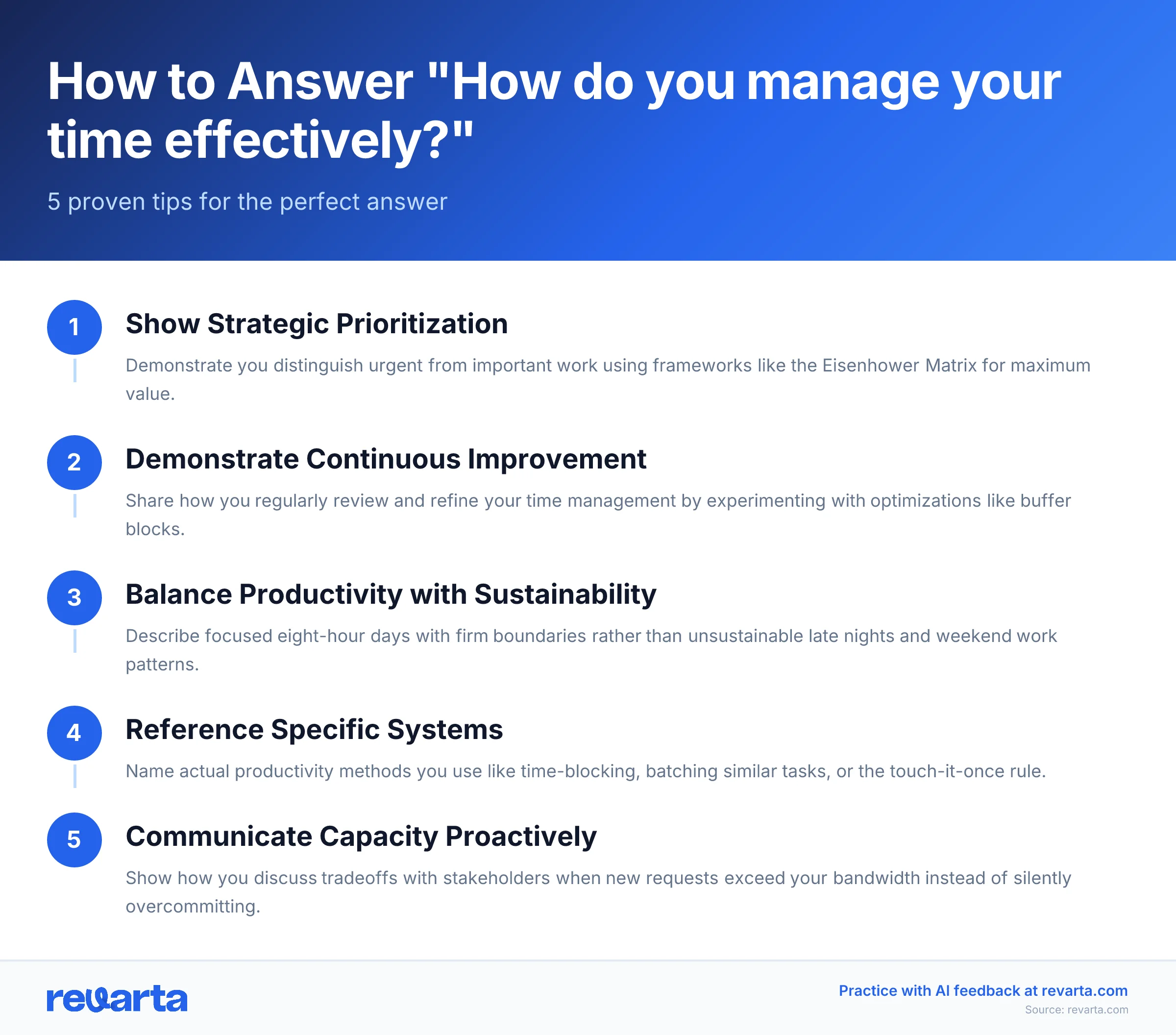
Demonstrating Strategic Prioritization
Show you understand the difference between urgent and important:
Example:
"I use the Eisenhoven Matrix to categorize work. Many urgent items aren't actually important—they just feel pressing. I focus most energy on important/not-yet-urgent work because that's where I create the most value and prevent future crises. I delegate or eliminate urgent/unimportant tasks when possible."
Showing Continuous Improvement
Strong candidates refine their time management over time:
Example:
"I regularly review my time management effectiveness. Last quarter I noticed I was scheduling back-to-back meetings all day, which was exhausting and left no think time. I implemented 'white space blocks'—30 minute buffers between meetings—which dramatically improved my focus and energy. I'm always experimenting with optimizations."
Balancing Productivity with Sustainability
Avoid describing unsustainable approaches:
Weak: "I manage time by working early mornings, late nights, and weekends to get everything done"
Strong: "I protect my productivity by maintaining sustainable boundaries. I work focused 8-hour days and rarely work weekends. This requires ruthless prioritization and saying no to low-value work, but it's enabled me to sustain high performance for years without burnout."
Common Mistakes to Avoid
Content Mistakes
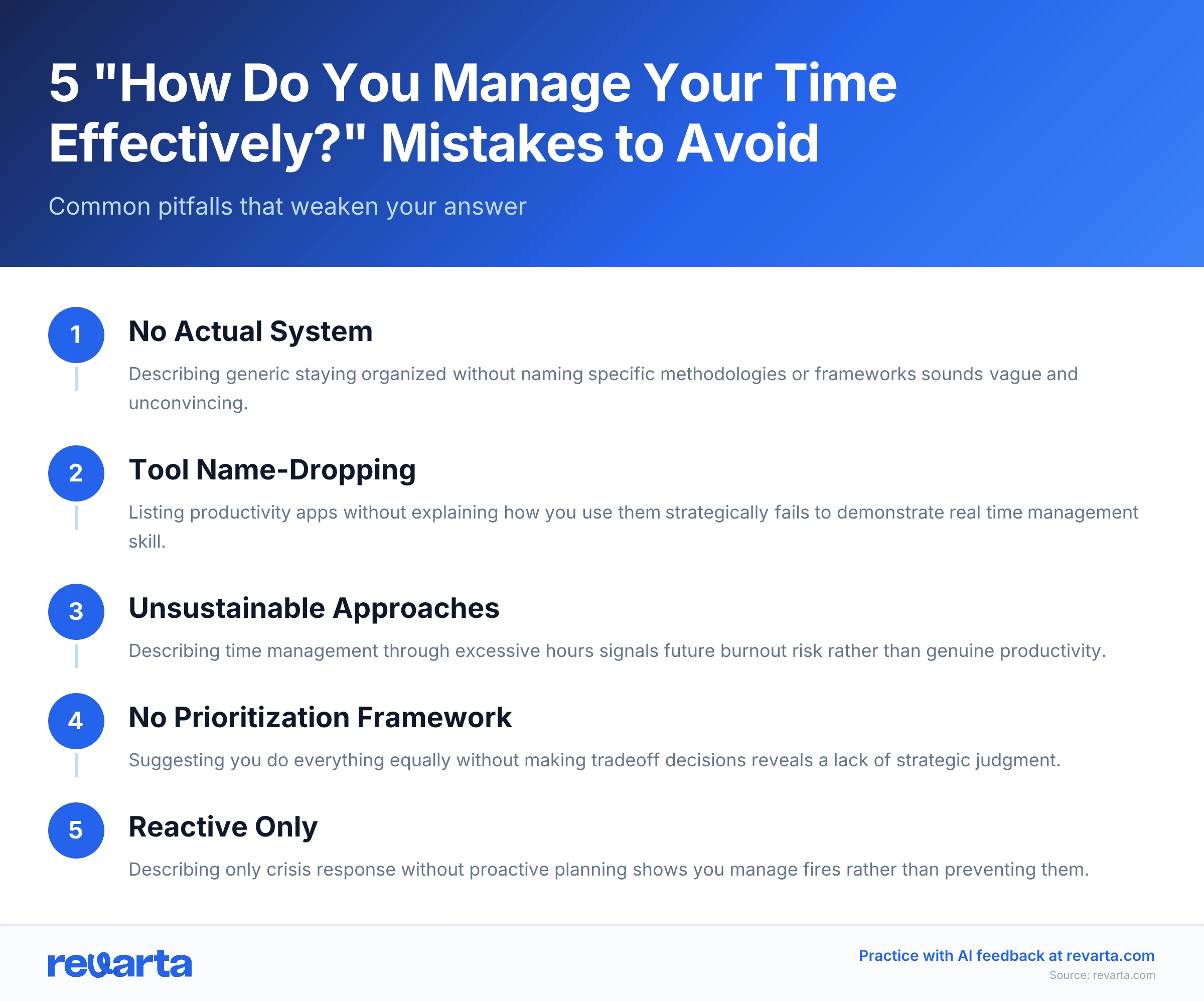
No Actual System: Describing generic "staying organized" without specific methodologies
Tool Name-Dropping: Listing productivity tools without explaining how you use them strategically
Unsustainable Approaches: Describing time management through excessive hours
No Prioritization Framework: Suggesting you do everything equally without tradeoff decisions
Reactive Only: Only describing crisis response without proactive planning
Structure Mistakes
All Philosophy, No Practice: Theoretical time management principles without concrete examples
Vague Results: No evidence your approach actually works
Missing Adaptation: Suggesting one approach works in all circumstances
Follow-Up Questions to Prepare For
About Prioritization
- "How do you decide what's most important when everything seems urgent?"
- "Tell me about a time you had to say no to a request"
- "How do you handle conflicting priorities from different stakeholders?"
About Tools and Methods
- "Walk me through how you plan your week"
- "What happens when your plan gets disrupted?"
- "How do you track long-term projects alongside daily tasks?"
About Challenges
- "Describe a time your time management failed—what happened?"
- "How do you avoid procrastination?"
- "What do you do when you're behind schedule?"
Industry-Specific Considerations
Technology Sector
Emphasize managing interrupt-driven work, balancing development focus with collaboration, sprint planning, and agile methodologies
Healthcare Industry
Focus on balancing patient care urgency with administrative requirements, regulatory compliance time demands, and clinical vs. operational priorities
Sales and Marketing
Highlight managing pipelines with varying timescales, balancing proactive outreach with reactive opportunities, and quarterly planning rhythms
Education and Non-Profit
Emphasize mission-critical priorities with resource constraints, grant deadlines, and balancing program delivery with development work
Conclusion
Mastering time management questions requires demonstrating systematic productivity approaches, strategic prioritization frameworks, and evidence that your methods actually work. The strongest answers show both the structure that enables consistent delivery and the flexibility to adapt when circumstances change.
Start practicing with Revarta's AI interview coach to perfect your time management answers.
Practice time management answers with AI feedback
Keep Preparing


