How to Answer "Tell Me About a Mistake You Made": The Complete Interview Guide (2026)
"Tell me about a mistake you made" ranks among the most challenging behavioral interview questions, appearing in over 70% of interviews across all industries and career levels. This question isn't about exposing your weaknesses—it reveals your self-awareness, accountability, learning capacity, humility, problem-solving under adversity, and emotional maturity when confronting failures. Research from Stanford Graduate School of Business shows that how professionals respond to mistakes predicts long-term career success more accurately than their initial capabilities.
This comprehensive guide provides everything you need to master mistake questions: 15+ detailed STAR method examples demonstrating accountability and growth, proven frameworks for selecting appropriate mistakes to share, advanced strategies for showcasing learning and resilience, and AI-powered practice tools to perfect your response.
Why Do Interviewers Ask About Mistakes?
Understanding the strategic purpose behind this question transforms your approach from defensive damage control to powerful demonstrations of professional maturity. Interviewers use mistake scenarios to evaluate critical workplace competencies:
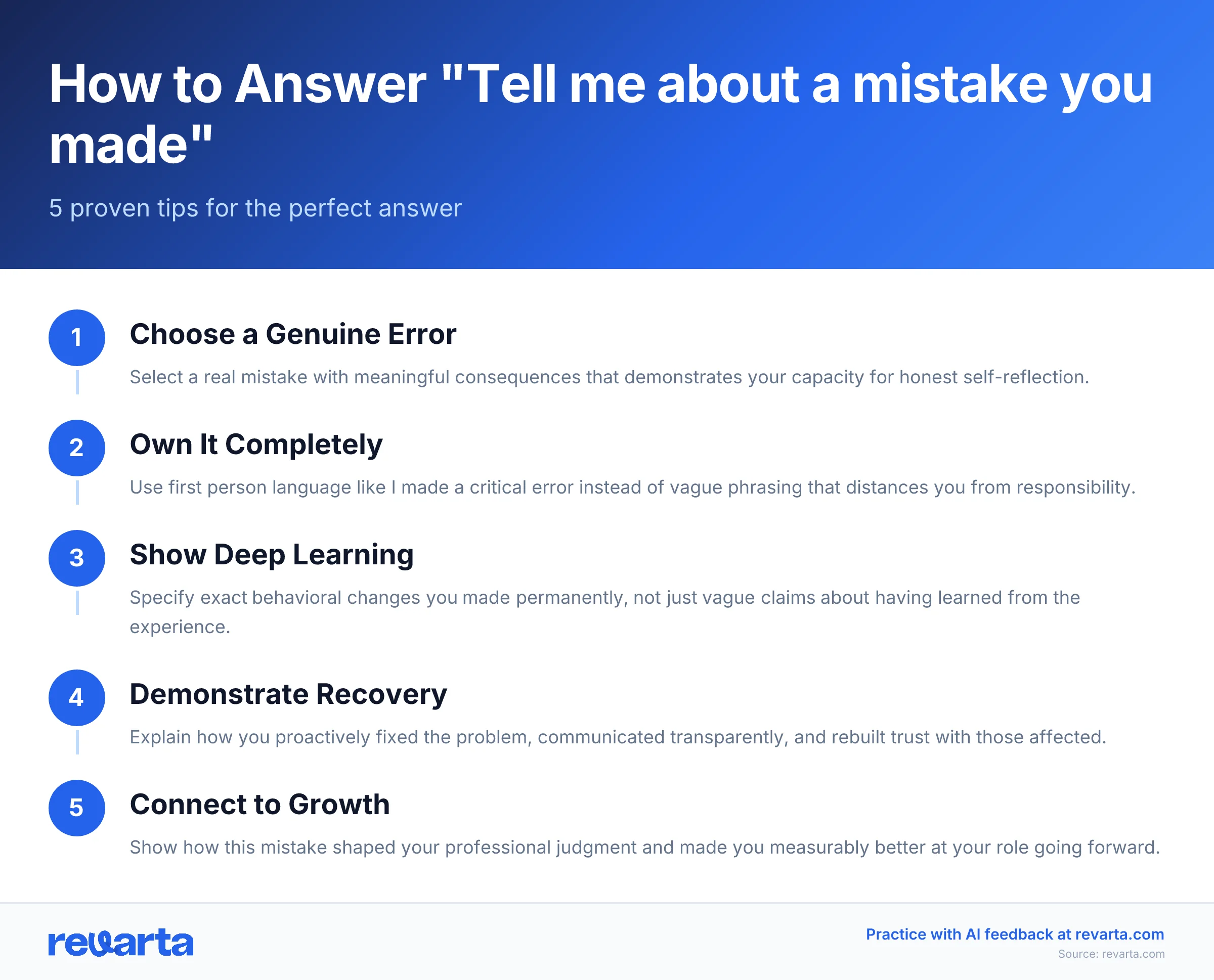
Assessing Accountability and Ownership
The fundamental test of this question is whether you take genuine responsibility for errors or deflect blame onto circumstances, other people, or bad luck. Interviewers distinguish between candidates who say "I made a mistake" versus those who say "mistakes were made" or "this happened to me." Your response reveals whether you'll own problems that arise in their organization or create a culture of excuse-making and finger-pointing.
Employees who take ownership of mistakes identify and fix problems quickly; those who deflect blame allow issues to fester while they protect their ego.
Evaluating Learning Agility and Growth Mindset
Everyone makes mistakes—the differentiator is what you do with them. Interviewers assess whether you extract lessons from failures and change behavior accordingly, view mistakes as learning opportunities rather than shameful events to hide, demonstrate self-reflection about what went wrong and why, and show evidence that you don't repeat the same mistakes.
Candidates with fixed mindsets view mistakes as evidence they're not capable; those with growth mindsets view mistakes as information about what to improve.
Understanding Self-Awareness and Humility
Genuine self-awareness requires acknowledging imperfections without spiraling into self-criticism. Interviewers evaluate whether you can discuss mistakes authentically without defensiveness, assess your own performance objectively, recognize the gap between your intentions and impact, and maintain appropriate confidence despite acknowledging errors.
Excessive defensiveness suggests fragile ego that will create workplace friction; appropriate vulnerability suggests emotional security that enables collaboration.
Gauging Problem-Solving Under Adversity
Mistakes create problems requiring resolution. Your story reveals whether you respond to errors proactively or wait for others to address them, generate creative solutions when you've created complications, maintain composure when dealing with consequences of your mistakes, and persevere through the discomfort of fixing problems you caused.
How you behave when you're wrong predicts your value during difficult organizational moments.
Measuring Relationship Repair and Communication
Professional mistakes often affect other people. Interviewers assess whether you communicate errors promptly and honestly, apologize authentically when appropriate, rebuild trust after disappointing others, and maintain productive relationships despite having made mistakes that affected colleagues or clients.
The ability to recover from errors while preserving relationships is critical for long-term career success.
What Interviewers Are Really Assessing
Beyond your story's surface content, interviewers evaluate multiple dimensions of your response:
Mistake Magnitude: Is this a genuinely meaningful error worthy of discussion, or are you minimizing by sharing trivial mistakes?
True Ownership: Do you genuinely own the mistake, or do you subtly shift blame while appearing to take responsibility?
Learning Depth: Can you articulate specific behavioral changes that resulted from this mistake, or do you offer vague claims about "learning from it"?
Recovery Quality: Did you effectively address the mistake's consequences, or did you leave problems for others to fix?
Current Perspective: Do you discuss this mistake with appropriate maturity, or are you still defensive about it years later?
Pattern Recognition: Is this an isolated error, or does it suggest concerning patterns in judgment or behavior?
The STAR Method for Mistake Questions
The STAR framework (Situation, Task, Action, Result) provides optimal structure for mistake questions, with special emphasis on accountability and learning. Here's the adapted approach:
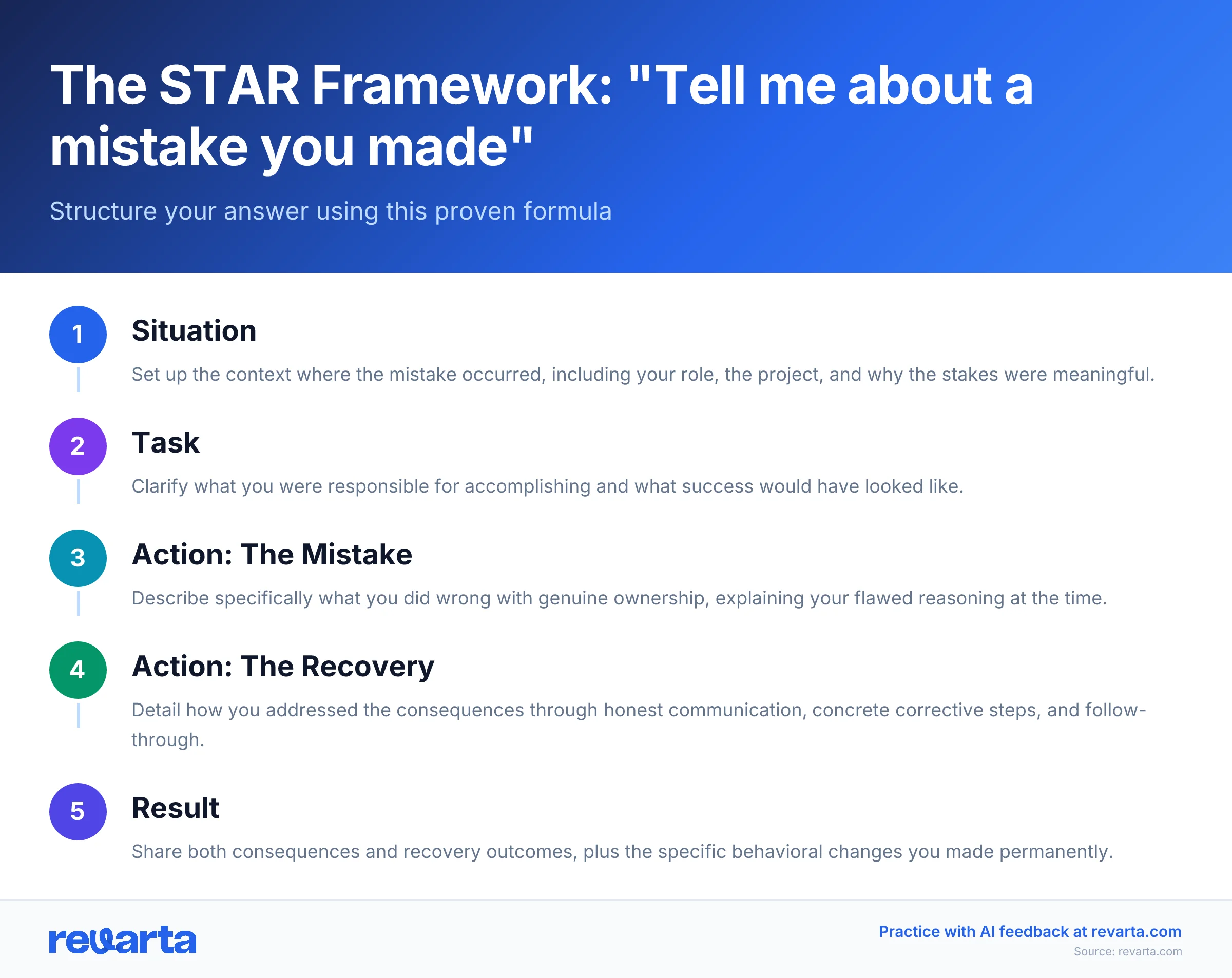
Situation (15% of your answer)
Set up the context where the mistake occurred. Include:
- Your role and responsibilities at the time
- The situation or project where the mistake happened
- What you were trying to accomplish
- Why this context matters (stakes, complexity)
Example:
"Early in my career as a project manager at SoftwareCorp, I was leading my first major client implementation—a six-month project to deploy our platform for a financial services client. This was my opportunity to prove I could handle complex, high-stakes projects independently. The client was particularly demanding but represented a strategic account we wanted to expand, so delivering excellently mattered enormously for both the client relationship and my professional development."
Task (10% of your answer)
Clarify what you were responsible for accomplishing.
Example:
"I was responsible for managing all aspects of the implementation: coordinating our internal technical team, managing client expectations and communications, ensuring we met agreed timelines and deliverables, and identifying and escalating risks that could affect project success."
Action (25% of your answer - THE MISTAKE)
This section describes what you did wrong. Be specific and genuinely own it:
Example:
"In week 8 of the project, our development team informed me they'd encountered technical complications that would delay our next milestone by two weeks. I made a critical mistake: I didn't immediately communicate this delay to the client.
My reasoning at the time was that I wanted to first confirm whether we could recover the timeline through extra effort, and I didn't want to alarm the client with a problem I thought we might solve. I told myself I was being strategic by managing the situation internally before involving the client.
I delayed the difficult conversation for a full week while our team worked to recover time. When it became clear we couldn't make up the delay, I finally scheduled a call with the client to inform them we'd miss the milestone by two weeks.
The client was understandably frustrated—not just about the delay itself, but about learning of it so late. They'd made business commitments based on our original timeline that were now at risk. More importantly, they'd lost confidence in my communication and transparency. The client escalated to my director, questioning whether I was capable of managing the project."
Action (30% of your answer - THE RECOVERY)
This section describes how you addressed the mistake's consequences:
Example:
"I immediately recognized that my credibility with this client was severely damaged and that I needed to rebuild trust through actions, not just apologies.
First, I owned the mistake completely in a follow-up meeting with the client. I didn't make excuses about wanting to solve it first—I acknowledged that my delay in communication was wrong and that I'd prioritized my discomfort with delivering bad news over their right to know about timeline changes affecting their business. I apologized genuinely and took full responsibility.
Second, I implemented a recovery plan: I worked with our technical team to create a revised timeline with conservative estimates and buffer time built in. I presented this to the client with complete transparency about our assumptions and risks. I also established a new communication protocol: I'd provide the client with weekly written status updates including any concerns or risks, even minor ones, and we'd have bi-weekly check-in calls where I'd proactively address questions.
Third, I involved my director in client communications for the next month to rebuild their confidence. Rather than hiding my mistake from leadership, I proactively briefed my director on what had happened and how I was addressing it. Her involvement signaled to the client that we were taking their concerns seriously at all levels.
Most importantly, I followed through religiously on my commitments. For the remaining four months of the project, I never missed a status update, I flagged risks the moment I identified them, and I under-promised and over-delivered on every subsequent milestone. When small issues arose, I communicated them immediately rather than trying to solve them silently."
Result (20% of your answer)
Share outcomes across multiple dimensions:
Immediate Consequences: What resulted from your mistake?
Recovery Success: Did you rebuild the damaged relationship/situation?
Long-term Impact: How did this affect your career and relationships?
Learning Integration: What specific changes did you make permanently?
Example:
"The immediate consequence was painful—the client nearly escalated to executive leadership about replacing me as project manager. However, my transparent recovery approach gradually rebuilt trust. We delivered the remaining project milestones on or ahead of schedule with zero surprises.
By the project's completion, the client's satisfaction score was 8/10—not exceptional, but respectable given the crisis. More importantly, they agreed to a contract expansion six months later, specifically requesting that I manage the new implementation. The client sponsor told my director that my mistake and recovery had actually increased their trust because they'd seen how I handled adversity.
Professionally, this mistake taught me several critical lessons that have shaped my project management approach ever since. First, delivering bad news early is always better than delivering it late—clients can adjust to problems if they know promptly, but delays eliminate their options. Second, my discomfort with difficult conversations is never a valid reason to delay communicating important information to stakeholders. Third, transparent over-communication during recovery is essential for rebuilding trust.
I now have a personal rule: any information that could affect a stakeholder's planning or expectations gets communicated within 24 hours of my learning it, regardless of whether I have a solution. I've never again delayed difficult client communication, and this discipline has prevented countless problems throughout my career.
This mistake was humbling but ultimately made me a much more effective project manager. I learned that credibility is built through transparency and reliability, not through hiding problems. The discomfort I felt during this experience taught me that short-term discomfort of difficult conversations prevents much larger problems down the road."
15+ Detailed STAR Examples Across Industries
Entry-Level Professional Examples
Recent Graduate - Marketing Coordinator
Situation:
"In my first role as a marketing coordinator at BrandCo, I was responsible for managing our company's social media presence across LinkedIn, Twitter, and Instagram. I'd been in the role for three months and was eager to prove myself as creative and proactive."
Task:
"My responsibilities included creating and scheduling social media content, engaging with our audience, and maintaining our brand voice and messaging consistency across all platforms."
The Mistake:
"I made a significant error that damaged our brand reputation. I created what I thought was a clever, humorous tweet referencing a popular meme to promote our new product. I didn't run it past my manager because previous posts had been approved and I wanted to demonstrate I could work independently.
The tweet used language that, while common in the meme, had an unintended double meaning that could be interpreted as insensitive to a marginalized community. I completely missed this interpretation because I'd only thought about the meme reference, not the broader connotations.
The tweet was live for four hours before our community manager flagged it after receiving angry responses from followers. By that time, it had been screenshotted and shared, with people criticizing our brand as insensitive. We had 30+ negative comments and several people announcing they'd stop using our products. I felt sick when I realized what I'd done."
The Recovery:
"I immediately deleted the tweet, but I knew that wasn't enough. I informed my manager right away rather than hoping she wouldn't notice—owning up to it immediately was the only right response even though I was terrified.
I drafted an apology for our social channels, but this time I reviewed it with my manager and our PR lead before posting. We posted a genuine apology acknowledging that the content was insensitive, taking responsibility without making excuses, and committing to being more thoughtful.
I also personally responded to every single person who'd commented negatively, apologizing individually and thanking them for holding us accountable. This took several hours but felt important—these weren't faceless critics, they were real people I'd offended.
Internally, I proposed implementing a review process for all social content before it goes live, at least until I'd demonstrated better judgment. I also enrolled in a diversity and inclusion communications course on my own time to educate myself about considerations I'd missed.
Most painfully, I offered to my manager that if the company felt my judgment error warranted it, I'd understand being removed from social media responsibilities. I was prepared to face consequences."
Result:
"My manager appreciated my immediate ownership and recovery actions. She didn't remove me from social responsibilities but did implement the review process I'd suggested—not as punishment but as sound practice we should have had from the beginning.
The community response to our apology was mixed—some people appreciated the accountability while others remained critical. We lost about 150 followers, which was painful. However, several people commented that our response showed genuine accountability.
This mistake fundamentally changed how I approach all professional communications. I learned that 'being creative' doesn't exempt me from being thoughtful. I now always consider: who might be affected by this communication, what unintended interpretations could exist, and when should I get a second opinion before publishing?
I've never again posted social content without considering diverse perspectives, and I proactively seek feedback on content that touches on anything potentially sensitive. This early-career mistake made me a much more thoughtful marketer. While I deeply regret the offense I caused, I'm grateful I learned this lesson early and in a recoverable situation."
Career Changer - From Retail to Corporate Finance
Situation:
"When I transitioned from retail management to corporate finance as a financial analyst, I was eager to prove myself in my new career. Six weeks into the role, I was assigned to prepare a monthly variance analysis report comparing actual expenses to budgeted amounts for our operations department."
Task:
"I needed to analyze $2.3M in monthly expenses, identify significant variances from budget, research root causes, and present findings to the CFO and department heads in our monthly finance review meeting."
The Mistake:
"I made a critical error in my analysis. Our accounting system showed a $180K variance in equipment expenses—actual spending was $180K over budget, which seemed significant and concerning.
I researched the variance and found that operations had purchased equipment not in the original budget. I concluded this was a budget overrun that needed explanation and potentially corrective action. I prepared slides highlighting this variance as a 'concern area' and recommended tighter purchase controls.
In the monthly review meeting, I presented my findings to the room of senior leaders, emphasizing this $180K budget overrun and my recommendation for improved controls. The operations director looked confused and asked about timing. That's when I realized my mistake.
The equipment purchase had been approved in a mid-year budget revision that I hadn't known existed. There was no overrun—the budget in our system hadn't been updated yet to reflect the approval. I'd just publicly accused a peer department of budget mismanagement in front of executives based on incomplete analysis. I felt my face flush as I realized my error in real-time during the meeting."
The Recovery:
"I immediately acknowledged my mistake in the meeting: 'I apologize—I clearly missed the budget revision approval in my analysis. This isn't actually a variance concern. I should have verified with operations before presenting this as a budget issue.' The CFO was visibly disappointed, and the operations director was understandably annoyed.
After the meeting, I went directly to the operations director's office and apologized personally. I explained what I'd missed in my analysis and acknowledged that my incomplete research had unfairly questioned his department's financial management in front of executives. I didn't make excuses about being new—I owned that I should have been more thorough.
I also met with my manager to discuss what had happened. Rather than being defensive, I asked her to help me understand what I should have done differently. She explained the budget revision process and how to access those records in our system—things I should have asked about during onboarding but hadn't.
I immediately created a personal checklist for variance analysis: verify budget version dates, check for mid-year revisions, confirm assumptions with department contacts before presenting concerns, and review analysis with manager before presenting to executives. I shared this checklist with my manager and asked her to review it to ensure I wasn't missing other steps.
For the next monthly report, I was extra thorough and had my manager review everything before the meeting. I also proactively reached out to department heads for any variances I was questioning, catching two similar issues before they became public errors."
Result:
"The immediate consequence was embarrassment and damaged credibility with the operations team and CFO. However, my prompt, genuine apology and the process improvements I implemented helped mitigate the damage.
The operations director later told me he appreciated my direct apology and that my mistake was understandable for someone new to corporate finance systems. Our working relationship recovered, and he actually became helpful in teaching me about how operations budgeting worked.
My manager appreciated that I'd asked for help understanding what I'd done wrong rather than just saying 'it won't happen again.' She told me in my 90-day review that while the mistake had been concerning, my response to it demonstrated maturity and learning orientation.
This mistake taught me critical lessons about the difference between retail and corporate environments. In retail, I'd learned to make quick decisions with incomplete information—that bias toward action served me well in that context. But in corporate finance, accuracy and thoroughness matter more than speed. I learned to slow down, verify assumptions, and consult with stakeholders before drawing conclusions.
I also learned the importance of understanding organizational systems before trying to optimize them. My retail instinct was to identify problems and propose solutions quickly, but in a corporate environment I didn't fully understand yet, that approach led to criticizing things I didn't comprehend.
This early mistake made me a much better analyst by teaching me to balance retail's action orientation with corporate finance's need for precision and verification."
Mid-Career Professional Examples
Product Manager - SaaS Company
Situation:
"As a product manager with four years of experience, I was leading development of a major feature for our enterprise SaaS platform. We'd promised this feature to several large customers who'd made it a condition of contract renewal, representing $4.2M in annual recurring revenue."
Task:
"I was responsible for defining product requirements, coordinating engineering implementation, ensuring the feature met customer needs, and delivering on our committed timeline of three months."
The Mistake:
"I made a significant judgment error in how I gathered and interpreted customer requirements. I conducted requirement discussions with sales engineers who worked with these customers rather than talking to the actual users directly. The sales engineers assured me they understood customer needs thoroughly.
Based on these conversations, I wrote detailed product specs for an advanced workflow automation feature. Engineering built exactly what I specified over three months. When we delivered the beta to customers for testing, the response was devastating: the feature was far too complex for their actual use case.
What they'd needed was simple, quick automation for routine tasks. What I'd designed was a sophisticated workflow builder that required training and ongoing maintenance. The sales engineers had over-interpreted customer requests through their technical lens, and I'd failed to validate this interpretation with actual users.
Three customer sponsors told us the feature was unusable in its current form and wouldn't meet their needs. We'd spent three months and significant engineering resources building the wrong thing, and contract renewals were at risk."
The Recovery:
"I immediately took ownership of this failure with my executive team, my engineering team, and most importantly, the customers. I didn't blame the sales engineers for miscommunicating requirements—I acknowledged that as product manager, validating requirements directly with users was my responsibility that I'd failed to fulfill.
I got on calls with each affected customer within 48 hours. I apologized for wasting their time with an unusable beta, acknowledged that I should have involved them earlier in the requirements process, and asked if they'd be willing to work with me to redesign the feature correctly. I emphasized that their feedback would directly shape the rebuild.
I then conducted intensive user research—something I should have done initially. I spent two weeks doing customer interviews, watching users work, and understanding their actual workflows and pain points. This revealed that the automation they needed was dramatically simpler than what I'd built.
I went back to engineering leadership and had a difficult conversation: we needed to essentially scrap three months of work and rebuild differently. This was painful because my team had worked hard on implementation, and this affected our roadmap commitments for other features. I owned that this rework was due to my requirements failure, not their execution.
I redesigned the feature based on actual user research and showed mockups to customers before engineering invested time building. This iterative validation process—which I should have used initially—ensured alignment before development.
I also implemented new product development practices across our team: all new features would include direct user research, not just stakeholder interviews; we'd validate designs with users before full implementation; and we'd build MVPs for user testing before investing in complex features."
Result:
"We rebuilt the feature correctly in six weeks—faster than the original three months because simpler design required less implementation. Customers were happy with the redesigned version, and all three customers renewed their contracts.
However, the mistake had consequences: our other roadmap commitments slipped by two months due to the rework, which disappointed other customers. My annual review noted this as a significant project failure, though my recovery actions were viewed positively.
Long-term, this mistake fundamentally changed how I approach product management. I learned that talking to customers directly is non-negotiable—no proxy (sales, support, success) can replace direct user research. I learned that validating assumptions early prevents much larger problems than it creates.
This failure also made me a better leader. I had to model accountability by owning the mistake publicly rather than letting my team take blame for 'building wrong.' This created trust that I'd protect them when I made strategic errors.
Three years later, I still reference this mistake when mentoring junior PMs: 'Talk directly to users, validate early and often, and remember that building the wrong thing perfectly is worse than building the right thing imperfectly.' This expensive lesson made me much more effective at my craft."
Senior Professional Examples
VP of Sales - Enterprise Software
Situation:
"As VP of Sales leading a team of 35 enterprise sales reps, I was under pressure to hit aggressive quarterly targets during a competitive market period. One of my top reps, James, had a major deal in final stages with a Fortune 500 prospect that would represent $2.8M annual contract value—enough to make or miss our quarter."
Task:
"My responsibility was to coach reps through complex deals, remove obstacles to closing, ensure deals were qualified and likely to close, and maintain forecast accuracy for our executive team and board."
The Mistake:
"James expressed concerns that the customer was asking for contractual terms we didn't typically offer—longer payment terms, unlimited user licenses without additional fees, and custom SLA commitments. Our legal and finance teams pushed back on these requests as unprofitable and risky.
I made a serious error in judgment: I pressured legal and finance to approve these terms because we desperately needed the deal to hit our quarter. I told them this was a strategic account worth being flexible on terms. I overrode their professional objections because I was focused on quarterly revenue, not long-term contract quality.
I also didn't adequately scrutinize James's claim that the customer was 'ready to sign immediately' if we agreed to terms. I wanted to believe it was true because we needed the revenue, so I didn't do sufficient diligence on deal qualification.
Legal reluctantly approved the terms, finance flagged that the economics were poor but didn't block it, and we got the contract signed at 11pm on the last day of the quarter. I celebrated hitting our number.
Three months later, the problems emerged: the customer had gone dark on implementation kickoff, they hadn't paid their first invoice despite extended payment terms, and when our success team finally got meetings, they discovered the customer had signed but hadn't actually budgeted for implementation and wasn't ready to deploy. The deal was essentially dead revenue—it would likely churn after year one, and we'd given away terms that made it unprofitable even if it stayed.
Worse, finance came to me with analysis showing that six other reps had started requesting similar aggressive terms for their deals, using my approval of James's deal as precedent. I'd created a culture of 'do whatever it takes to close' that was degrading our contract quality company-wide."
The Recovery:
"I had to take complete ownership of multiple failures here—poor judgment on deal quality, overriding expert objections for short-term gain, and creating precedent that damaged our business model.
First, I met with our CFO and General Counsel and apologized genuinely for overriding their professional judgment. I acknowledged that my revenue pressure wasn't a valid reason to ignore their expertise, and that I'd damaged trust between sales and these critical functions. I asked how we could rebuild collaborative deal review processes.
Together we implemented a new deal governance framework: any non-standard terms would require cross-functional review with sales, legal, finance, and customer success, with clear criteria for what constituted acceptable flexibility. I wouldn't have override authority—we'd need consensus or escalation to CEO.
Second, I had a difficult team meeting where I acknowledged what I'd done wrong with James's deal. I explained that while I wanted to support them in closing business, I'd set a bad example by prioritizing short-term revenue over long-term customer and company health. I announced the new governance framework and emphasized we'd compete on value, not on giving away terms.
This was hard because some reps had gotten used to the flexibility, and they pushed back. I held firm, explaining that sustainable business mattered more than any single quarter.
Third, I worked with James to try to rescue the customer relationship. We got honest about implementation readiness, offered to extend their contract start date to align with their actual budget timing, and committed to ensuring their success. The customer appreciated the honesty and we salvaged the relationship, though revenue was delayed two quarters.
Most importantly, I examined what had made me override my judgment. I realized that our quarterly incentive structure had incentivized behavior that damaged long-term business health. I proposed to our CEO that we restructure sales compensation to include long-term customer health metrics alongside bookings—deals that churned in year one would claw back commissions. This aligned incentives with sustainable revenue."
Result:
"The immediate consequences were painful: we missed next quarter's target because the James deal revenue was delayed, my compensation was affected because my bonus was tied to hitting plan, and I had to rebuild trust with legal and finance teams I'd alienated.
However, the changes we implemented had lasting positive impact. Our deal quality metrics improved significantly—year-one churn decreased from 18% to 8% for enterprise accounts. Our finance team reported that average contract profitability increased 22% because we stopped giving away unfavorable terms.
My relationship with legal and finance actually strengthened through this experience. They appreciated that I'd acknowledged my error and implemented structural changes rather than just promising to 'be more careful.' We developed highly collaborative deal review processes that balanced sales creativity with business rigor.
Personally, this was one of the most important learning experiences of my career. I learned that leadership means having the courage to make hard calls even when they affect your compensation. I learned that short-term results achieved through poor judgment create long-term problems. Most importantly, I learned that admitting mistakes and implementing systems to prevent repeating them builds more credibility than pretending to be infallible.
This mistake made me a better executive because it taught me to examine incentive structures critically and to resist pressure to compromise long-term health for short-term metrics. I now actively coach other sales leaders on the importance of deal quality over deal quantity, using my own mistake as a teaching story."
Common Variations of This Question
Direct Variations
- "Tell me about a time you failed"
- "Describe your biggest professional mistake"
- "Give me an example of when something went wrong"
- "What's a failure you've experienced?"
Learning-Focused Variations
- "Tell me about a time you learned from a mistake"
- "Describe a situation where you had to admit you were wrong"
- "What's something you'd do differently if you could?"
Outcome-Focused Variations
- "Tell me about recovering from a setback"
- "Describe fixing a problem you created"
Advanced Strategies and Pro Tips
Choosing the Right Mistake
Avoid:
- Trivial errors with no real consequences
- Mistakes that reveal fundamental character flaws
- Very recent mistakes (suggests pattern)
- Mistakes you clearly haven't processed or learned from
Seek:
- Genuine errors with real consequences
- Mistakes where you took clear ownership
- Errors that taught meaningful lessons
- Situations where you successfully recovered
Demonstrating Genuine Ownership
Weak ownership: "I was part of a team that made a mistake"
Strong ownership: "I made a critical error by..."
Weak: "In hindsight, I could have communicated better"
Strong: "I failed to communicate the delay to stakeholders, which was my responsibility"
Showing Deep Learning
Don't just say "I learned from this." Specify:
- What specific behaviors you changed permanently
- Systems or processes you implemented to prevent recurrence
- How this mistake shaped your professional judgment going forward
- Evidence you haven't repeated this mistake
Common Mistakes to Avoid
Content Mistakes
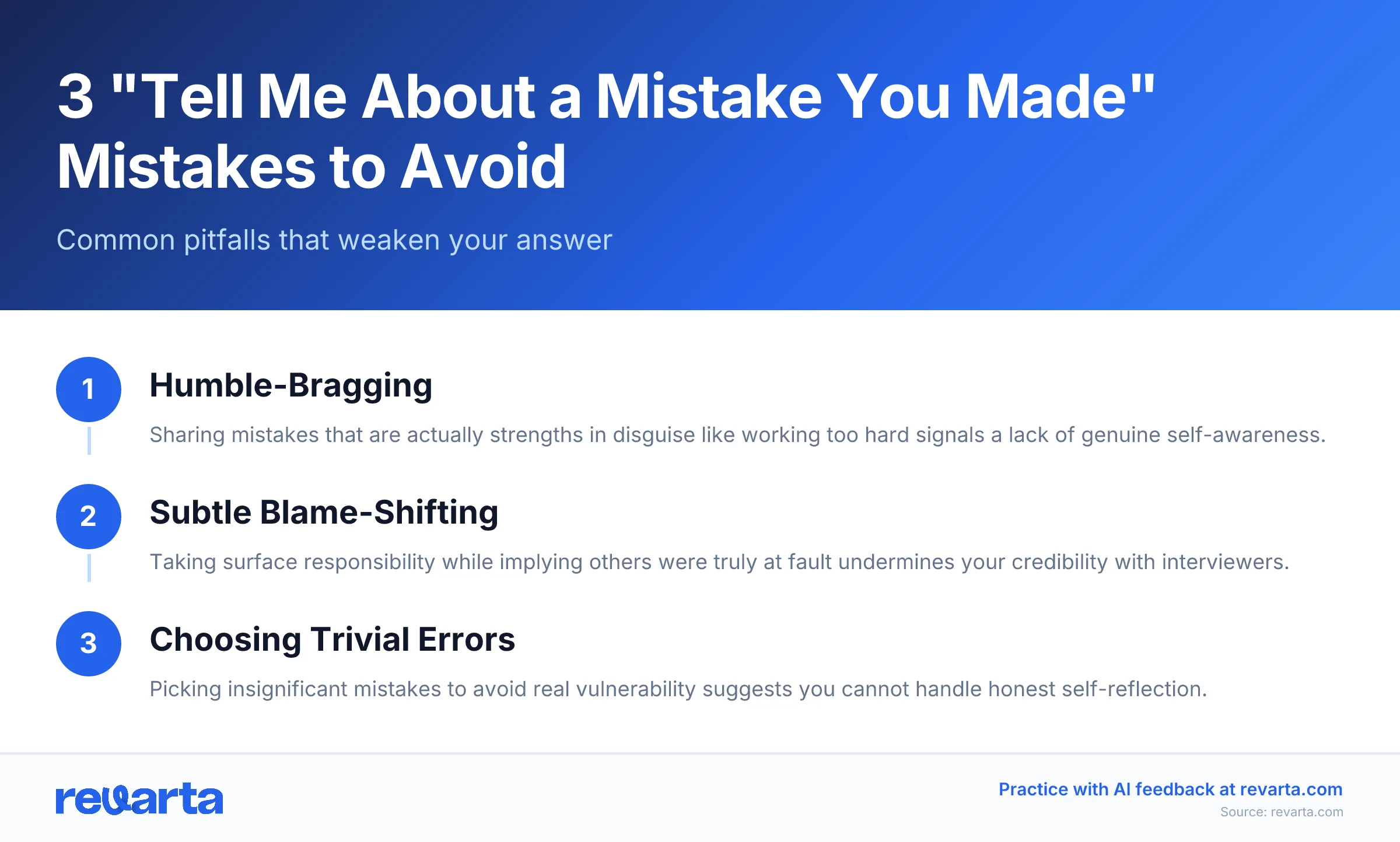
Humble-Bragging: Sharing "mistakes" that are actually strengths ("I work too hard")
Blame-Shifting: Subtle ways of suggesting others were really at fault
Minimizing: Choosing insignificant errors to avoid real vulnerability
Not Actually Wrong: Describing situational failures without owning your role
No Recovery: Describing mistakes without explaining how you fixed them
Structure Mistakes
Too Much Self-Flagellation: Dwelling on how terrible you felt
Defensive Tone: Making excuses while claiming to take responsibility
No Learning: Failing to articulate what changed in your behavior
Delivery Mistakes
Still Emotional: Getting upset or defensive when recounting the mistake
Cavalier Attitude: Treating serious mistakes too lightly
Blaming Others Through Subtext: Word choices that subtly shift responsibility
Follow-Up Questions to Prepare For
About Learning
- "What would you do differently if you faced this situation again?"
- "How has this experience affected your approach to similar situations?"
- "What's another mistake you've made and learned from?"
About Patterns
- "Do you tend to make certain types of mistakes?"
- "How do you prevent repeating mistakes?"
- "Tell me about a time you almost made a similar mistake but caught it"
About Recovery
- "How did others respond to how you handled this mistake?"
- "What was hardest about recovering from this?"
- "How long did it take to rebuild trust/credibility?"
Industry-Specific Considerations
Technology Sector
Emphasize: code errors with production impact, architectural decisions with consequences, missed technical requirements
Healthcare Industry
Focus on: process errors (not patient safety issues), communication breakdowns, administrative mistakes
Financial Services
Highlight: analysis errors, risk assessment failures, client communication mistakes (not compliance violations)
Sales/Marketing
Emphasize: campaign errors, customer mismanagement, revenue forecasting mistakes
Conclusion
Mastering mistake questions requires selecting genuinely meaningful errors, taking complete ownership without defensiveness, demonstrating thorough learning and behavioral change, and showing evidence of successful recovery. The strongest answers reveal both the humility to acknowledge imperfection and the maturity to grow from failures.
Practice mistake questions with AI feedback
Keep Preparing


