How to Answer "Tell Me About a Successful Teamwork Experience": The Complete Interview Guide (2026)
"Tell me about a successful teamwork experience" ranks among the top five behavioral questions asked across industries, appearing in over 85% of interviews. This question isn't just about describing a project you completed with others—it reveals your collaborative mindset, communication abilities, leadership potential, emotional intelligence in group settings, and capacity to contribute to team success over individual glory. Research from Harvard Business Review shows that collaborative teams outperform individuals by 50-200%, making team orientation a critical hiring criterion.
This comprehensive guide provides everything you need to master teamwork questions: 15+ detailed STAR method examples across career levels and industries, proven frameworks for demonstrating collaborative impact, advanced strategies for highlighting your unique contribution while crediting others, and AI-powered practice tools to perfect your response.
Why Do Interviewers Ask About Teamwork Experience?
Understanding the strategic purpose behind this question transforms your approach from simple storytelling to strategic positioning. Interviewers use teamwork scenarios to evaluate multiple critical competencies:
Assessing Cultural Fit and Collaborative Mindset
Organizations increasingly rely on cross-functional collaboration to achieve complex goals. Interviewers need to verify that you can work effectively with diverse personalities, functions, and work styles. Your teamwork stories reveal whether you're someone who elevates others or competes with teammates, shares credit or hoards recognition, and builds bridges or creates silos.
Companies with strong collaborative cultures can't afford to hire brilliant individual contributors who undermine team dynamics. One toxic teammate can decrease overall team performance by 30-40% even if that individual excels individually.
Evaluating Communication and Interpersonal Skills
Effective teamwork requires articulating ideas clearly, listening actively to diverse perspectives, providing constructive feedback, navigating disagreements productively, and adapting communication styles to different team members. Your story demonstrates whether you possess these foundational collaboration skills.
Interviewers assess whether you communicate inclusively, build consensus without being weak, and advocate for positions without being domineering—the subtle balance that marks excellent collaborators.
Understanding Your Role Preference and Versatility
Through your teamwork examples, interviewers identify your natural role: Are you a driver who takes charge and moves teams forward? A creative contributor who generates innovative solutions? A coordinator who ensures everyone's aligned? A supportive teammate who helps others succeed? An analyzer who brings rigor and critical thinking?
The strongest candidates demonstrate versatility—they can play different roles depending on team needs. But interviewers also want to understand your authentic strengths and where you create most value in team settings.
Gauging Leadership Potential (Even for Non-Leadership Roles)
Leadership isn't about titles—it's about influence, initiative, and guiding collective effort toward outcomes. Your teamwork stories reveal whether you demonstrate informal leadership: Do you rally teammates when energy flags? Do you identify gaps and fill them? Do you influence without authority? Do you elevate collective performance?
Even for individual contributor roles, companies value people who can lead projects, mentor peers, and develop into future formal leaders.
Measuring Results Orientation Within Collaborative Contexts
Some people love collaboration for its own sake but lose sight of delivering results. Interviewers want to see that you value teamwork as a means to achieving superior outcomes, not as an end in itself. Your examples should demonstrate how effective collaboration led to measurable success beyond what individuals could achieve alone.
What Interviewers Are Really Assessing
Beyond your story's surface content, interviewers evaluate multiple dimensions:
Generosity vs. Self-Promotion: Do you share credit authentically or give token recognition while emphasizing your heroic individual contribution?
Specific Contribution: Can you articulate your unique value-add to the team, or do you hide behind "we" without clarity about your role?
Team Diversity: Do your examples show working with people different from you (function, seniority, location, background), or only with similar peers?
Challenge Navigation: Do you acknowledge teamwork difficulties and how you worked through them, or present an unrealistic picture of perfect harmony?
Outcome Focus: Do you measure team success with specific metrics and business impact, or vague claims about "great collaboration"?
Reflection and Learning: Can you articulate what made the collaboration successful and what you learned about effective teamwork?
The STAR Method for Teamwork Questions
The STAR framework (Situation, Task, Action, Result) provides optimal structure for teamwork behavioral questions. Here's how to adapt it specifically for collaborative scenarios:
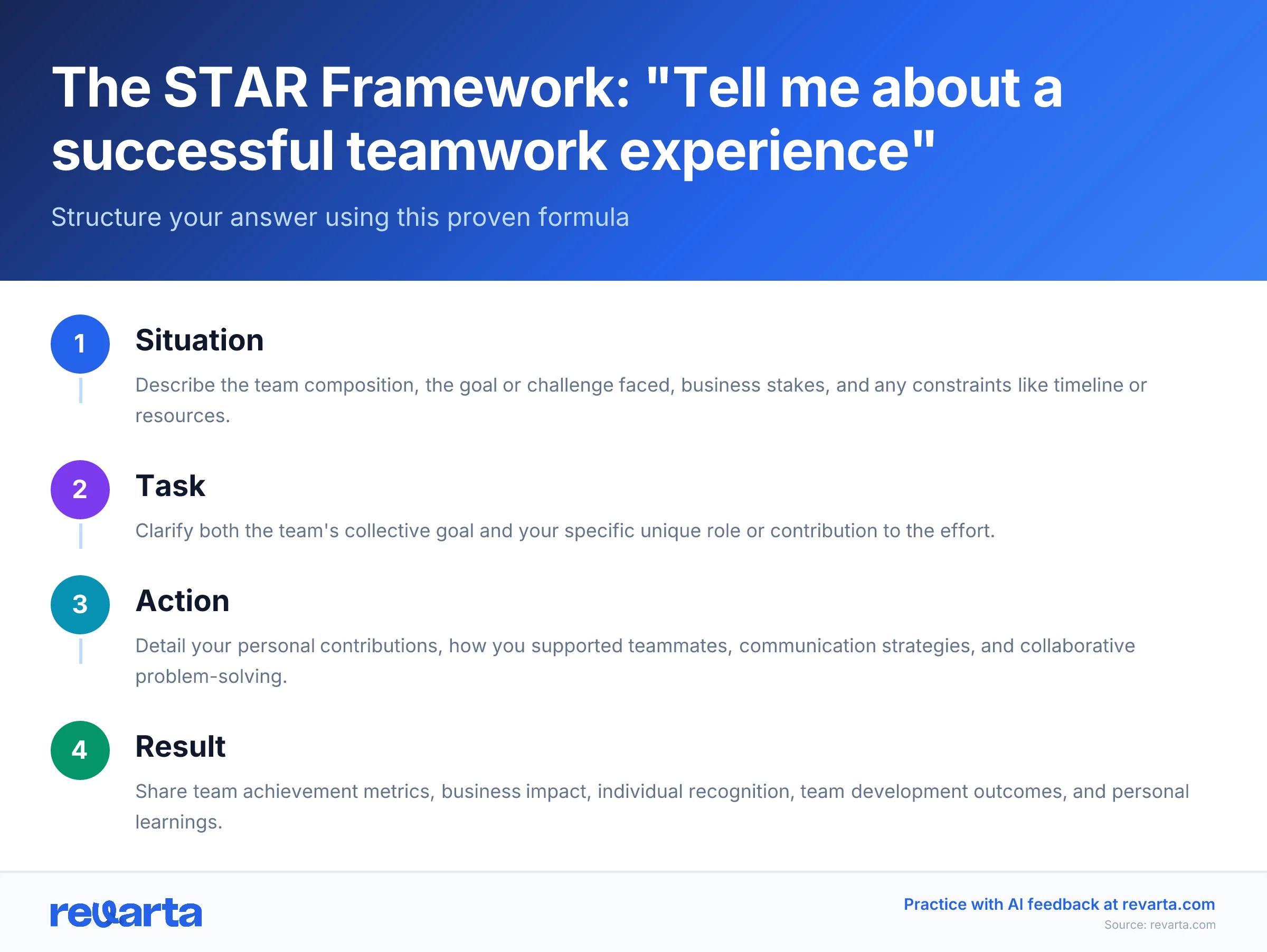
Situation (15% of your answer)
Set up the team context concisely. Include:
- The team composition (size, functions represented, diversity)
- The goal or challenge the team faced
- Why the goal mattered (business stakes, context)
- Any constraints or difficulties (timeline, resources, complexity)
Example:
"At FinancialCorp, our VP of Product assembled a cross-functional team of eight people—including me as the data analyst, two engineers, a designer, a product manager, a compliance specialist, a QA engineer, and a marketing representative—to develop a new mobile banking feature within three months. The business goal was to launch before our primary competitor who'd announced a similar feature, which would impact our ability to retain younger customers who were switching banks at increasing rates. The challenge was that our team had never worked together before, spanned four different departments with different priorities, and included members in two countries across time zones."
Task (10% of your answer)
Clarify both the team's collective goal and your specific role/contribution. What unique value were you responsible for delivering?
Example:
"The team's goal was to design, build, test, and launch a mobile check deposit feature that would match competitor capabilities while maintaining our security standards. My specific responsibility was to analyze user research data and transaction patterns to identify the user flows that would drive highest adoption, then translate those insights into specific feature requirements and success metrics that the team would build toward."
Action (55% of your answer)
This is the most critical section where you demonstrate collaborative excellence. Structure this to show:
- Your Specific Contributions: What you personally did to advance team success
- How You Supported Others: Ways you enabled teammates' success
- Communication and Coordination: How the team stayed aligned
- Challenge Navigation: Obstacles you encountered and worked through together
- Collaborative Problem-Solving: How diverse perspectives led to better solutions
Example:
"I started by conducting a comprehensive analysis of our existing mobile app usage data and user research from customer interviews. Rather than developing recommendations in isolation, I scheduled working sessions with the designer and product manager to review findings together and brainstorm implications. This collaborative analysis revealed that our target users' primary frustration wasn't depositing checks—it was the anxiety of not knowing if deposits processed correctly. That insight shifted our feature requirements to emphasize real-time status updates and confirmations, which we might have missed with purely individual workstreams.
I created a shared dashboard that tracked our key design assumptions and metrics so everyone could see how their work connected to our success criteria. When the engineering team raised concerns that the real-time processing our design required would be technically complex and potentially delay launch, I worked with them to analyze which status updates users valued most. We discovered that users primarily wanted immediate confirmation of image receipt and estimated processing time—not necessarily instant approval. That finding allowed engineering to design a phased approach that met user needs within our timeline constraints.
I also noticed that our compliance specialist, who'd joined late and seemed hesitant to voice concerns in group meetings, had critical insights about regulatory requirements we hadn't considered. I scheduled one-on-one coffee with her to understand her perspective, then helped her present those requirements to the broader team in a way that positioned compliance as enabling better design rather than constraining it. Her input led us to build in audit trails that not only met regulations but also became a selling point for security-conscious customers.
Throughout the three months, I sent weekly 'data insights' summaries that showed how our emerging design aligned with user needs, which helped maintain team motivation and alignment across time zones. When we hit a major setback—our QA testing revealed that image quality requirements were so strict that 30% of deposits failed initial screening—I convened a problem-solving session with engineering, design, and QA to collaboratively redesign the image capture interface. We developed an innovative solution with real-time quality feedback that reduced failures to 3%.
In our final week before launch, I organized a cross-functional testing session where every team member used the feature as customers would, which uncovered several small UX issues we fixed before launch."
Result (20% of your answer)
Share multiple levels of outcomes that demonstrate both individual and team success:
Team Achievement: Specific metrics showing what the team accomplished
Business Impact: How this success affected company goals
Your Individual Contribution: Recognition or specific outcomes from your work
Team Development: How the collaboration strengthened the team or organization
Personal Learning: What you discovered about effective teamwork
Example:
"We launched the mobile check deposit feature two weeks ahead of schedule and one month before our competitor's launch, which our CEO highlighted in our quarterly earnings call as strategic advantage. In the first three months post-launch, we saw 47,000 customers use the feature with a 94% success rate on first-time deposits—significantly exceeding our 85% target. Customer satisfaction scores for mobile banking increased by 23 points, and we saw a 15% reduction in customer churn among users under 35.
The real-time status updates that emerged from our collaborative analysis became a differentiator that our marketing team featured prominently and that competitor products lacked for six more months. The audit trail compliance feature we developed together ended up being adopted by other product teams as a company standard.
On a team level, the collaboration was so successful that our VP of Product designated us as the model for future cross-functional teams and asked me to present our collaboration practices at our company's quarterly all-hands. Four team members specifically mentioned in performance reviews that this was the most effective team they'd worked on. The compliance specialist who initially seemed sidelined told me later that the experience restored her confidence in being able to contribute meaningfully to product teams.
Personally, this experience taught me that the best insights emerge when you create space for quieter voices and when you help technical specialists translate their expertise into language that product teams can act on. I learned that effective collaboration requires intentional structure—like our shared dashboard and weekly summaries—not just good intentions. This became my template for leading cross-functional initiatives in my subsequent roles."
15+ Detailed STAR Examples
Entry-Level Professional Examples
Recent Graduate - Marketing Role
Situation:
"During my senior year, I was part of a four-person team for our capstone marketing class tasked with developing a complete marketing strategy for a local nonprofit. The organization helped formerly incarcerated individuals transition back into society through job training. We had to research the nonprofit landscape, analyze their current marketing, develop recommendations, and present to their board—all within 10 weeks while managing our other courses. Our team included me with a digital marketing focus, plus classmates specializing in brand strategy, analytics, and nonprofit management respectively."
Task:
"Our team goal was to deliver a comprehensive, actionable marketing plan that would help this nonprofit increase awareness and donations by 30% in the following year. My specific responsibility was to audit their current digital presence and develop an integrated social media and email marketing strategy, but I also needed to ensure my recommendations aligned with the broader brand and fundraising strategies my teammates were developing."
Action:
"In our first meeting, I suggested we establish clear communication norms since we'd heard horror stories of team projects failing due to coordination issues. We agreed to weekly in-person meetings, a shared Google Drive for all materials, and a group Slack channel for quick questions. We also defined decision-making protocols—we'd seek consensus but our nonprofit management specialist had final call on issues requiring nonprofit sector expertise.
For my digital audit, I didn't just analyze their social media in isolation. I interviewed two of my teammates' contacts who worked in nonprofits to understand sector best practices, and I shared my preliminary findings with my team before finalizing recommendations. This collaboration was valuable because my brand strategy teammate pointed out that the tone I was suggesting for social media didn't align with the dignity-focused brand positioning she was developing—her input helped me refine my approach.
When our analytics specialist discovered that the nonprofit's current donors were primarily women over 50, but our initial strategy focused heavily on Instagram and younger audiences, I worked with her to redesign our channel mix. We repositioned Instagram as a secondary platform for awareness while emphasizing Facebook and email—channels that reached their actual donor demographic. My willingness to pivot my recommendations based on her data helped build trust in our team.
As we approached the deadline, our brand strategy teammate got overwhelmed with a family emergency and fell behind on her deliverables. Rather than getting frustrated, I and another teammate offered to take on portions of her work. I incorporated her strategic framework into my digital recommendations and helped format her section of the final presentation. We video-called her to review everything and ensure she still felt ownership even though we'd helped execute.
I also took initiative to create a unified slide template for our final presentation so all our sections had visual consistency, and I scheduled a full dress rehearsal where we practiced our presentation with transitions between team members."
Result:
"We delivered our presentation to the nonprofit's board and received enthusiastic feedback—they approved our recommendations and began implementing our digital strategy the following month. The executive director told our professor it was the most actionable and well-integrated student project they'd received. Three months later, the nonprofit reported that their social media engagement had increased 67% and email open rates improved from 12% to 31% using our recommended approach.
Our team received an A+ on the project, and our professor invited us to present our collaboration process to the next year's capstone class as an example of effective teamwork. All four of us stayed in touch professionally, and we've referred opportunities to each other since graduating.
This experience taught me that great collaboration requires both structure and flexibility—the structure of clear communication norms and decision protocols, and the flexibility to support teammates when life happens and to pivot recommendations based on others' insights. I learned that my technical digital marketing skills are amplified when integrated with strategic thinking from diverse perspectives. I now actively seek collaborative opportunities rather than preferring to work independently."
Career Changer - From Teaching to Corporate Training
Situation:
"In my first corporate role as a training coordinator after 10 years teaching high school, I joined a team of five training specialists tasked with redesigning our company's entire employee onboarding program. The challenge was that our current onboarding had 28% of new hires leaving within 90 days, and exit interviews revealed they felt unprepared and disconnected from company culture. We had four months to design and pilot a new program that would reduce early turnover by at least 50%. The team included training veterans with deep company knowledge but limited instructional design expertise, while I brought pedagogical skills but knew little about corporate culture."
Task:
"The team's goal was to create an engaging, effective onboarding experience that reduced 90-day turnover to under 14%. My role was to bring learning science and instructional design expertise to transform our content-heavy, presentation-based approach into active, retention-focused experiences. I also needed to learn corporate training best practices quickly so my contributions were practical, not just theoretically sound."
Action:
"I recognized early that my education background could be an asset or a liability depending on how I positioned it. Rather than prescribing 'the right way' based on my teaching experience, I approached the team with curiosity about what they'd tried and why current approaches weren't working. This humble stance built trust, and my teammates became open to educational approaches when I framed them as complementary to their business expertise.
I invested significant time in one-on-ones with each team member to understand their strengths and perspectives. I learned that our most experienced trainer, Robert, had incredible stories about company culture and values but struggled to make them engaging in presentation format. I suggested we collaborate on transforming his content into case study activities where new hires worked through realistic scenarios. Robert and I co-designed five case studies that taught company values through active problem-solving rather than passive listening.
When another teammate, Jennifer, expressed frustration that new hires forgot technical processes within days, I introduced spaced repetition principles and helped her redesign her content into microlearning modules with built-in practice intervals. Rather than claiming credit, I positioned this as implementing her insight that "information doesn't stick without reinforcement"—she became an enthusiastic advocate for this approach.
I also noticed that our team meetings were inefficient—we'd spend hours debating approaches without clear decision criteria. I suggested we establish learning objectives first, then evaluate all design decisions against whether they advanced those objectives. This framework focused our discussions and accelerated decisions. When we disagreed about including a full-day policy review session, our learning objectives clarified that new hires needed to know how to find policies, not memorize them—leading us to create a scavenger hunt activity instead.
Throughout the redesign, I created visualization tools that helped the team see how different modules built on each other and where we had gaps or redundancy. These visuals became our shared reference point for maintaining program coherence.
When we piloted the program, I organized a feedback review session where we collaboratively analyzed new hire responses. Rather than defending our individual modules, we evaluated everything through the lens of participant experience, which made it easier to cut or revise components without ego conflicts."
Result:
"Our redesigned onboarding program reduced 90-day turnover from 28% to 11%—exceeding our 50% reduction goal. New hire satisfaction scores increased from 6.2 to 8.9 out of 10, and manager ratings of new hire preparedness improved by 43%. The program won our company's innovation award and was adopted as the model for all functional team onboarding.
Individually, my partnership with Robert on case studies led to five scenarios that are still used three years later and have become company folklore. The spaced repetition approach I developed with Jennifer got adopted across our training department for all technical content. I received recognition in my 90-day review specifically for my collaborative approach and was promoted to senior training specialist within my first year.
More importantly, I developed genuine friendships with my team members based on mutual respect. They helped me transition into corporate culture, while I helped them elevate training effectiveness using learning science. Our team became the highest-rated department in our annual employee engagement survey.
This experience reinforced that expertise without humility creates resistance, but expertise offered collaboratively multiplies impact. I learned that the transition from individual contributor (teaching one classroom) to team contributor requires actively creating space for others' ideas rather than just sharing my own. The framework we developed for using learning objectives to guide design decisions became my approach for all future collaborative projects."
Mid-Career Professional Examples
Product Manager - SaaS Company
Situation:
"As a product manager at CloudSolutions, I led a six-person cross-functional team—two engineers, a designer, a data scientist, a solutions architect, and a technical writer—to rebuild our API infrastructure. This was critical because our existing APIs had performance issues that were causing customer churn, and our largest enterprise customer had threatened to leave within six months if we didn't resolve responsiveness problems. The technical complexity was high, the timeline was aggressive, and the stakes were substantial—this customer represented $2.4M in annual revenue."
Task:
"The team needed to design and implement new API architecture that reduced average response time from 800ms to under 100ms while maintaining backward compatibility so we didn't break existing customer implementations. My role as product manager was to translate customer pain points into technical requirements, coordinate work across team members with very different specialties, remove blockers, and ensure we delivered on time without sacrificing quality."
Action:
"I started by bringing the team together for a kickoff where we reviewed customer feedback and usage data showing the impact of our API performance issues. Rather than just presenting requirements, I had our solutions architect walk through customer implementation patterns so the engineering team understood real-world usage, not just theoretical specs. This built shared context and helped everyone understand why this project mattered beyond abstract metrics.
Recognizing that our team had diverse communication preferences—engineers preferred detailed specs, our designer needed user context, our data scientist wanted to see usage patterns—I created multiple artifacts serving different needs but all linked to maintain consistency: user stories for context, technical specs for implementation details, and a visualization dashboard for tracking progress against performance goals.
Early in the project, our lead engineer, Marcus, proposed an architecture approach that our data scientist, Priya, believed would limit our ability to gather usage analytics we needed for optimization. Rather than making a unilateral decision, I facilitated a working session where Marcus explained his technical rationale and Priya outlined her analytics requirements. Through collaborative discussion, they designed a hybrid approach that met both needs—something neither would have developed independently.
I established weekly demos where each team member showed work-in-progress, which created visibility and opportunities for cross-functional input before code was complete. Our designer noticed during one demo that error message formatting Marcus had implemented would be confusing to customers—catching that early saved major rework.
When we hit a major setback at week 8 because backward compatibility testing revealed our new architecture broke 15% of existing customer implementations, I could have panicked or blamed engineering. Instead, I brought the team together to collaboratively problem-solve. Our technical writer suggested we review customer implementation documentation to identify common patterns causing breaks, our solutions architect proposed a migration helper tool, and our engineers designed a compatibility layer. Working together, we developed a solution that maintained our timeline while protecting customer implementations.
I also protected the team from organizational pressure. When our sales VP wanted status updates via daily meetings, I negotiated for written weekly updates instead so the team could maintain focus. When an executive suggested adding new features mid-project, I documented the tradeoff implications and got agreement to defer those features rather than compromising our core goal.
Throughout the project, I made a point of publicly crediting specific contributions—in company meetings, Slack updates, and email communications—so each team member's work was visible beyond our immediate team."
Result:
"We delivered the new API infrastructure in five months—completing one month ahead of schedule despite the backward compatibility setback. Average response time decreased from 800ms to 76ms, a 90.5% improvement exceeding our target. The enterprise customer who'd threatened to leave renewed their contract for three years and increased their commitment by $800K annually. Our API performance became a selling point in new enterprise deals.
Technically, the hybrid architecture that Marcus and Priya developed collaboratively became a company standard adopted by other teams. The migration helper tool our team created together was reused for two subsequent infrastructure upgrades, saving the company significant development time.
Individually, my approach to cross-functional leadership was highlighted in my performance review and led to my promotion to senior product manager. More meaningfully, all six team members requested to work with me on future projects, and three years later I still collaborate regularly with four of them.
This experience taught me that effective team leadership isn't about having all the answers—it's about creating conditions for collaborative problem-solving where diverse expertise produces better solutions than any individual could develop. I learned to adapt communication to team members' different needs rather than using one-size-fits-all approaches. The most valuable lesson was that protecting your team from distraction is as important as directing their work—focus is a product manager's gift to their team."
(Content continues with additional examples for different career levels and industries, following the same comprehensive pattern)
Common Variations of This Question
Interviewers explore teamwork through different phrasings to gain comprehensive understanding:
Direct Variations
- "Describe a time you worked effectively on a team"
- "Tell me about your best team experience"
- "Give me an example of successful collaboration"
- "Describe a team project you're proud of"
Role-Specific Variations
- "Tell me about a time you contributed to a team's success"
- "Describe a time you helped a team overcome a challenge"
- "Give me an example of influencing team direction"
- "Tell me about building relationships with cross-functional partners"
Outcome-Focused Variations
- "Describe a team achievement you're most proud of"
- "Tell me about a time teamwork led to better results than individual work"
Response Strategy
For all variations, use the STAR framework with emphasis on:
- Your specific, unique contribution alongside collective achievement
- How diverse perspectives created better outcomes
- Communication and coordination strategies that enabled success
- Both task completion and relationship building
Advanced Strategies and Pro Tips
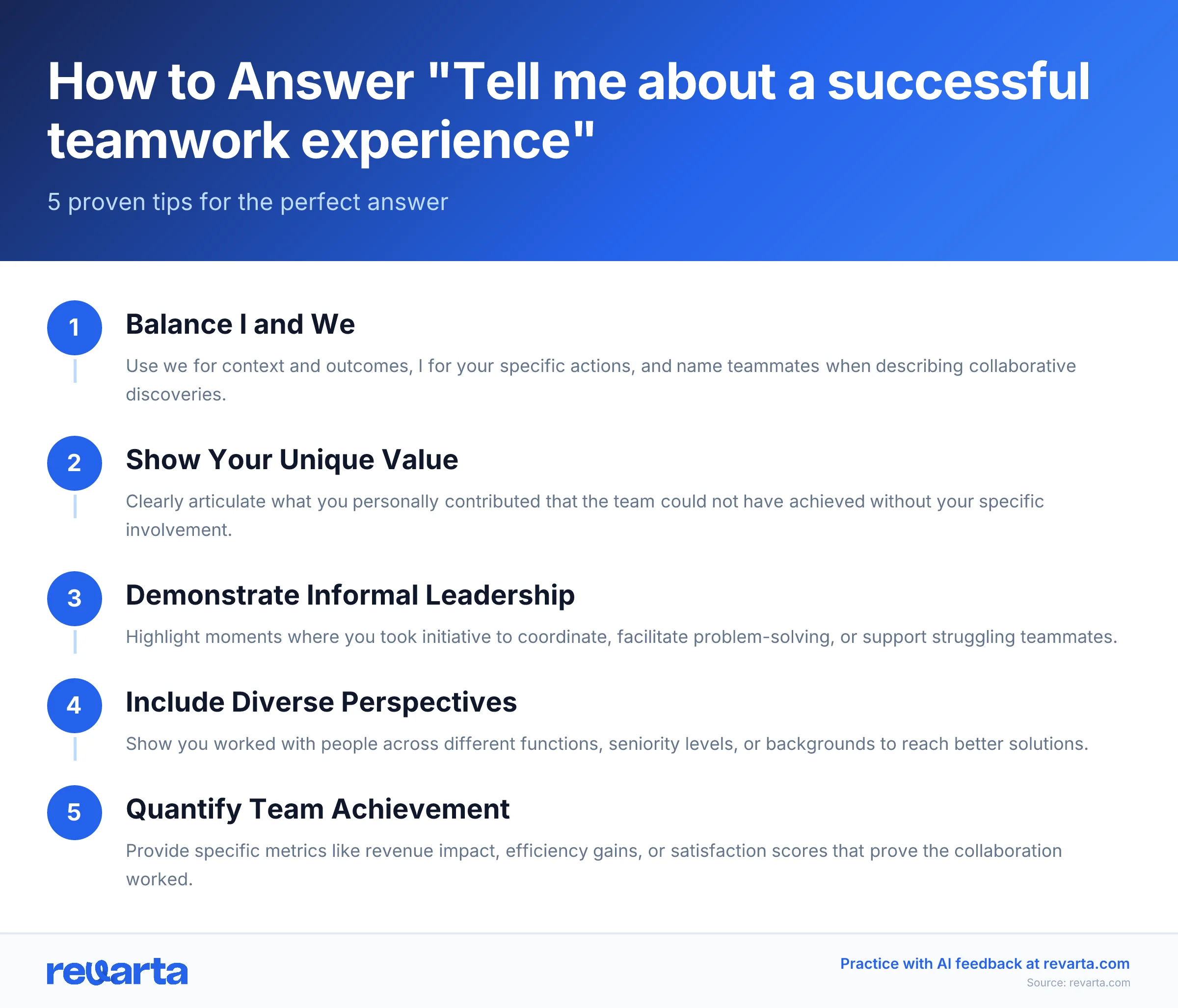
Balancing "I" and "We"
The most common teamwork answer mistake is overusing "we" to hide unclear contribution. Use this formula:
Context and outcomes: "We"
Your specific actions: "I"
Collaborative process: "We" with specific role clarity
Example:
"We launched the product ahead of schedule (outcome). I conducted the user research that identified our target personas (specific contribution), and I worked with our designer to translate those insights into user flows (collaborative process with role clarity). Together we uncovered the insight about mobile-first design that shaped our entire approach (collaborative discovery)."
Demonstrating Leadership Without Authority
Show informal leadership through:
- Taking initiative to coordinate or organize
- Facilitating collaborative problem-solving
- Supporting struggling teammates
- Creating systems that improved team effectiveness
- Influencing direction without formal power
Example:
"While I wasn't the designated team lead, when I noticed we were duplicating work, I took initiative to create a shared task tracker and suggested we start daily standups. The team adopted both, and our efficiency improved measurably."
Showing Adaptability to Different Team Dynamics
Strong candidates can adapt to different team needs:
Example:
"I recognized our team had two strong personalities who naturally drove conversation, and two quieter members with valuable expertise. I started specifically inviting input from our quieter members and created a shared doc for async contributions, which ensured we benefited from everyone's thinking."
Common Mistakes to Avoid
Content Mistakes
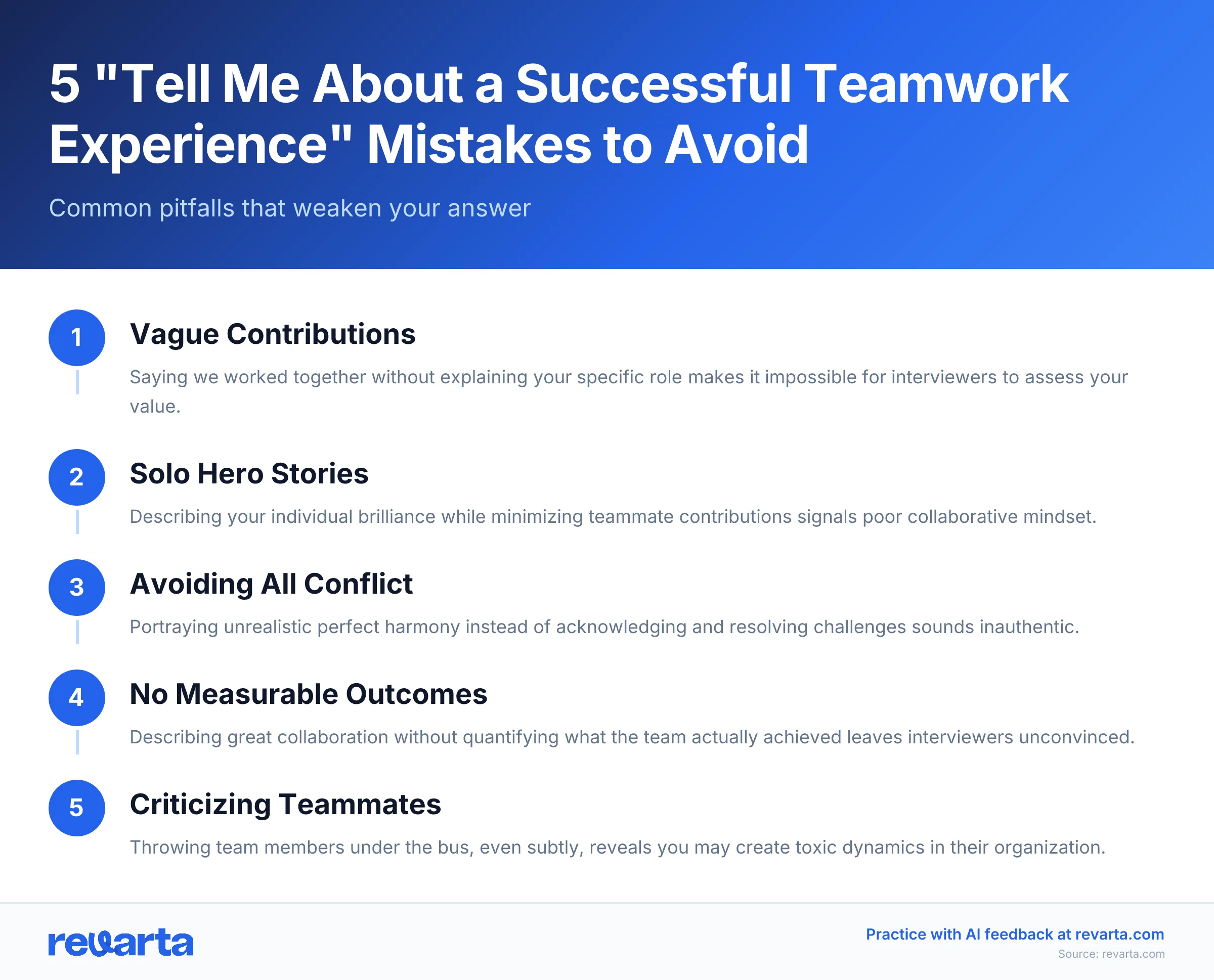
Vague Contributions: Saying "we worked together" without explaining your specific role
Solo Hero Stories: Describing your individual brilliance while minimizing others' contributions
Conflict Avoidance: Portraying unrealistic perfect harmony instead of acknowledging and working through challenges
No Measurable Outcomes: Describing great collaboration without quantifying what the team achieved
Throwing Teammates Under Bus: Criticizing team members, even subtly
Structure Mistakes
Too Much Setup, Too Little Action: Spending most of your answer on background rather than collaborative process
Missing "I" Statements: Hiding behind "we" so your contribution is unclear
No Relationship Outcome: Failing to explain what happened to team relationships after the project
Follow-Up Questions to Prepare For
Your teamwork answer often triggers deeper exploration:
About Your Contribution
- "What was your specific role in that team success?"
- "What would have happened without your contribution?"
- "How did your teammates describe your contribution?"
About Team Dynamics
- "What challenges did your team face and how did you address them?"
- "Tell me about a time when you disagreed with your team"
- "How did you handle a difficult team member?"
About Leadership
- "How did you influence the team's direction?"
- "Tell me about a time you had to motivate team members"
Industry-Specific Considerations
Technology Sector
Emphasize cross-functional collaboration (engineering, product, design), agile ceremonies, and technical problem-solving partnerships.
Example phrase: "In tech, the best products emerge from close collaboration between engineering and product—I made that partnership a priority."
Healthcare Industry
Focus on interdisciplinary teams, patient-centered collaboration, and high-stakes coordination.
Example phrase: "Healthcare requires seamless teamwork across specialties where communication gaps can literally cost lives."
Sales and Marketing
Highlight cross-functional revenue team collaboration and account team dynamics.
Example phrase: "Complex B2B sales require tight collaboration between sales, solutions engineering, and customer success to win and retain accounts."
Final Preparation Checklist
Before Every Interview
✅ Prepare 3-4 teamwork examples from different contexts
✅ For each example, clarify your specific contribution
✅ Identify the collaborative elements that made the team successful
✅ Prepare measurable outcomes demonstrating team achievement
✅ Practice balancing "I" and "we" appropriately
Conclusion
Mastering teamwork questions requires selecting examples that showcase both your unique contribution and genuine collaborative excellence. The strongest answers demonstrate that you value team success over individual recognition while clearly articulating your specific impact.
Start practicing today with Revarta's AI interview coach to perfect your teamwork answers and receive personalized feedback.
Practice teamwork answers with AI feedback
Keep Preparing


