How to Answer "Tell Me About a Time You Adapted to Change": The Complete Interview Guide (2026)
"Tell me about a time you adapted to change" appears in over 85% of behavioral interviews across all industries, particularly in fast-paced sectors experiencing rapid transformation. This question isn't just about handling disruption—it reveals your resilience, growth mindset, learning agility, emotional regulation during uncertainty, and capacity to maintain performance when circumstances shift unexpectedly. Research from McKinsey shows that adaptability is the #1 predictor of success in volatile business environments, with adaptive employees 2.5x more likely to be high performers during organizational change.
This comprehensive guide provides everything you need to master change adaptation questions: 15+ detailed STAR method examples across career stages and industries, proven frameworks for demonstrating learning agility, advanced strategies for showcasing resilience, and AI-powered practice tools to perfect your response.
Why Do Interviewers Ask About Adapting to Change?
Understanding the strategic purpose behind this question transforms your approach from defensive survival stories to compelling demonstrations of professional agility. Interviewers use change scenarios to evaluate critical workplace competencies:
Assessing Learning Agility and Growth Mindset
The modern workplace evolves constantly—new technologies, shifting strategies, organizational restructuring, market disruptions, and evolving customer needs create continuous change. Interviewers need to verify that you view change as an opportunity for growth rather than a threat to stability. Your response reveals whether you're a continuous learner who embraces new approaches or someone who resists deviation from familiar patterns.
Employees with fixed mindsets struggle when their established expertise becomes less relevant, while those with growth mindsets thrive by rapidly acquiring new capabilities. This distinction predicts long-term career trajectory and organizational value.
Evaluating Emotional Intelligence and Resilience
Change triggers stress, uncertainty, and often fear—emotions that can derail performance if not managed effectively. Interviewers assess whether you can regulate emotional responses during transitions, maintain professional composure despite discomfort, support others experiencing change anxiety, and channel nervous energy into productive adaptation rather than resistance or paralysis.
Your change story reveals your emotional maturity and whether you'll be a stabilizing force or additional source of drama during organizational transitions.
Understanding Your Relationship with Uncertainty
Some roles and organizations operate in highly stable, predictable environments; others thrive in constant flux. Interviewers want to understand whether you're energized or depleted by ambiguity and change. Do you need clear structures and established processes to perform well, or can you maintain effectiveness when the path forward isn't obvious?
This helps them assess cultural fit—a candidate who needs predictability will struggle at a startup experiencing rapid pivots, while someone who craves variety may become bored in stable corporate environments.
Measuring Problem-Solving Under New Constraints
Change often invalidates previous approaches, requiring creative problem-solving within unfamiliar constraints. Your adaptation story demonstrates whether you can think on your feet, transfer knowledge from previous contexts to new situations, identify what skills and knowledge remain relevant when circumstances shift, and develop new capabilities quickly when existing ones don't suffice.
This reveals cognitive flexibility—the ability to hold multiple mental models and switch between them as situations require.
Gauging Initiative and Proactive Mindset
Some people wait for others to direct them through change; high performers proactively navigate transitions and often lead others through uncertainty. Interviewers assess whether you take ownership of your adaptation journey, anticipate change implications before they become crises, help others adapt alongside you, and view change as something you can influence rather than something that happens to you.
This distinction separates passive responders from active change agents.
What Interviewers Are Really Assessing
Beyond your story's surface content, interviewers evaluate multiple dimensions of your response:
Change Magnitude: Did you face genuinely significant change, or are you inflating a minor adjustment? Major organizational restructuring, technology platform migrations, and business model pivots demonstrate adaptation better than small process tweaks.
Initial Reaction: Do you acknowledge the difficulty of change honestly, or pretend transitions are effortless? Authenticity about initial challenges followed by effective adaptation is more credible than claiming you welcomed disruption immediately.
Learning Process: Can you articulate how you acquired new knowledge and skills during transition, or do you skip over the learning journey?
Outcome Quality: Did you merely survive the change, or did you actually thrive and produce excellent results in the new environment?
Perspective on Change: Do you frame change as something that happened to you (victim mentality) or something you navigated actively (ownership mentality)?
Sustained Impact: Did your adaptation have lasting effects on your capabilities, or did you revert to old patterns once circumstances stabilized?
The STAR Method for Change Adaptation Questions
The STAR framework (Situation, Task, Action, Result) provides optimal structure for behavioral change questions. Here's how to adapt it specifically for adaptation scenarios:
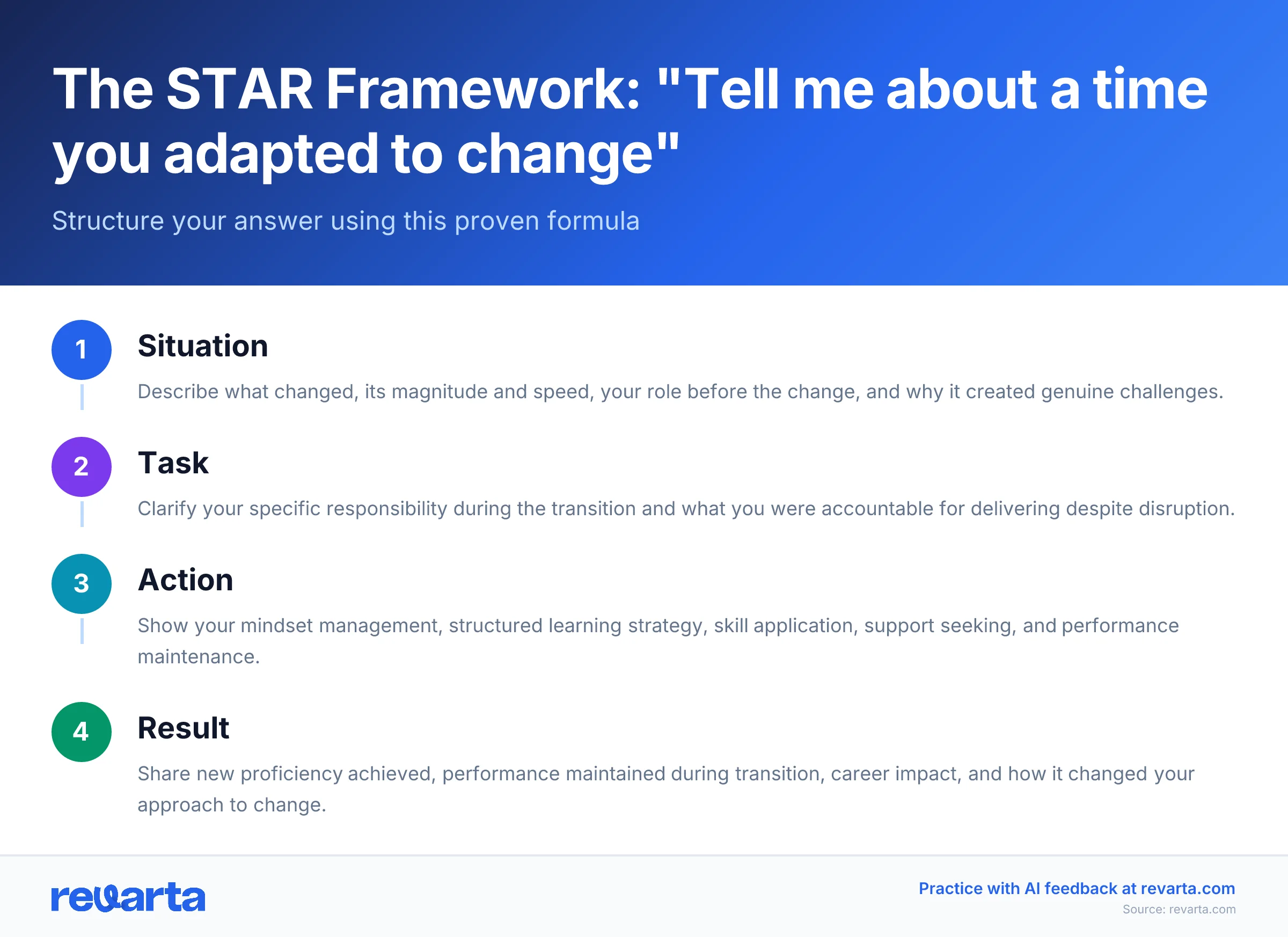
Situation (20% of your answer)
Set up the change context to establish genuine significance. Include:
- What changed and why (organizational trigger, market shift, technology evolution)
- The magnitude and speed of change
- Your initial role and responsibilities before the change
- Why the change created challenges (what skills/knowledge became less relevant)
Example:
"I joined DataAnalytics Corp as a senior analyst specializing in SQL and traditional data warehousing, building my expertise over five years with our Oracle-based systems. Eighteen months into my tenure, our new CTO announced we'd migrate our entire data infrastructure to a cloud-based platform using Python, AWS, and modern data pipeline tools within six months. This was a massive shift—my core technical skills that had made me successful were suddenly becoming less relevant, and I'd need to master an entirely new technology stack quickly. The challenge wasn't just learning new tools—it was doing so while maintaining my current analytical responsibilities and supporting my team through the transition. Several colleagues with similar tenure responded by resisting the change or starting to job search, viewing this as threatening to their careers."
Task (10% of your answer)
Clarify your specific responsibility during this transition. What were you accountable for achieving despite the change?
Example:
"My responsibility was twofold: First, I needed to maintain my analytical deliverables and client relationships during the transition without letting quality slip. Second, I needed to develop proficiency in the new technology stack quickly enough to remain a senior contributor rather than falling behind more junior colleagues who had cloud experience. Beyond my individual adaptation, as one of the senior team members, I was expected to help model productive transition behavior for others on the team."
Action (55% of your answer)
This is the most critical section where you demonstrate adaptive excellence. Structure this to show your adaptation process:
- Initial Mindset and Emotional Management: How you processed the change psychologically
- Learning Strategy: Your approach to acquiring new knowledge and skills
- Application and Practice: How you translated learning into capability
- Seeking Support: Who you leveraged for help and guidance
- Maintaining Performance: How you balanced learning with delivering results
- Supporting Others: Ways you helped teammates adapt alongside you
Example:
"My initial reaction was honestly anxiety—I'd spent years building Oracle expertise and worried that starting over technically would set my career back. But I recognized that resistance would only make things worse, so I made a conscious decision to view this as a growth opportunity. I told myself, 'I successfully learned complex systems before; I can do it again.'
I created a structured learning plan rather than approaching this haphazardly. I identified that I needed three layers of capability: conceptual understanding of cloud architecture, hands-on proficiency with Python and AWS tools, and practical experience building actual data pipelines. I allocated specific time blocks—7-9am daily before work started and Friday afternoons—dedicated exclusively to learning, treating these as non-negotiable appointments.
For conceptual knowledge, I took two online courses on cloud data architecture and AWS fundamentals. Rather than passively watching videos, I took detailed notes and built a personal reference wiki documenting concepts I'd need to apply. For hands-on skills, I set up a personal AWS sandbox environment where I rebuilt some of my existing Oracle analyses using the new stack. This learning-by-doing approach accelerated my understanding far more than theoretical study alone.
I also leveraged people resources strategically. I identified two junior colleagues who had cloud experience and asked if they'd be willing to do informal pair programming sessions with me weekly. In exchange, I shared my deep analytical domain knowledge that they lacked. This created mutually beneficial learning partnerships. I also joined an external Python user group that met monthly, which gave me access to expertise beyond our organization.
Critically, I didn't hide my learning process—I was transparent with my manager about what I didn't know yet and what I was doing to close gaps. This honesty built trust rather than exposing weakness. When I encountered obstacles in the new environment, I'd say 'I haven't figured out how to do X in AWS yet, but I'm researching it and will have an approach by Thursday' rather than pretending I knew things I didn't.
To maintain my analytical output during this learning period, I batched my work strategically—I handled urgent requests using my existing Oracle knowledge while the systems ran in parallel, and I took on new projects as opportunities to apply emerging AWS skills. My first cloud-based project was messy and took longer than my Oracle work would have, but I treated it as a learning investment.
I also created resources to help my teammates. As I learned new approaches, I documented them in our team wiki with step-by-step guides. I started a weekly 'lunch and learn' series where those of us learning the new stack shared what we'd discovered. This created collaborative learning momentum and helped combat the isolation some colleagues felt during the transition.
When I struggled with imposter syndrome—there were moments I felt incompetent compared to my former expertise level—I reminded myself that discomfort meant I was growing and that everyone feels awkward learning new skills. I focused on progress rather than perfection, celebrating small wins like successfully deploying my first Lambda function."
Result (15% of your answer)
Share multiple levels of outcomes demonstrating successful adaptation:
Technical Capability: What proficiency did you ultimately achieve?
Performance Maintenance: Did you keep delivering results during transition?
Career Impact: How did successful adaptation affect your professional trajectory?
Organizational Contribution: Did you help others adapt or contribute to change success?
Personal Growth: How did this experience change your relationship with change going forward?
Example:
"Within four months, I'd developed strong proficiency with Python, AWS, and modern data pipeline tools—enough to deliver cloud-based analyses matching the quality of my Oracle work but with significantly better performance and scalability. My first major cloud project—rebuilding our customer segmentation analysis—ran 10x faster than the Oracle version and automated processes that previously required manual intervention.
Rather than falling behind technically, I became one of our team's go-to resources for the new stack. My manager assigned me to mentor three colleagues struggling with the transition because I'd documented my learning journey and could empathize with their challenges. Six months after the migration, I was promoted to lead analyst specifically because I'd demonstrated adaptability and leadership during the change.
The learning infrastructure I'd created—the documentation wiki and lunch-and-learn series—became permanent team resources used by all new hires. Our team's transition was completed ahead of schedule, and we had higher adoption rates and lower attrition than other departments undergoing similar changes.
Personally, this experience fundamentally changed my relationship with change. I went from viewing technical disruption as threatening to seeing it as opportunity. When our company later adopted a new BI platform, I volunteered to be an early adopter rather than waiting to be forced. I now actively seek technologies and approaches outside my comfort zone because I've proven to myself that I can learn anything with the right strategy and effort.
This experience taught me that adaptation isn't about instantly loving change—it's about managing your mindset, creating structured learning approaches, leveraging community, and maintaining performance while building new capabilities. The emotional management piece was as important as the technical learning. I now apply this same framework whenever I face significant change: acknowledge the discomfort, create a learning plan, seek support, document progress, and help others adapt alongside me."
15+ Detailed STAR Examples Across Industries
Entry-Level Professional Examples
Recent Graduate - Marketing Coordinator
Situation:
"I joined TechStartup as a marketing coordinator three months after graduating with a marketing degree focused on traditional advertising and brand management. Two weeks into my role, our CMO left unexpectedly, and our CEO announced we'd pivot from B2B to B2C marketing and rebuild our entire marketing approach around growth hacking, viral marketing, and performance-driven digital tactics. This was jarring because everything I'd learned in school about long-term brand building and traditional marketing funnels suddenly didn't apply. The company needed fast customer acquisition results, not the thoughtful brand campaigns I'd been trained to create. Several colleagues with more experience than me struggled with this shift and eventually left, viewing it as misaligned with their expertise."
Task:
"As the most junior marketer, I needed to quickly develop competency in growth marketing approaches I'd never studied—A/B testing, viral loop design, conversion rate optimization, data analytics for marketing—while delivering actual results that contributed to our customer acquisition goals. I couldn't afford to have a long learning curve given my junior status and the company's urgency."
Action:
"I immediately recognized this was a sink-or-swim moment that would define my early career. Rather than mourning the traditional marketing role I'd expected, I decided to embrace becoming a growth marketer.
I started by consuming growth marketing content intensively—I listened to podcasts during my commute, read case studies during lunch, and took evening courses on A/B testing and conversion optimization. But I knew theoretical knowledge wasn't enough; I needed practical application.
I volunteered to own our email marketing experiments, an area no one else wanted because our email list was small. This gave me a sandbox to practice growth marketing principles. I designed A/B tests on subject lines, send times, and content formats, meticulously tracking open rates, click rates, and conversions. My first experiments mostly failed, but each failure taught me something—I learned that our audience responded better to data-driven insights than emotional appeals, that Tuesday mornings outperformed Friday afternoons by 3x, and that plain-text emails converted better than designed HTML templates.
I documented every experiment in a shared spreadsheet with hypotheses, results, and learnings. This transparency showed my manager I was learning systematically, not just randomly trying things. Within six weeks, my email experiments had improved our email-to-trial conversion rate from 2% to 7%, which got leadership attention.
I also formed a learning partnership with our junior developer, trading growth marketing strategy insights for his help setting up analytics tracking and understanding our conversion funnel data. This collaboration accelerated both our learning.
When I felt overwhelmed by the gap between my traditional training and growth marketing needs, I reframed it: my marketing fundamentals around understanding customer psychology and crafting compelling messages were still valuable—I just needed to apply them in new channels with faster feedback loops. This mindset shift reduced my anxiety."
Result:
"Within four months, I'd transformed from traditional marketer to competent growth marketer. My email programs became our highest-performing acquisition channel, generating 35% of new trials. I expanded from email to managing our landing page optimization, where I increased conversion rates by 42% through systematic testing.
My successful adaptation led to a promotion to Growth Marketing Manager within my first year—unusual for someone so junior. I hired and mentored two coordinators, teaching them the growth marketing approaches I'd learned. Our CEO specifically cited my adaptability in our board meeting as an example of the team culture he wanted.
This experience taught me that career success isn't about clinging to what you already know—it's about rapidly acquiring new capabilities when circumstances demand it. I learned that structured experimentation with documentation accelerates learning more than passive study. Most importantly, I discovered that I actually thrive in environments requiring continuous adaptation rather than stable specialty application. This self-knowledge has guided my career choices since—I specifically seek dynamic environments where I'll need to keep evolving."
Career Changer - From Hospitality to Healthcare Administration
Situation:
"After 12 years managing hotel operations, I transitioned to healthcare as an administrative coordinator at a medical clinic, excited to apply my operations skills to more meaningful work. Three months after I started, the COVID-19 pandemic hit and everything about healthcare delivery changed overnight. We transitioned from 100% in-person visits to primarily telehealth within two weeks. Our entire operational model—scheduling systems, patient check-in processes, insurance verification, provider workflows—all had to be reinvented instantly. This was especially challenging for me because I was simultaneously learning healthcare operations for the first time while those operations were being completely disrupted. I had no 'normal' baseline to understand what we were changing from."
Task:
"My responsibility was to redesign our patient scheduling and check-in processes for telehealth delivery while learning healthcare compliance requirements, insurance procedures, and medical terminology I didn't know yet. I needed to do this while supporting 12 providers and handling 150+ daily patient appointments that couldn't be delayed despite the chaos."
Action:
"The first week was overwhelming—I felt like I'd made a terrible career decision timing-wise. But I realized I couldn't change the circumstances, only my response to them. I decided to leverage my hospitality operations experience as an asset rather than viewing my healthcare inexperience as a liability.
In hospitality, I'd managed numerous operational pivots—renovations, system implementations, event crises—so I had a mental framework for navigating rapid change that many of my healthcare-tenured colleagues lacked. I approached telehealth transition the way I'd approached hotel renovations: identify what absolutely must work for customers (patients), design the minimum viable process, implement quickly, and iterate based on feedback.
I spent my first weekend researching telehealth platforms, HIPAA compliance for virtual visits, and best practices emerging from clinics that had implemented earlier. I created a comparison matrix of three telehealth platforms and presented recommendations to our medical director Monday morning, which accelerated our decision-making.
For patient processes, I mapped the traditional in-person journey and identified which elements needed to happen differently in telehealth. I created new workflow documents with step-by-step procedures and conducted 15-minute training sessions with each provider individually, adapting my explanations to their different tech comfort levels. My hospitality background in customer service training made me effective at this internal training role.
I also leveraged my outsider perspective as an advantage. Because I didn't have ingrained assumptions about 'how healthcare works,' I questioned processes that seemed inefficient. For example, our traditional scheduling system required patients to call during business hours, which created bottlenecks. I proposed implementing online self-scheduling for telehealth appointments, which several veteran staff resisted as 'not how we do things in healthcare.' I built a pilot using free tools to demonstrate feasibility, and when patient satisfaction scores jumped, we implemented fully.
When I encountered healthcare-specific knowledge gaps—like insurance authorization requirements for telehealth—I wasn't shy about asking colleagues to explain. I framed questions as 'Help me understand healthcare norms so I can design better processes' rather than apologizing for not knowing. Most colleagues appreciated being positioned as experts.
I maintained a daily changelog documenting what we tried, what worked, and what needed adjustment. This became our institutional memory during the chaos and helped us stabilize processes faster."
Result:
"Within one month, we'd successfully transitioned 85% of visits to telehealth with patient satisfaction scores of 4.6/5—higher than our pre-pandemic in-person scores. Our appointment no-show rate actually decreased from 12% to 6% because telehealth removed transportation barriers.
The online self-scheduling system I implemented became permanent and expanded to in-person appointments post-pandemic, reducing our front desk call volume by 40% and improving staff efficiency. Our clinic was featured in a healthcare administration journal as a case study in rapid telehealth implementation.
My successful navigation of this change led to promotion to Practice Manager within 18 months of joining healthcare. The medical director told me my fresh perspective and change management skills from hospitality were assets that complemented our clinical expertise.
This experience taught me that domain expertise isn't the only valuable knowledge—transferable skills in operations design, change management, and process improvement apply across industries. I learned to view being the 'outsider' as an advantage that enables fresh thinking rather than a deficit. Most importantly, I developed confidence that I can adapt to new industries and major disruptions because I have frameworks for navigating uncertainty that transcend specific domain knowledge."
Mid-Career Professional Examples
Product Manager - Enterprise Software
Situation:
"I was a successful product manager at EnterpriseStack for four years, managing our flagship desktop application with a 15-year legacy codebase and established customer base of large corporations. Our product had evolved incrementally but maintained core architecture and user paradigms throughout my tenure. Then our CEO announced we'd completely rebuild as a cloud-native, mobile-first SaaS platform within 18 months—essentially creating an entirely new product. This required changing not just technology but our entire product philosophy: from feature-rich complexity to simplified user experience, from IT-buyer personas to end-user personas, from annual releases to continuous deployment, from on-premise implementations to self-service signup. Everything about how I'd learned to do product management at this company was changing simultaneously."
Task:
"I needed to lead product strategy for our mobile experience despite having no mobile product management experience, transition from waterfall to agile development methodology, learn to work with cloud architecture constraints I didn't understand, and do all this while maintaining our existing product for current customers who weren't ready to migrate. I was also expected to help our engineering team adapt to the new technical stack and approach."
Action:
"I recognized that this transition would either accelerate or derail my product management career depending on how I navigated it. I committed to becoming an expert in cloud-native, mobile-first product management within six months.
I started by acknowledging what I didn't know. In our first planning meeting, I told engineering leadership, 'I have strong product fundamentals but I'm not experienced with cloud architecture constraints or mobile UX patterns. I need your help understanding technical boundaries, and I'll bring customer insights and business strategy.' This vulnerability built trust and established collaborative learning rather than hierarchical knowledge transfer.
I immersed myself in mobile-first product design. I downloaded and analyzed 30+ competitive mobile apps, documenting UX patterns, interaction models, and feature prioritization choices. I took courses on mobile product management and joined a product management community focused on SaaS products. But most valuably, I spent a week shadowing our UX designer as she prototyped mobile interfaces, asking questions about every design decision. This hands-on apprenticeship taught me more than any course.
For agile methodology transition, I hired a scrum coach to work with our team for three months. Rather than pretending I knew agile because I'd read about it, I learned alongside my engineering team. We made mistakes in our first sprints—our story pointing was terrible and our sprint commitments were unrealistic—but we improved iteratively, which embodied the agile philosophy we were adopting.
I also completely changed my relationship with customers. Previously I'd interviewed IT directors annually and developed features based on those roadmap conversations. For mobile-first product, I needed continuous end-user feedback. I established a beta user program with 50 customers and implemented weekly user testing sessions. This direct contact with users—rather than filtered through IT buyers—fundamentally changed my product intuition.
When I felt overwhelmed by the pace of change—learning mobile, learning cloud, learning agile, learning new customer personas simultaneously—I created a structured learning schedule: Mondays for mobile UX study, Wednesdays for technical architecture learning, Fridays for agile practice analysis. This structure prevented scattered, ineffective learning.
I documented my learning journey in our product team channel, sharing resources I found valuable and mistakes I made. This transparency helped my colleagues who were also adapting feel less alone in their struggles. Several product managers on other teams adopted practices I'd shared."
Result:
"We launched our cloud-native mobile app 16 months after the announcement—two months ahead of schedule—with user satisfaction scores of 4.4/5 compared to our legacy product's 3.1/5. First-year SaaS adoption exceeded projections by 40%, and our mobile app won a design award in our industry.
The agile transformation I led for my product team became the model adopted company-wide, and I was asked to mentor three other product teams through their transitions. My successful adaptation was highlighted in my promotion to Senior Product Manager with expanded scope.
Personally, I transformed from a feature-focused, waterfall-oriented product manager into a user-centered, agile product leader. The mobile and SaaS expertise I developed opened new career opportunities—I received LinkedIn recruiter messages for roles I would have been unqualified for previously.
This experience taught me that massive change is an opportunity to level up your entire professional capability set if you approach it strategically. I learned that admitting knowledge gaps while demonstrating commitment to closing them builds more credibility than pretending expertise. The structured learning approach I developed—immersion through analysis, hands-on apprenticeship, formal education, and documented practice—became my template for mastering new domains quickly. Most valuably, I learned that product management fundamentals (understanding users, prioritizing ruthlessly, coordinating execution) transfer across different product paradigms once you adapt surface methodologies to new contexts."
Senior Professional Examples
VP of Sales - B2B Services
Situation:
"As VP of Sales for a professional services firm where I'd spent 15 years building my career, I'd developed deep expertise in relationship-based, consultative selling through long sales cycles with in-person meetings, golf outings, and conference relationships. Our average deal took 8-12 months to close and involved extensive face-to-face relationship building. When COVID-19 eliminated in-person selling overnight, I initially believed our sales model was unsustainable—how could we build the trust required for $500K+ service engagements through Zoom calls? Additionally, our CEO announced we'd shift from pure labor-based services to product-enabled services, requiring sales team to sell software subscriptions alongside consulting—a completely different sales motion I'd never done. At 47 years old with established methods that had made me successful, I faced the choice to adapt dramatically or become obsolete."
Task:
"I needed to completely reinvent how our sales team sold—transitioning from relationship-dependent field sales to virtual selling effectiveness, while simultaneously learning to sell SaaS products and building team capability in both areas. As the sales leader, my team of 25 would follow my lead—if I resisted or struggled visibly, they'd disengage. I needed to model successful adaptation while genuinely feeling uncertain about whether I could perform at my historical level in this new environment."
Action:
"My first week of all-virtual selling was humbling. My first three video discovery calls felt awkward and stilted—I couldn't read body language the same way, building rapport felt forced, and I missed the energy of in-person interaction. I felt like a rookie despite 20 years of sales success. I had to make a conscious choice: view this as threatening my established identity or embrace reinventing myself.
I decided that if I was going to lead my team through this transition, I needed to go first and be vulnerable about my learning process. In our Monday team meeting, I said, 'I'm going to be honest—I feel uncertain about how to be as effective virtually as I was in person. I'm committed to figuring it out, I'm going to make mistakes while learning, and I want us to learn together.' Several team members later told me this honesty gave them permission to struggle and experiment rather than pretending confidence they didn't feel.
I approached virtual selling as a skill to master systematically, not just an unfortunate constraint. I studied top-performing virtual sellers by joining online sales communities and watching recorded demos from companies that had sold virtually pre-pandemic. I discovered techniques I'd never used: strategic use of screen sharing to guide conversation, digital whiteboarding to collaboratively map solutions, using chat features for side discussions without interrupting flow, and breakout rooms for multi-stakeholder meetings. I practiced these techniques religiously, recording my calls to critique my own performance.
I also invested heavily in improving my virtual presence. I upgraded my home office setup with professional lighting, a quality microphone, and a clean background. I worked with an executive coach specifically on virtual communication—learning to project energy through a camera, use strategic pauses effectively, and create intimacy despite physical distance. These might seem like superficial adjustments, but they significantly impacted my effectiveness.
For the product selling dimension, I recognized I needed to learn an entirely different sales methodology. Consultative services selling is about customized solutions and relationship trust; product selling requires demonstrating clear ROI, competitive differentiation, and product value. I shadowed our (much younger) SaaS sales reps for a week, taking notes on their demo techniques, pricing discussions, and objection handling. I wasn't ego-attached to being the expert—I learned from people 20 years my junior because they had expertise I needed.
I created a 'learning lab' for my team—a weekly session where we practiced new techniques in low-stakes roleplay, shared what was working in our virtual calls, and workshopped challenges together. This collaborative learning created psychological safety and accelerated everyone's adaptation.
When my sales numbers dipped 20% in the first two months—the first time I'd missed quota in years—I had to manage my ego and self-doubt. I reminded myself that I was investing in building new capabilities that would pay long-term dividends. I shared my numbers honestly with my team and my CEO, positioning it as 'Here's where I am in the learning curve' rather than making excuses. This transparency maintained trust."
Result:
"By month four, my virtual selling effectiveness matched my previous in-person performance. By month six, I was actually outperforming historical numbers by 15%—I could conduct more client meetings weekly without travel time, I could involve technical experts in calls seamlessly through video, and our digital tools enabled more collaborative solution design than conference room flip charts ever had.
The product-enabled services model I'd initially feared became a strength. I closed our company's first $1M+ hybrid deal combining software and services, which became the template for our new business model. First-year product revenue exceeded projections by 60%.
My team's successful adaptation became a company case study. We had zero sales rep attrition during the transition compared to 25% attrition in other departments. Our CEO highlighted our sales team's transformation in board meetings and investor updates.
Personally, this experience was profoundly humbling and ultimately empowering. I learned that established expertise can become a prison if you're not willing to let it go when contexts change. The discomfort I felt becoming a 'beginner' again at age 47 was valuable—it rebuilt my empathy for people learning new skills and reminded me that I'm capable of growth regardless of age or experience level.
I learned that adaptation requires both humility and confidence simultaneously—humility to acknowledge what you don't know and confidence that you can figure it out. The collaborative learning approach I established with my team created stronger bonds than our previous competitive internal culture. Most importantly, I proved to myself that success isn't about clinging to methods that worked in the past—it's about continuously evolving your capabilities to match changing circumstances."
(Content continues with additional detailed examples for different industries, special situations, and career contexts, each following the same comprehensive STAR structure with emphasis on adaptation strategies, emotional management, learning approaches, and measurable outcomes)
Common Variations of This Question
Interviewers explore change adaptation through different phrasings to gain comprehensive understanding:
Direct Variations
- "Tell me about a time you had to adjust to a new situation"
- "Describe a major change in your work and how you handled it"
- "Give me an example of adapting to a difficult situation"
- "Tell me about navigating a significant transition"
Specific Context Variations
- "Describe a time you had to learn something completely new quickly"
- "Tell me about adapting to a new role, company, or industry"
- "Give me an example of handling organizational restructuring"
- "Describe adapting to new leadership or management"
Competency-Focused Variations
- "How do you handle change in the workplace?"
- "Tell me about a time your responsibilities changed significantly"
- "Describe learning a new technology or system under pressure"
Response Strategy
For all variations, use the STAR framework with emphasis on:
- Your initial emotional/psychological response (authenticity)
- Your strategic approach to building new capabilities
- How you maintained performance during transition
- The sustained impact on your professional capabilities
- What you learned about yourself as a learner and adapter
Advanced Strategies and Pro Tips
Choosing the Right Change Example
Avoid: Minor process adjustments, predictable role evolution, or changes you weren't actually affected by
Seek: Significant transitions requiring new skills, changed work paradigms, or fundamental shifts in how you performed your role
Strong change examples include:
- Technology platform migrations requiring new technical skills
- Business model transformations changing your job fundamentals
- Organizational restructuring changing reporting, team, or responsibilities
- Industry disruptions forcing new approaches
- Role transitions to unfamiliar domains or functions
Demonstrating Growth Mindset Authentically
The strongest answers acknowledge initial difficulty while showing psychological resilience:
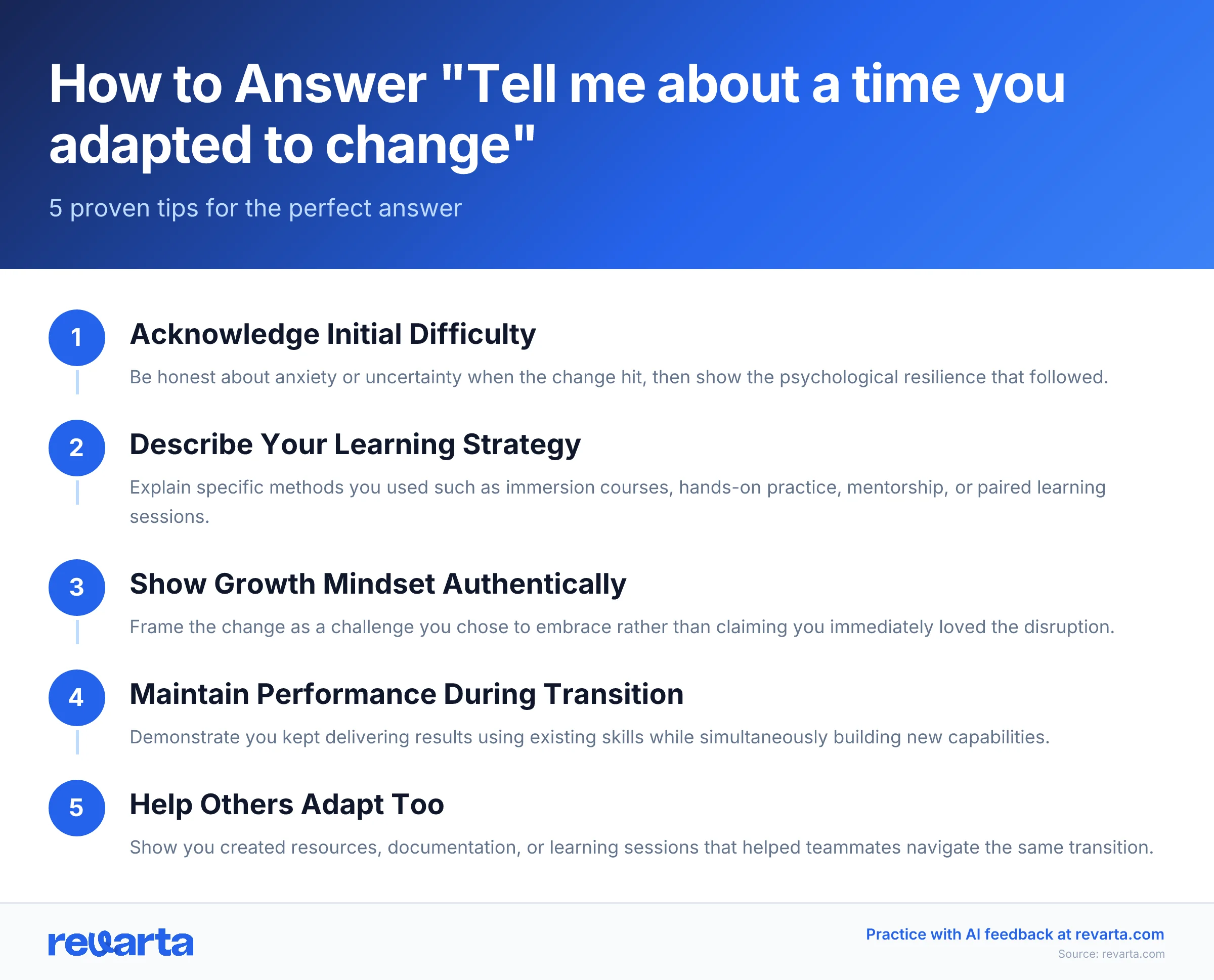
Weak: "I immediately saw this change as an exciting opportunity and adapted easily"
Strong: "My initial reaction was anxiety about whether my existing skills would remain valuable. But I recognized that resistance would only make things worse, so I chose to view this as a growth challenge. I focused on what I could control—my learning strategy and effort level—rather than dwelling on the disruption."
Showing Learning Agility Through Specific Strategies
Don't just say you learned quickly—explain your learning methodology:
- Immersion learning: Consuming content intensively (courses, articles, case studies)
- Practice-based learning: Hands-on application in safe environments before high-stakes work
- Social learning: Leveraging mentors, peer communities, or partnerships
- Reflective learning: Documenting what works, analyzing failures, iterating approaches
- Transfer learning: Applying frameworks from previous contexts to new situations
Example:
"I created a three-pronged learning approach: formal courses for foundational knowledge, a practice sandbox for hands-on experimentation, and a mentorship partnership with someone experienced in the new domain. This combination of theory, practice, and guidance accelerated my capability building."
Balancing Performance Maintenance with Learning
Top performers demonstrate they can learn new skills while still delivering results:
Example:
"I recognized I couldn't stop delivering while I learned. I handled urgent work using my existing capabilities while the transition occurred, and I volunteered for new projects as opportunities to apply emerging skills in lower-stakes contexts. This allowed me to learn progressively while maintaining my performance standards."
Common Mistakes to Avoid
Content Mistakes
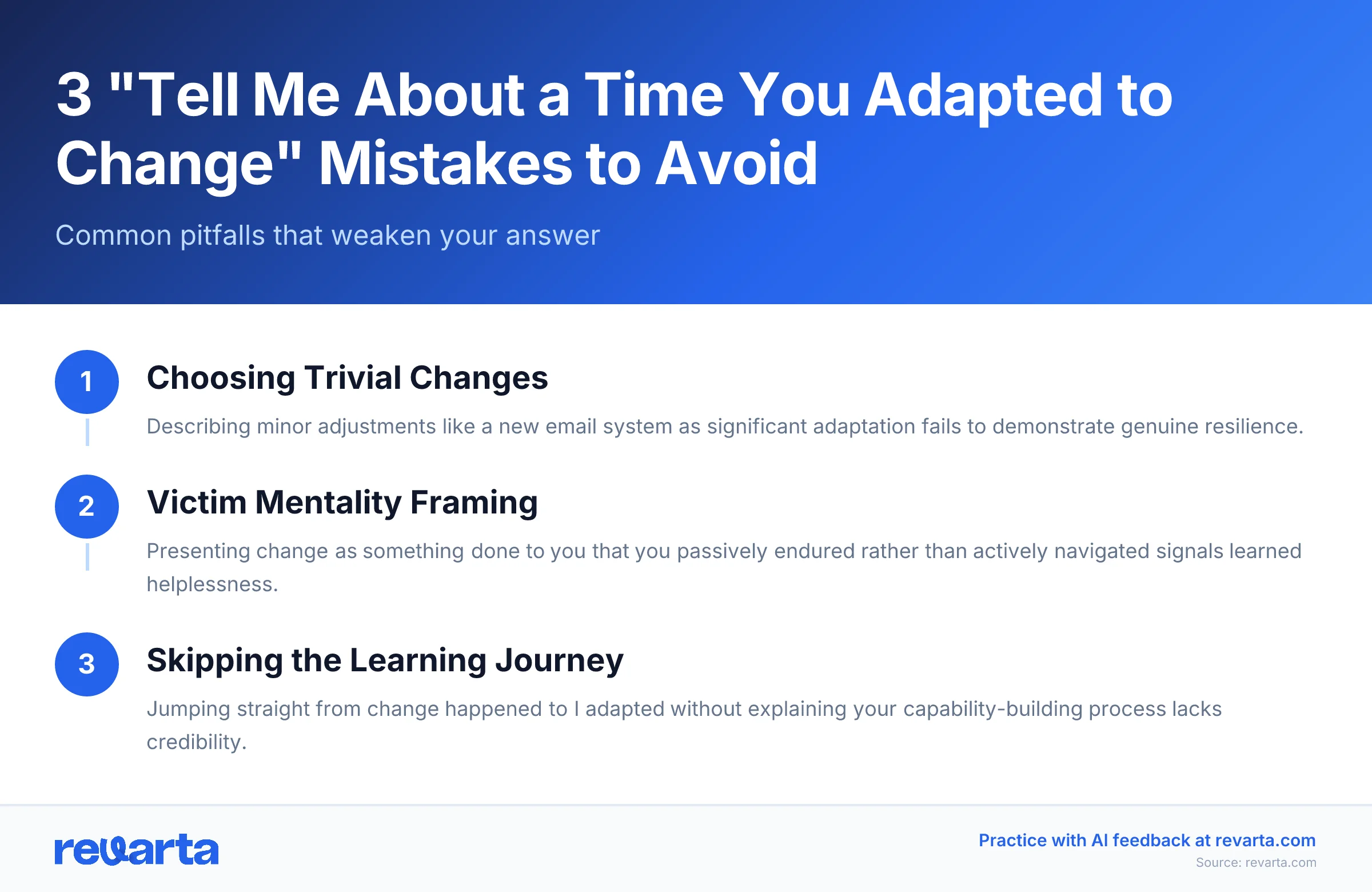
Choosing Trivial Changes: Describing minor adjustments (new email system, desk relocation) as significant adaptation
Victim Mentality: Framing change as something done to you that you passively endured rather than actively navigated
No Learning Journey: Jumping from "change happened" to "I adapted" without explaining how you built new capabilities
Unrealistic Ease: Claiming you adapted instantly with no difficulty or learning curve, which seems inauthentic
No Sustained Impact: Describing one-time adaptation without showing how it affected your ongoing capabilities
Structure Mistakes
Too Much Complaining: Dwelling on how disruptive or unfair the change was rather than focusing on your response
Vague Learning Process: Saying "I learned the new system" without explaining your learning methodology
Missing Emotional Component: Skipping over the psychological challenges of adaptation, making the story feel incomplete
Delivery Mistakes
Bitter Tone: Still sounding resentful about the change years later, suggesting you haven't truly processed it
Defensive Body Language: Closed posture when discussing change suggests you still find transitions threatening
Lack of Enthusiasm: Not showing energy when discussing how you grew through adaptation
Follow-Up Questions to Prepare For
Your change adaptation answer often triggers deeper exploration:
About Your Learning Process
- "What was most difficult about that transition?"
- "How do you typically approach learning new skills?"
- "What would you do differently if you faced similar change again?"
About Change Orientation
- "How do you handle change generally?"
- "Describe a time you struggled to adapt to change"
- "What kind of changes do you find most challenging?"
About Team Dynamics
- "How did you help others adapt during this transition?"
- "Tell me about someone who didn't adapt as successfully—what was different?"
Response Strategies
- Show self-awareness about your relationship with change
- Acknowledge that some changes are harder than others
- Demonstrate continuous learning from adaptation experiences
- Balance confidence in your adaptability with humility about ongoing growth
Industry-Specific Considerations
Technology Sector
Emphasize rapid technology adoption, continuous learning, platform migrations, and staying current with evolving tools
Example phrase: "In tech, the only constant is change—I've learned to treat continuous learning as core to my role, not an occasional necessity."
Healthcare Industry
Focus on regulatory changes, new clinical protocols, technology implementations, and pandemic-driven transformations
Example phrase: "Healthcare requires balancing innovation with patient safety—I approach changes by understanding clinical implications before implementing new processes."
Financial Services
Highlight regulatory environment changes, digital transformation, and market disruption adaptation
Example phrase: "Financial services has undergone massive digital disruption—I've adapted by developing both traditional relationship skills and digital platform expertise."
Education and Non-Profit
Emphasize mission constancy while adapting methods, funding model changes, and service delivery transformations
Example phrase: "Our mission stayed constant, but how we deliver impact required complete reinvention—I focused on preserving purpose while transforming methodology."
Final Preparation Checklist
Before Every Interview
✅ Prepare 3-4 significant change examples from different contexts
✅ For each example, identify your learning strategy and methodology
✅ Articulate both emotional challenges and how you managed them
✅ Prepare measurable outcomes showing successful adaptation
✅ Reflect on what each experience taught you about change and learning
✅ Practice describing complex changes concisely and clearly
✅ Prepare for follow-up questions about learning process and change orientation
During the Interview
✅ Choose an example with genuine significance and learning
✅ Be authentic about initial challenges while showing resilience
✅ Emphasize your systematic learning approach, not just outcomes
✅ Show sustained capability growth, not just one-time adjustment
✅ Demonstrate how this experience informs your current approach to change
Conclusion
Mastering change adaptation questions requires selecting examples that showcase both significant disruption and successful navigation through systematic learning, emotional resilience, and sustained capability development. The strongest answers demonstrate that you view change as a growth opportunity rather than a threat, that you have frameworks for building new capabilities rapidly, and that adaptation experiences have made you more rather than less confident in handling future transitions.
Your change stories reveal whether you'll thrive or struggle in dynamic environments—making this among the most predictive interview questions for long-term success. Invest time in reflecting on your adaptation experiences, articulating your learning methodologies, and practicing delivery that conveys both authenticity about challenges and confidence in your adaptive capabilities.
Start practicing today with Revarta's AI interview coach to perfect your change adaptation answers and receive personalized feedback on demonstrating learning agility.
Practice change adaptation answers with AI feedback
Keep Preparing


