How to Answer "Tell Me About a Time You Took Initiative": The Complete Interview Guide (2026)
"Tell me about a time you took initiative" appears in over 80% of interviews across all career levels. This question reveals your proactive mindset, ownership mentality, leadership potential beyond formal authority, problem-solving orientation, and self-motivation. Research shows that employees who demonstrate initiative are 3x more likely to be promoted and contribute 47% more value than those who only complete assigned work.
This comprehensive guide provides everything you need to master initiative questions: 15+ detailed STAR method examples, frameworks for demonstrating proactive leadership, and strategies for showcasing value creation beyond job descriptions.
Why Interviewers Ask About Initiative
Assessing Proactive vs. Reactive Mindset
Organizations need people who identify and solve problems before being asked, not just those who complete assigned tasks. Your response reveals whether you wait for direction or create value independently, whether you see opportunities others miss, and whether you take ownership beyond formal responsibilities.
Evaluating Leadership Potential
Initiative is informal leadership—influencing outcomes without formal authority. Interviewers assess whether you can rally resources and people around ideas, drive projects without positional power, overcome resistance to make improvements, and demonstrate leadership behaviors regardless of title.
Understanding Problem-Solving Orientation
Initiative requires seeing problems as opportunities. Your story shows whether you identify root causes proactively, generate creative solutions independently, execute improvements without being instructed, and create lasting value through self-directed effort.
Measuring Self-Motivation and Ownership
Intrinsically motivated employees don't need constant supervision. Interviewers evaluate whether you're driven by internal standards of excellence, take pride in going beyond minimum requirements, seek opportunities to contribute additional value, and maintain high performance without external pressure.
Gauging Risk-Taking and Judgment
Initiative involves appropriate risk—acting without explicit permission. Your example reveals whether you can judge when to seek approval versus act independently, balance innovation with organizational norms, and take smart risks that drive value.
The STAR Method for Initiative Questions
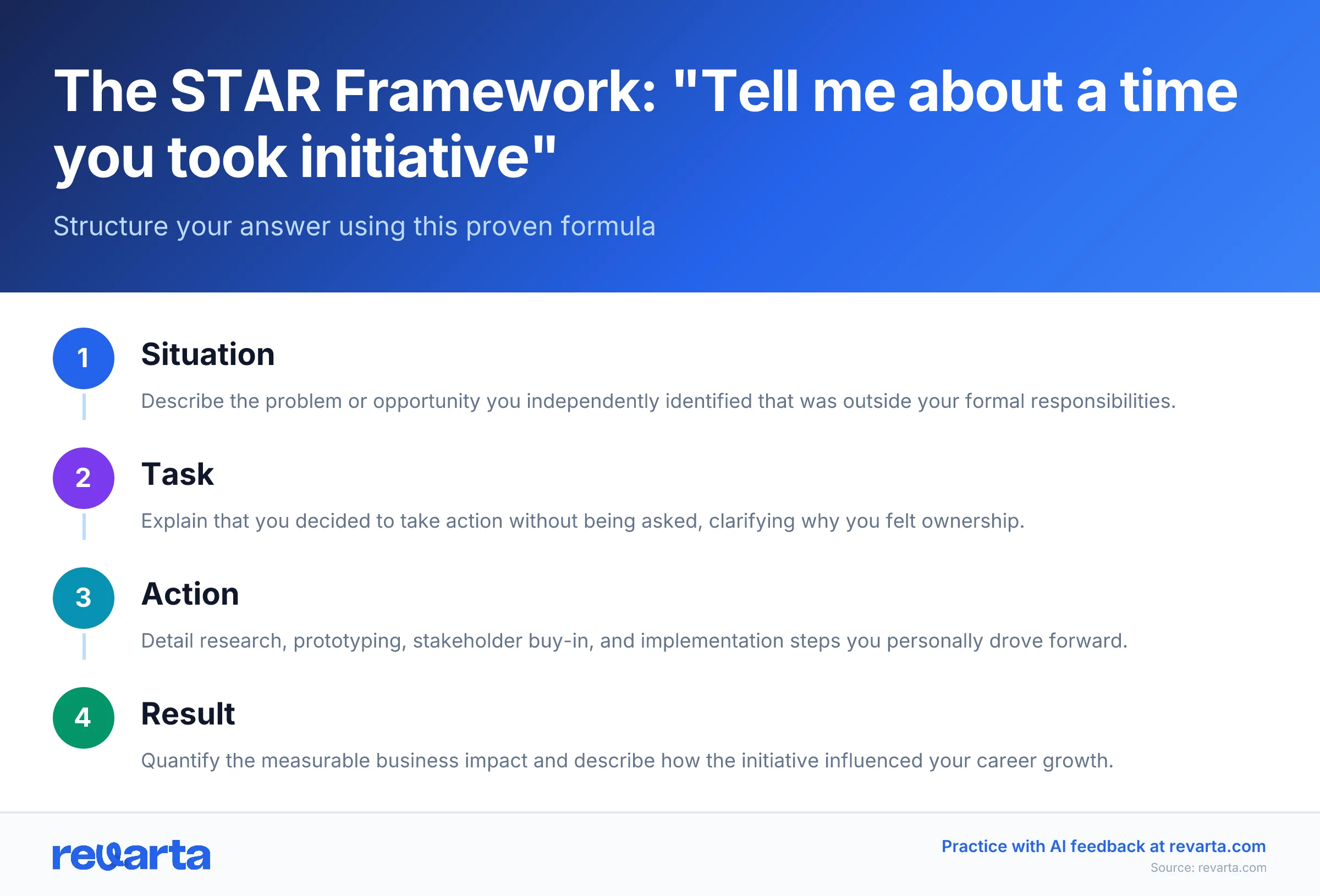
Situation (15% of answer)
Example:
"As a customer success manager at SaaS Corp, I noticed a concerning pattern: 30% of our new customers weren't fully onboarding despite completing our standard training program. While customer churn wasn't formally part of my job responsibilities—I was measured on support ticket response times—I recognized this represented significant revenue risk and customer dissatisfaction."
Task (10% of answer)
Example:
"Rather than waiting for leadership to notice this problem or for it to become a crisis, I decided to take initiative to understand root causes and propose solutions, even though improving onboarding wasn't in my job description and no one had asked me to investigate this issue."
Action (55% of answer)
Example:
"I started by conducting informal research on my own time. I reached out to 25 customers who'd struggled with onboarding and asked permission to interview them about their experience. I discovered that our training focused heavily on product features but didn't teach workflow integration—customers knew what buttons to press but not how to adapt the product to their actual business processes.
I drafted a proposal for a revamped onboarding program focusing on workflow integration and value realization, not just feature education. This included creating industry-specific onboarding tracks, developing workflow templates, and implementing success milestones instead of just feature completion metrics.
I didn't have budget authority or formal permission to build this, so I created a prototype using free tools. I volunteered to pilot the new approach with 10 upcoming customers, tracking engagement and activation metrics compared to our standard onboarding.
I presented my findings and pilot proposal to my manager and the VP of Customer Success, positioning it as 'I've identified a significant revenue risk and prototyped a potential solution—here's what I learned and what I'm proposing we test.'
After getting approval to pilot, I coordinated with product marketing to develop industry-specific content, worked with our implementation team to create workflow templates, and personally delivered the new onboarding program to pilot customers."
Result (20% of answer)
Example:
"The pilot customers showed 89% full activation compared to 70% baseline—a 27% improvement. They also achieved time-to-value 40% faster and had 94% satisfaction scores versus 76% for standard onboarding.
Based on these results, leadership approved company-wide implementation of the new onboarding approach. Within six months, overall customer activation improved from 70% to 85%, first-year retention increased by 8 percentage points, and customer lifetime value grew by an average of $12,000 per customer.
My initiative led to my promotion to Senior Customer Success Manager with responsibility for the entire onboarding program. More broadly, this demonstrated to leadership that I thought strategically about customer outcomes, not just task completion.
This experience taught me that initiative is most effective when combined with data and prototype validation—I didn't just propose an idea, I demonstrated proof of concept. I learned that framing initiative as solving business problems rather than just 'having ideas' increases buy-in. Most importantly, I discovered that taking ownership beyond job descriptions accelerates career growth and creates significantly more impact than staying within formal boundaries."