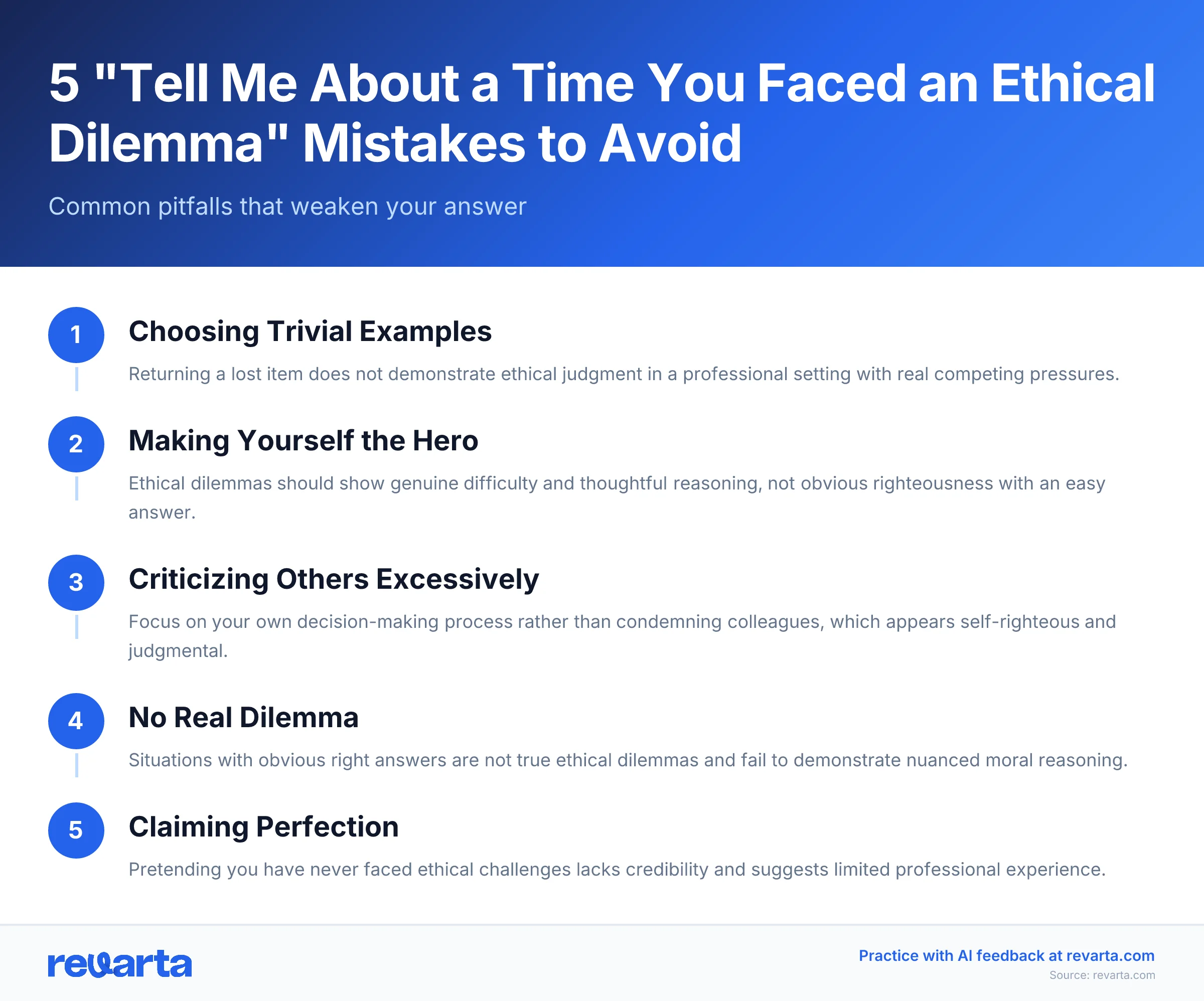
How to Answer "Tell Me About an Ethical Dilemma": The Complete Interview Guide (2026)
"Tell me about a time you faced an ethical dilemma" appears in over 70% of interviews across industries, particularly in leadership, finance, healthcare, and consulting roles. This question reveals your moral compass and value system, ability to navigate pressure when ethics and business conflict, courage to speak up about ethical concerns, judgment in complex situations without clear answers, and commitment to doing right over doing easy. Research from ECI shows that organizations with strong ethical cultures have 50% lower employee turnover and significantly higher financial performance than those with weak ethical cultures.
This comprehensive guide provides 15+ STAR method examples, frameworks for ethical decision-making under pressure, and strategies for demonstrating principled leadership without appearing self-righteous.
Why Interviewers Ask About Ethical Dilemmas
Assessing Core Values
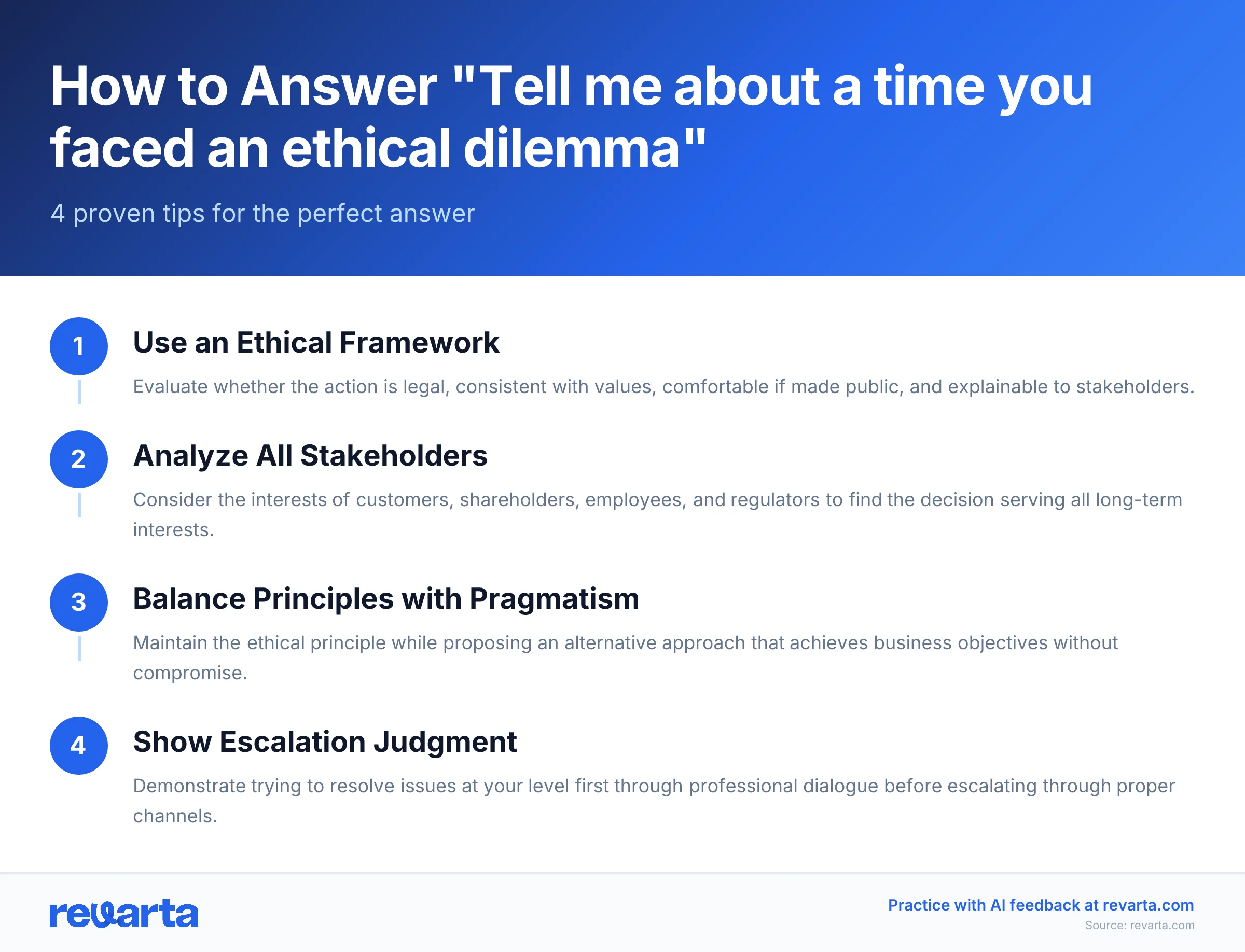
Values predict behavior better than skills. Your response reveals whether you have a clear ethical framework guiding decisions, prioritize integrity over short-term convenience, recognize ethical dimensions of business situations, and make value-based decisions consistently.
Evaluating Courage and Integrity
Doing the right thing often requires courage. Interviewers assess whether you speak up when you observe ethical problems, maintain principles despite pressure or consequences, prioritize long-term reputation over short-term gain, and take action on convictions rather than just voicing concerns.
Understanding Judgment in Ambiguity
Real ethical dilemmas rarely have obvious answers. Your story shows whether you can navigate situations with competing legitimate interests, make thoughtful decisions when options all have downsides, seek diverse perspectives on complex ethical questions, and explain reasoning behind difficult ethical choices.
Measuring Transparency and Accountability
How you discuss ethics reveals character. Interviewers evaluate whether you're honest about ethical challenges you've faced, take responsibility for ethical decisions and outcomes, admit when you've made mistakes or faced difficult choices, and demonstrate learning from ethical experiences.
Gauging Organizational Thinking
Individual ethics must consider organizational context. Your example reveals whether you understand how individual choices affect organizational reputation, balance stakeholder interests in ethical decisions, know when and how to escalate ethical concerns, and build ethical culture through your actions.
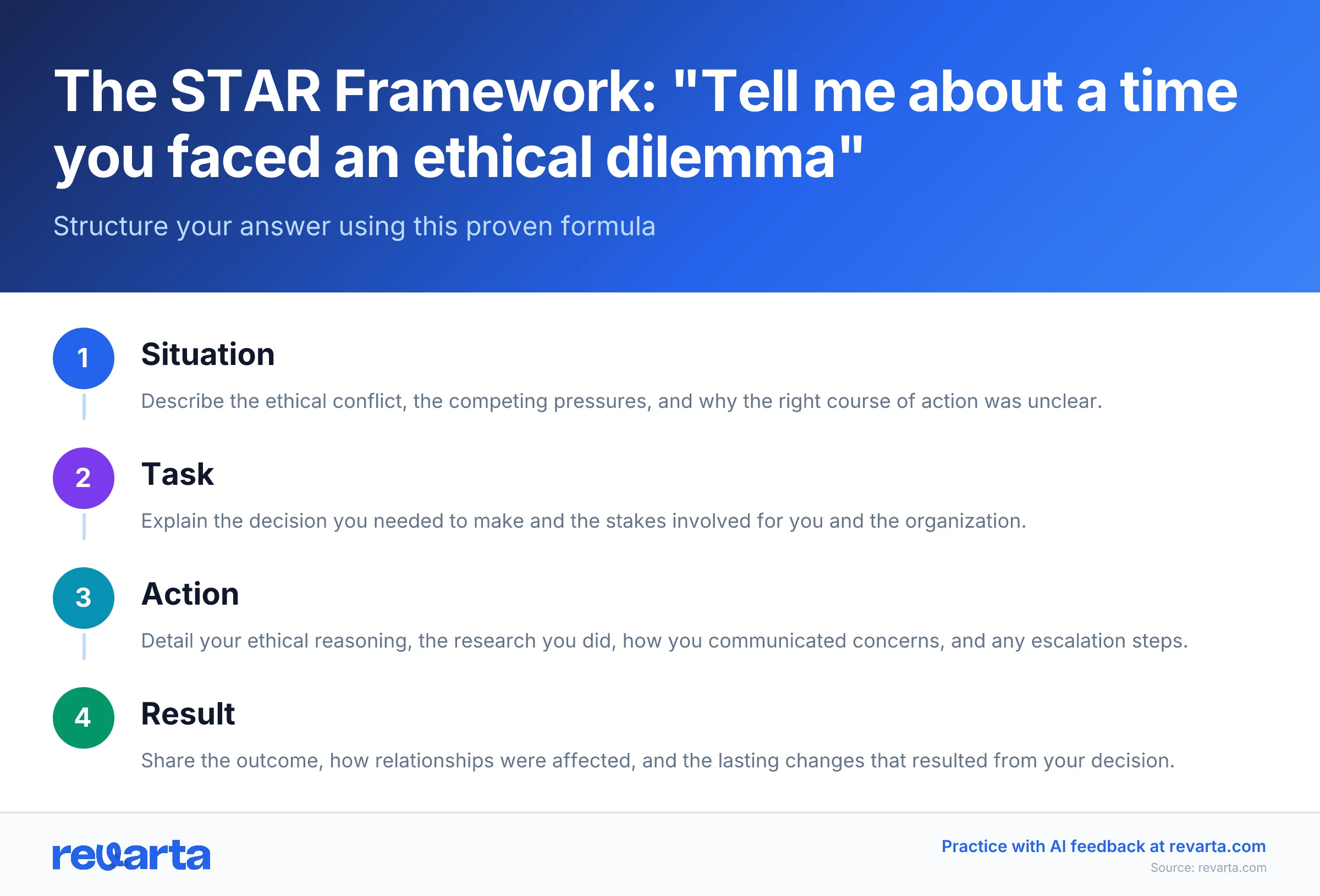
The STAR Method for Ethical Dilemma Questions
Situation (15%)
Example:
"As a financial analyst at InvestCorp, I was preparing quarterly earnings materials for our investor call. Three days before the call, I discovered a significant accounting error in how we were recognizing revenue from a new product line. The error overstated our revenue by $2.3M for the quarter—not enough to miss earnings guidance, but enough to show 12% growth instead of 8%. My manager, who was under intense pressure from the CFO to show strong growth for this new initiative he had championed, saw my analysis and said: 'The accounting treatment is defensible. Different experts interpret the standard differently. Let's not create unnecessary volatility before the investor call. We'll revisit this next quarter.'"
Task (10%)
Example:
"I needed to decide whether to accept my manager's guidance to defer the issue or escalate the accounting concern, balance my responsibility to accurate financial reporting with organizational relationships and career risk, and act in a way I could be proud of regardless of consequences."
Action (55%)
Example:
"I felt immediate discomfort with my manager's response. While revenue recognition standards do involve judgment, this felt less like reasonable interpretation and more like motivated reasoning to avoid bad news. I needed to think through this carefully rather than react emotionally or comply automatically.
I started by evaluating the situation objectively. I consulted the accounting standard directly and researched how similar companies handled comparable situations. My research confirmed that our current treatment was aggressive at best and likely not compliant with GAAP. This wasn't a gray area where reasonable people could disagree—it was incorrect.
I also considered the consequences. If we reported incorrect revenue and later had to restate, that would damage investor trust, potentially trigger SEC scrutiny, and harm the company's reputation far more than missing growth expectations by a few points. Personally, refusing to defer the issue could damage my relationship with my manager and potentially affect my career progression.
Despite the personal risk, I knew what I needed to do. I scheduled a meeting with my manager and prepared my case carefully. I approached the conversation respectfully but clearly: 'I understand the pressure to show strong results, and I know this timing is difficult. But I've researched the accounting standard thoroughly, and I'm confident our current treatment doesn't comply. Here's my analysis and how comparable companies handle this.'
He pushed back: 'Your job is to prepare the materials I direct you to prepare. I'll make the judgment calls on accounting treatment.' I responded calmly: 'I understand you're the decision-maker, but I have a professional responsibility to raise concerns when I believe financial reporting is inaccurate. I'm not comfortable signing off on materials I believe are incorrect.'
He became frustrated: 'Are you saying I'm asking you to do something unethical?' I was careful with my words: 'I'm saying I believe the current accounting treatment is incorrect, and I have a responsibility to raise that concern. I'm not questioning your intentions—I'm raising a technical accounting issue that needs to be resolved.'
When he continued to resist, I knew I needed to escalate. This was uncomfortable—I respected my manager and didn't want to go over his head. But I also knew that if I stayed silent and the error later came to light, my silence would be complicity.
I scheduled a meeting with the controller and explained the situation factually, without being dramatic or accusatory: 'I've identified what I believe is a revenue recognition error. My manager and I disagree on the interpretation. I'd like the controller's perspective on the appropriate accounting treatment.' I brought my detailed analysis and external research.
The controller reviewed my work and agreed the accounting treatment was incorrect. She thanked me for raising the issue and said she would work with my manager and the CFO to address it before the investor call.
This triggered a difficult conversation with the CFO. The CFO was initially frustrated about the late notice but ultimately made the right decision: we corrected the revenue recognition and communicated 8% growth instead of 12% on the investor call.
My relationship with my manager was strained for several weeks. He felt I had made him look bad. I tried to repair the relationship by acknowledging the difficulty: 'I know this created a tough situation. I wasn't trying to undermine you—I was trying to fulfill my professional responsibility. I hope we can move forward constructively.'"
Result (20%)
Example:
"We reported accurate financial results on the investor call. While investors were slightly disappointed with 8% vs. 12% growth, there were no negative consequences beyond normal market reaction. More importantly, we avoided what would have been a far more damaging restatement later.
My relationship with my manager remained tense for about two months. However, the controller mentioned my handling of the situation in my performance review, noting my professional integrity. Six months later, my manager actually apologized: 'I was wrong to push you to defer that issue. You did the right thing, and I should have listened immediately.'
The CFO implemented a new process requiring dual review of significant accounting judgments specifically because of this incident, strengthening our financial reporting controls.
This experience taught me that doing the right thing isn't always immediately rewarded and often carries short-term costs. My relationship with my manager suffered, and I lost sleep over the decision. But I learned that I could live with temporary discomfort from doing right far better than I could live with long-term regret from doing wrong.
I discovered that how you raise ethical concerns matters enormously. I wasn't accusatory or self-righteous—I focused on the technical issue, provided thorough analysis, and respected the hierarchy while fulfilling my professional responsibility. This approach made escalation more effective than dramatic declarations about ethics would have been.
Most importantly, I learned to trust my moral intuition. When I felt immediate discomfort with my manager's response, that discomfort was signal worth heeding. Now when I feel that ethical unease, I pause to examine it carefully rather than dismissing it or automatically complying."