
How to Answer "Tell Me About an Innovative Solution": The Complete Interview Guide (2025)

"Tell me about an innovative solution you developed" appears in over 75% of interviews, particularly for roles requiring creativity, problem-solving, or process improvement. This question reveals your creative thinking ability, willingness to challenge conventional approaches, practical application of innovative ideas, resourcefulness within constraints, and capacity to drive meaningful change. Research from Harvard Business School shows that innovative employees generate 3-4x more value than those who only apply existing methods.

This comprehensive guide provides 15+ STAR method examples, frameworks for demonstrating creative problem-solving, and strategies for showcasing innovation that creates measurable business impact.

Why Interviewers Ask About Innovation

Assessing Creative Problem-Solving
Organizations facing disruption need people who can generate novel solutions when standard approaches fail. Your response reveals whether you think creatively beyond established playbooks, challenge assumptions that others accept, combine existing concepts in new ways, and find elegant solutions to complex problems.

Evaluating Practical Innovation vs. Theory

Anyone can propose wild ideas; valuable innovation balances creativity with feasibility. Interviewers assess whether you can implement creative ideas practically, work within real-world constraints creatively, pilot and refine innovations iteratively, and measure innovation impact objectively.

Understanding Learning and Adaptation

Innovation requires intellectual curiosity and continuous learning. Your story shows whether you stay current with emerging approaches, learn from other industries or domains, adapt external concepts to your context, and evolve thinking based on new information.

Measuring Risk-Taking and Persistence

Innovation involves uncertainty and potential failure. Interviewers evaluate whether you take calculated risks on unproven approaches, persist when initial attempts don't work, learn from failed experiments, and maintain confidence despite setbacks.

Gauging Change Leadership

Innovative solutions require convincing others to try new approaches. Your example reveals whether you can build support for unconventional ideas, overcome resistance to change, communicate benefits compellingly, and lead others through unfamiliar territory.

The STAR Method for Innovation Questions

Situation (15%)
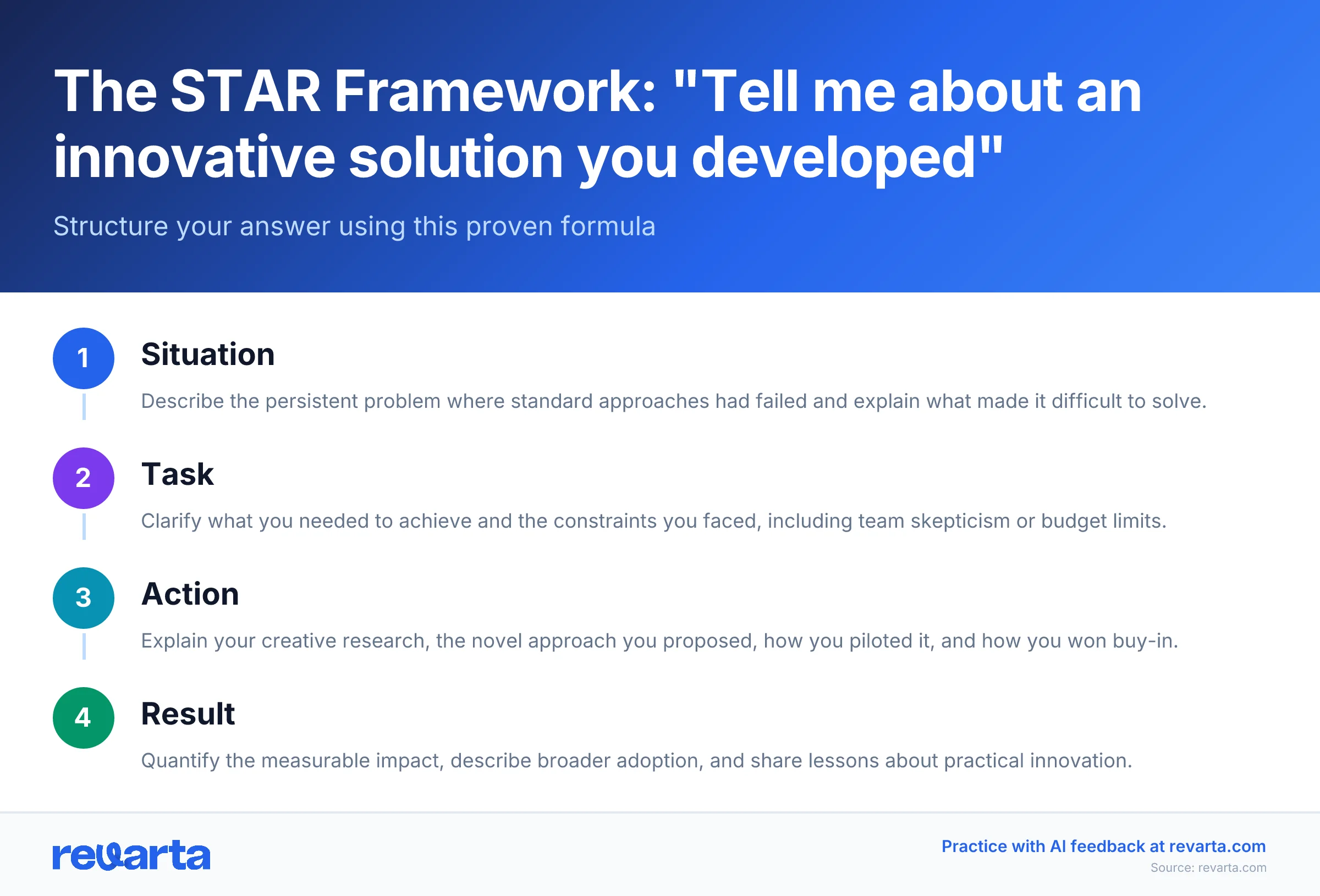
Example: "As operations manager at Manufacturing Co, we faced a persistent quality control problem: 8% of products failed final inspection, requiring expensive rework. Our standard approach was hiring more quality inspectors, but that increased costs without addressing root causes. The company had used the same quality process for 15 years, and several previous improvement initiatives had failed to reduce defect rates meaningfully."

Task (10%)

Example: "I needed to reduce defect rates to under 3% without significantly increasing costs, find a solution that addressed root causes rather than symptoms, and do this with a team skeptical about 'new approaches' after previous failed initiatives."

Action (55%)

Example: "Rather than accepting our traditional quality inspection approach, I researched how other industries handled quality. I discovered that Toyota's manufacturing philosophy emphasized building quality into the process rather than inspecting it out—defect prevention rather than detection.

I proposed a radical shift: instead of adding inspectors at the end, we'd train production workers to conduct quality checks at each manufacturing stage, giving them authority to stop production if they spotted defects. This was controversial—management worried about production delays, and workers were concerned about additional responsibility.

I piloted the approach in one production line with volunteers. I invested in training workers on quality standards and gave them simple quality measurement tools. Most importantly, I created a 'no-blame' culture around defect reporting—workers who caught defects early received recognition, not criticism.

The pilot required 40 hours of worker training and $15K in measurement tools. Within three weeks, we saw defect rates on that line drop from 8% to 2.5%. Workers reported feeling more ownership and pride in their work.

Based on pilot success, I developed a rollout plan for all production lines, creating peer training where successful pilot participants taught other workers. I also implemented a visual quality dashboard showing real-time defect rates for each production stage, gamifying quality improvement."

Result (20%)

Example: "Within six months of full implementation, overall defect rates dropped from 8% to 1.8%—exceeding our 3% goal by 40%. This generated $420K in annual savings from reduced rework and inspection costs.

Beyond financial impact, worker engagement scores increased 22 points because they felt trusted and empowered. Several workers proposed additional process improvements, creating a culture of continuous innovation.

The approach was so successful that our parent company adopted it across 12 manufacturing facilities, crediting our innovation. I presented this case study at an industry conference, positioning our company as a quality leader.

This experience taught me that innovative solutions often exist in other industries or domains—the key is adapting them thoughtfully to your context. I learned that involving skeptics in pilots converts them to advocates more effectively than presenting finished solutions. Most importantly, I discovered that innovative process changes must address cultural elements alongside technical ones—giving workers ownership and recognition was as critical as the new process itself."

15+ Detailed Examples

Entry-Level: Marketing Coordinator

Innovative social media engagement strategy using user-generated content when budget was cut 60%, created viral campaign generating 5x more engagement than paid advertising

Mid-Career: Product Manager

Developed freemium pricing model in traditionally enterprise-only industry, drove 300% user growth and created new revenue stream

Senior: VP Engineering

Pioneered remote-first engineering culture before pandemic, innovative collaboration tools and practices became competitive advantage

Healthcare: Nurse Manager

Created patient family communication app solving visiting restriction challenges during pandemic, improved patient satisfaction 35%

Finance: Financial Analyst

Developed machine learning model for expense forecasting replacing manual spreadsheets, increased accuracy 40% and saved 15 hours weekly

Sales: Account Executive

Innovative proposal format using interactive presentations instead of static PDFs, increased close rate 28% and shortened sales cycles

Education: Program Director

Created hybrid learning model combining in-person and online elements before widespread adoption, improved student outcomes and program accessibility

Nonprofit: Development Director

Innovative fundraising approach using crowdfunding and social media storytelling, engaged younger donors and increased donations 45%

Operations: Supply Chain Manager

Implemented predictive maintenance system using IoT sensors, reduced equipment downtime 60% and maintenance costs 35%

Customer Success: CS Manager

Developed customer health scoring algorithm predicting churn risk, enabled proactive intervention reducing churn 25%

HR: Talent Acquisition

Created employee referral gamification program with creative incentives, improved quality of hire and reduced recruiting costs 40%

Technology: Software Engineer

Built automated testing framework reducing QA time from 3 days to 4 hours, accelerated release cycles and improved quality

Retail: Store Manager

Innovated inventory management using mobile app for real-time stock tracking, reduced stockouts 55% and overstock 40%

Consulting: Management Consultant

Developed diagnostic framework combining quantitative and qualitative analysis, improved client problem diagnosis accuracy and engagement value

Real Estate: Property Manager

Created tenant communication platform with automated maintenance requests and real-time updates, improved satisfaction 40% and reduced response time 60%

Common Variations

  • "Describe a time you thought outside the box"
  • "Tell me about a creative solution to a problem"
  • "Give an example of improving an existing process"
  • "Describe implementing a new idea"
  • "Tell me about challenging conventional thinking"

Advanced Strategies

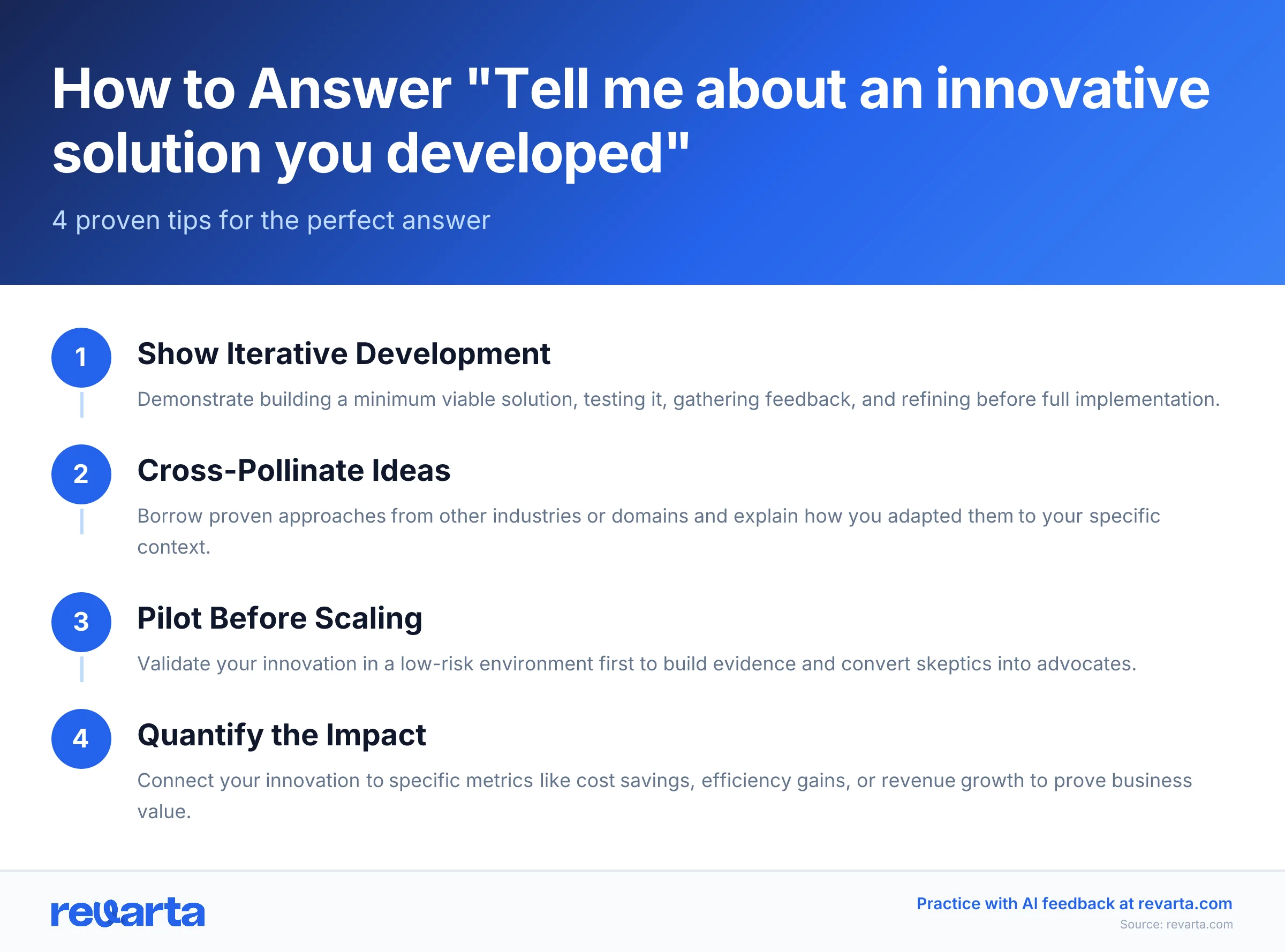
Demonstrating Iterative Innovation

"I didn't expect the first version to be perfect. I built a minimum viable solution, tested it, gathered feedback, and refined it three times before full implementation..."

Showing Cross-Pollination

"I borrowed this approach from the hospitality industry and adapted it to our manufacturing context..."

Balancing Innovation with Risk Management

"I piloted the approach in a low-risk environment first to validate before broader implementation..."

Quantifying Innovation Impact

"This innovation generated $X in savings, improved Y metric by Z%, and created reusable capabilities worth..."

Common Mistakes

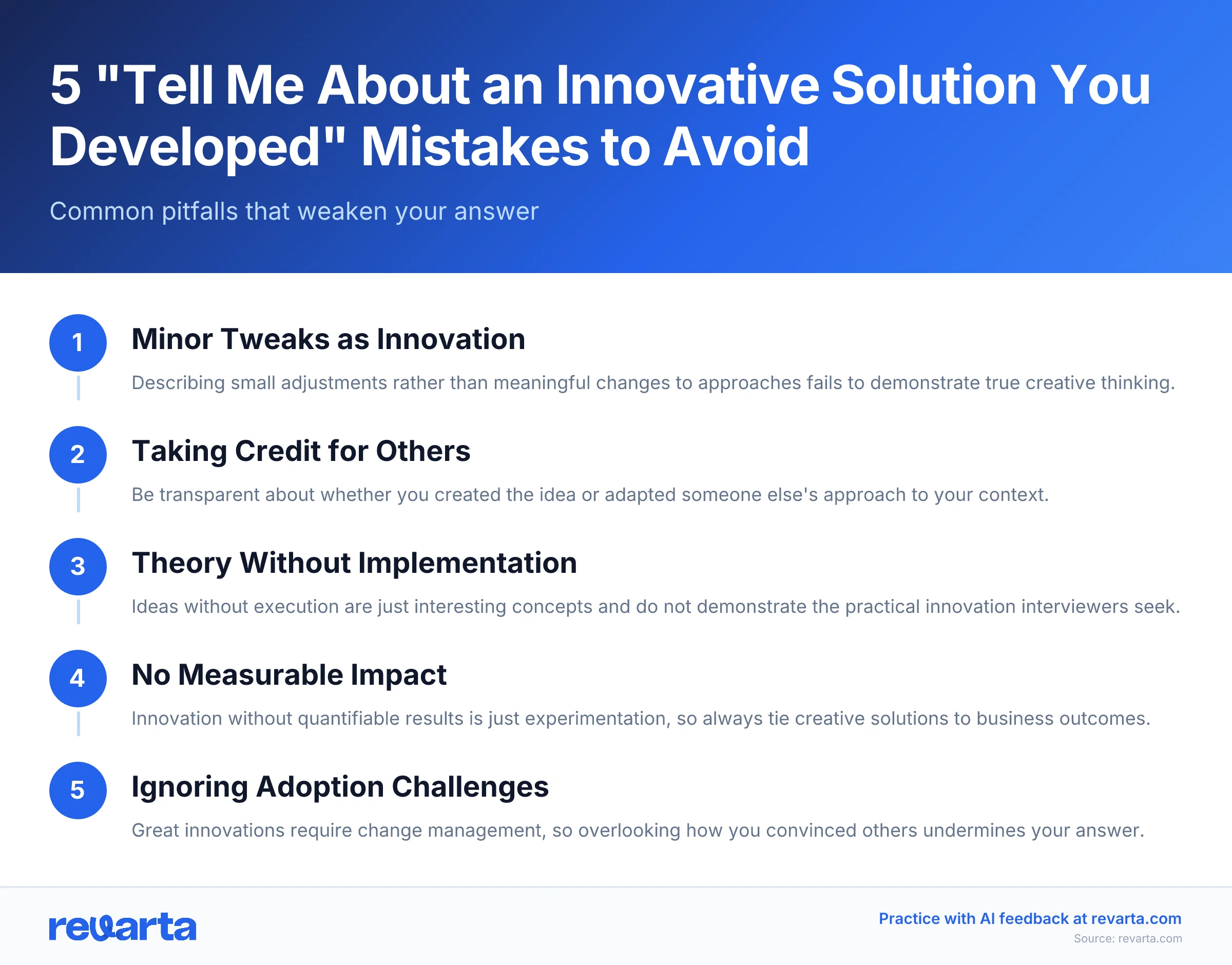
  • Describing minor tweaks as innovation: True innovation meaningfully changes approaches
  • Taking credit for others' ideas: Innovation you adapted vs. created should be clear
  • Theory without implementation: Ideas without execution don't demonstrate innovation
  • No measurable impact: Innovation without results is just interesting ideas
  • Ignoring adoption challenges: Great innovations require change management

Follow-Up Questions

  • "How did you develop this innovative idea?"
  • "What resistance did you face and how did you overcome it?"
  • "Has this innovation been sustained or improved since?"
  • "Tell me about an innovation that didn't work out"
  • "How do you stay current with new approaches and ideas?"

Industry Considerations

Technology: Platform innovations, architecture improvements, development methodology advances Healthcare: Patient care delivery innovations, clinical workflow improvements, safety enhancements Finance: Risk management innovations, process automation, analytical methodology advances Manufacturing: Production process innovations, quality improvements, efficiency gains Retail: Customer experience innovations, inventory management, omnichannel approaches Education: Learning delivery innovations, engagement approaches, accessibility improvements Nonprofit: Fundraising innovations, program delivery, volunteer engagement approaches

Conclusion

Mastering innovation questions requires selecting examples of genuine creative problem-solving that generated measurable business impact. The strongest answers demonstrate both creative thinking and practical implementation, showing you can turn innovative ideas into valuable organizational improvements.

Practice innovation answers with AI feedback

Explore More Interview Questions

Want to see more common interview questions? Explore our full list of top questions to practice and prepare for any interview.

Browse All Questions

Perfect Your Answer With Revarta

Get AI-powered feedback and guidance to master your response

Voice Practice

Record your answers and get instant AI feedback on delivery and content

Smart Feedback

Receive personalized suggestions to improve your responses

Unlimited Practice

Practice as many times as you need until you feel confident

Progress Tracking

Track your progress and see how you're improving

Reading Won't Help You Pass. Practice Will.

You've invested time reading this. Don't waste it by walking into your interview unprepared.

Free, no signup
Know your weaknesses
Fix before interview