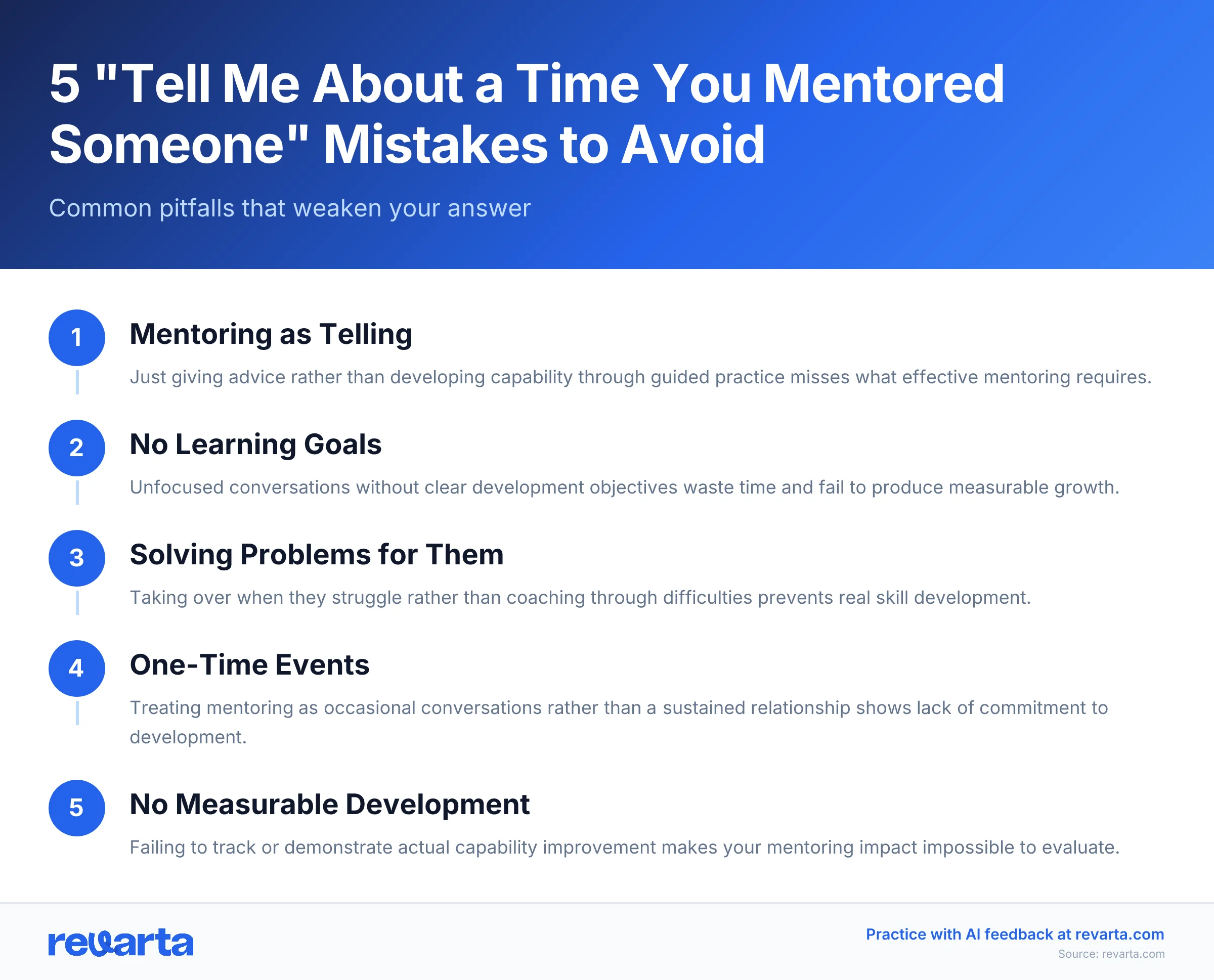
How to Answer "Tell Me About Mentoring Someone": The Complete Interview Guide (2026)
"Tell me about a time you mentored someone" appears in over 75% of senior-level and leadership interviews. This question reveals your investment in others' development, ability to transfer knowledge and skills effectively, patience with learning curves and mistakes, leadership through teaching rather than directing, and commitment to building organizational capability. Research from DDI shows that organizations with strong mentoring cultures have 20% higher employee retention and 23% faster skill development than those without structured mentoring.
This comprehensive guide provides 15+ STAR method examples, mentoring frameworks for different development needs, and strategies for demonstrating how you develop talent while achieving business results.
Why Interviewers Ask About Mentoring
Assessing Leadership Philosophy
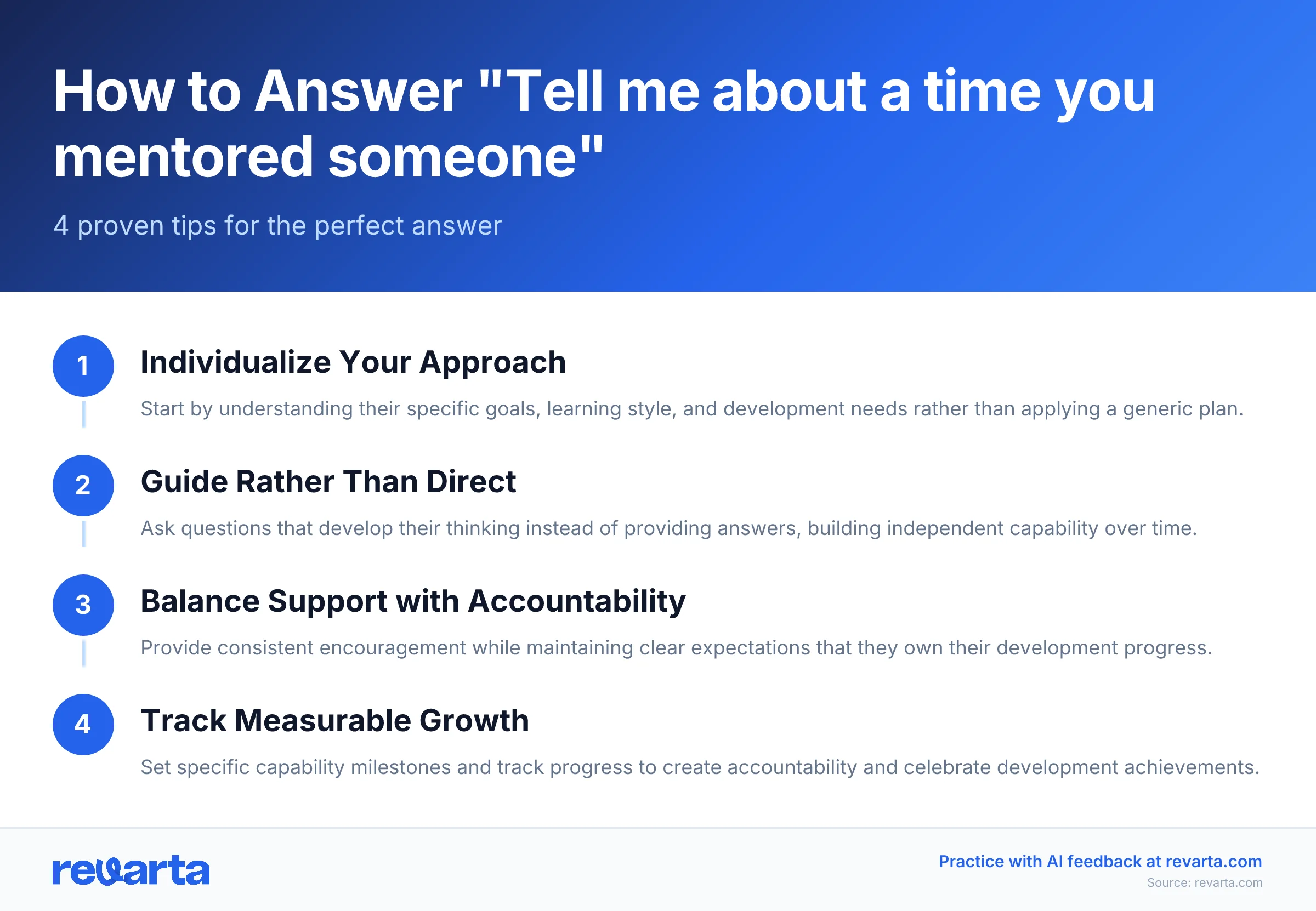
True leaders develop other leaders. Your response reveals whether you view developing others as core responsibility vs. burden, invest time in people despite competing priorities, measure success through others' growth, and find fulfillment in others' achievements.
Evaluating Teaching Capability
Mentoring requires translating expertise into learning. Interviewers assess whether you can explain complex concepts clearly, adapt communication to learning styles, provide actionable feedback, and make implicit knowledge explicit.
Understanding Patience and Long-Term Thinking
Development takes time and involves setbacks. Your story shows whether you maintain commitment through slow progress, tolerate mistakes as learning opportunities, provide support without taking over, and think in months and years rather than days and weeks.
Measuring Empathy and Individual Focus
Effective mentoring is personalized. Interviewers evaluate whether you understand individual motivations and goals, adapt development approach to person's needs, recognize and build on strengths, and address specific development gaps.
Gauging Organizational Thinking
Mentoring builds institutional capability. Your example reveals whether you develop people for organizational benefit, create knowledge transfer and succession, strengthen team capability systematically, and reduce organizational dependency on key individuals.
The STAR Method for Mentoring Questions
Situation (15%)
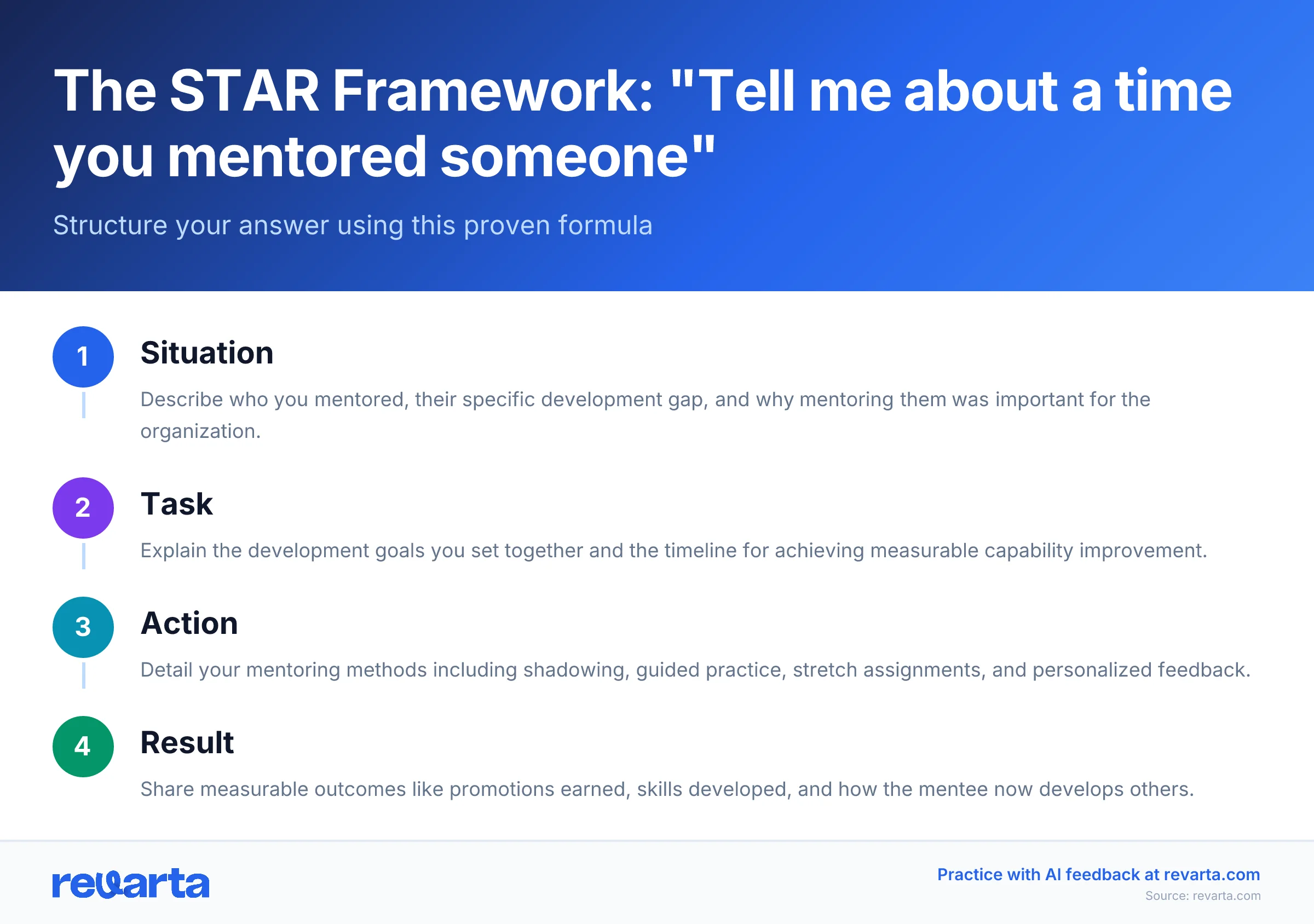
Example:
"As a senior software architect at CloudTech, I noticed that one of our mid-level engineers, Michael, had strong technical skills but struggled with system-wide thinking. He could build excellent features but didn't understand how architectural decisions affected scalability, maintainability, and system performance. During code reviews, he often made technically sound choices that created long-term technical debt. Our engineering director asked me to mentor Michael because he showed leadership potential but needed to develop strategic technical thinking."
Task (10%)
Example:
"I needed to help Michael develop architectural thinking and system-wide perspective, do this while maintaining my own deliverables and responsibilities, and prepare him for potential promotion to senior engineer within 12-18 months."
Action (55%)
Example:
"I started by understanding Michael's goals and learning style. In our first conversation, I asked: 'Where do you want to be in your career in 3-5 years?' He shared that he wanted to become a technical leader making important architectural decisions, but he wasn't sure how to develop that capability.
Rather than creating a generic development plan, I focused on his specific gap: translating tactical technical skill into strategic architectural thinking. I proposed meeting weekly for 60 minutes to work on this systematically, and he enthusiastically agreed.
I used several complementary approaches:
Shadowing and Explanation: I invited Michael to observe my architectural design sessions. Before each session, I'd explain what I was thinking about. During the session, I'd narrate my thought process: 'I'm choosing this database approach because of these scalability requirements and cost constraints, not just because it's technically superior.' Afterward, I'd explain decisions I made and ask what he observed.
Guided Practice: When architecture decisions came up for his projects, I'd coach him through the thinking rather than providing answers. 'What are the critical requirements for this component? What happens if user volume grows 10x? What's the maintenance burden of different approaches?' I let him struggle through the analysis before guiding him.
Code Review as Teaching: During code reviews, I shifted from just noting problems to explaining systemic thinking. Instead of 'This pattern will cause scaling issues,' I'd explain: 'This pattern creates N+1 database queries. That works fine at current volume, but when we hit 10,000 concurrent users, it will overload the database. Here's how to structure this for scalability...'
Real-World Problem Solving: I assigned Michael a challenging architectural problem our team was facing: redesigning our authentication system for better security and performance. Instead of solving it myself, I had him research approaches, propose solutions, and present to the architecture team. I coached him through multiple iterations, helping him think through tradeoffs and edge cases.
Pattern Recognition: I helped Michael build a mental library of architectural patterns. When reviewing designs, I'd name patterns: 'This is an example of the circuit breaker pattern protecting against cascading failures.' Over time, he started recognizing and applying these patterns independently.
Feedback Sandwiches Done Right: I provided regular, specific feedback. Not generic 'good job' but concrete: 'Your API design meeting yesterday was strong—you proactively addressed versioning and backward compatibility, which shows you're thinking beyond immediate implementation.' When I saw gaps, I framed them as development opportunities: 'Here's an area to work on: considering operational complexity in design decisions...'
Stretch Assignments: As Michael's capability grew, I advocated for him to lead larger architectural initiatives. When he was nervous about presenting to executive leadership, I prepared him: 'Let's practice your presentation. I'll ask the tough questions they might ask.'
I also shared my own learning journey and mistakes: 'When I was at your career stage, I made this same mistake. Here's what I learned...' This normalized the learning process and reduced pressure to be perfect.
The mentoring wasn't one-directional. I asked Michael to teach me about newer technologies he was learning, which reinforced his expertise and created reciprocal learning.
Over 12 months, I watched for indicators of progress: Was he asking better questions in design sessions? Were his architectural proposals showing systemic thinking? Was he catching scalability issues earlier? When I saw progress, I reinforced it specifically."
Result (20%)
Example:
"After 14 months of mentoring, Michael was promoted to senior engineer based on demonstrated architectural thinking capability. He led the redesign of our core API infrastructure—a project that would have been beyond his capability when we started. The redesigned system improved performance 3x and reduced operational incidents 67%.
More importantly, Michael is now mentoring two other engineers using similar approaches I used with him, multiplying the impact of the initial investment. He told me in his promotion conversation: 'You didn't just teach me architecture—you taught me how to think architecturally. That's the difference.'
The time investment was significant—roughly 50 hours over 14 months—but the return was substantial. I gained a senior engineer capable of solving complex problems I would have previously handled personally, freeing my time for higher-level strategic work.
This experience reinforced that mentoring isn't about transferring knowledge—it's about developing capability. When I explained my thinking process explicitly, Michael could internalize the patterns and apply them independently. The shadowing, guided practice, and real-world problem-solving created lasting capability that knowledge transfer alone wouldn't achieve.
I learned that patience through setbacks is essential. There were moments when Michael's architectural proposals still showed gaps, and I had to resist the urge to just provide the answer. Letting him struggle, make mistakes, and learn from them was more valuable than protecting him from errors.
Most importantly, I discovered that mentoring creates compounding value. Michael now mentors others, who will mentor others, creating organizational capability that extends far beyond any individual contribution I could make. The best leverage isn't doing more myself—it's multiplying effectiveness through developing others."