How to Answer "Tell Me About Missing a Deadline": The Complete Interview Guide (2026)
"Tell me about a time you missed a deadline" appears in over 70% of professional interviews, particularly for project-based roles. This question reveals your accountability when things go wrong, ability to communicate problems early, crisis management and recovery skills, honesty about failures, and capacity to learn from setbacks. Research shows that how professionals handle missed deadlines predicts their long-term reliability better than their success stories.
This comprehensive guide provides 15+ STAR method examples, frameworks for demonstrating accountability, and strategies for showing how deadline failures drive process improvements.
Why Interviewers Ask About Missing Deadlines
Assessing Accountability
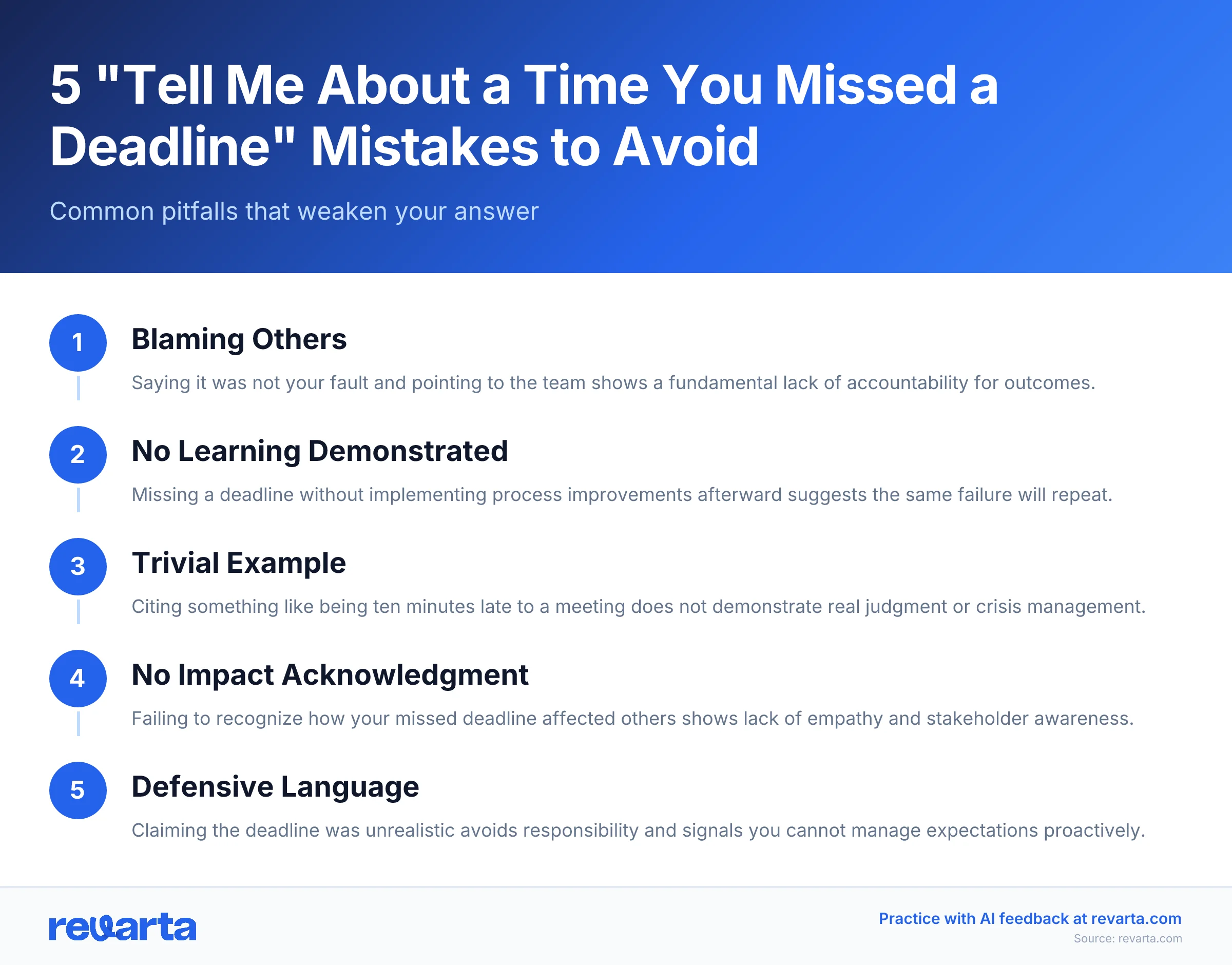
Organizations need people who own outcomes, not make excuses. Your response reveals whether you take responsibility without blame-shifting, acknowledge the impact on others, communicate problems transparently, and focus on solutions rather than justifications.
Evaluating Crisis Management
How you handle deadline pressure reveals crisis management capability. Interviewers assess whether you stay calm when timelines slip, prioritize recovery over panic, make difficult tradeoff decisions, and maintain quality despite time pressure.
Understanding Communication Patterns
Deadline misses often involve communication failures. Your story shows whether you communicate risks early rather than late, set realistic expectations proactively, escalate appropriately when needed, and keep stakeholders informed during recovery.
Measuring Learning and Adaptation
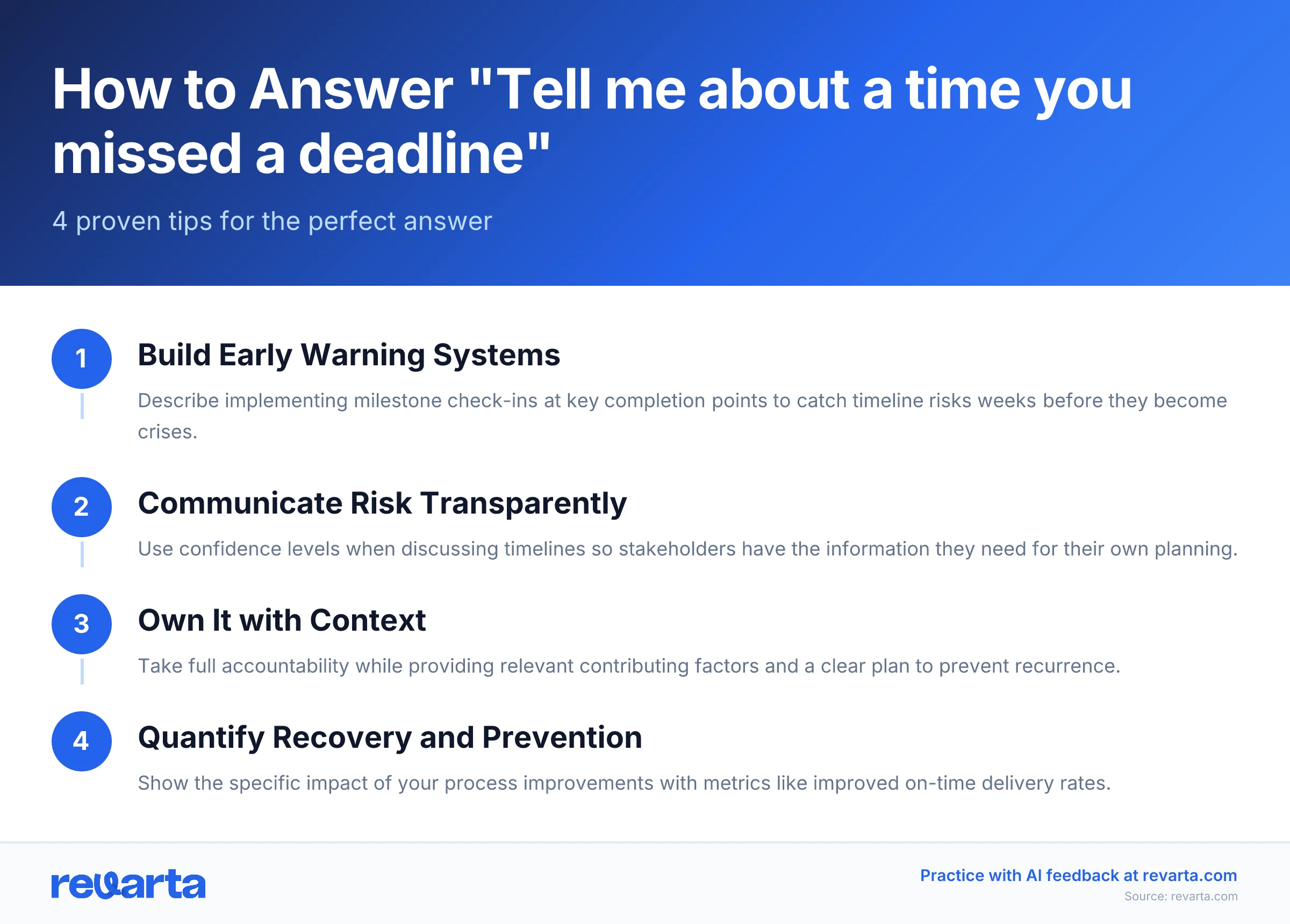
The best professionals turn failures into learning. Interviewers evaluate whether you analyze what went wrong systematically, implement preventive measures, apply lessons to future projects, and build better systems based on failures.
Gauging Professional Maturity
How you discuss failures reveals character. Your example reveals whether you can admit mistakes without defensiveness, discuss failures honestly in interviews, maintain perspective about setbacks, and demonstrate growth from difficulties.
The STAR Method for Missed Deadline Questions
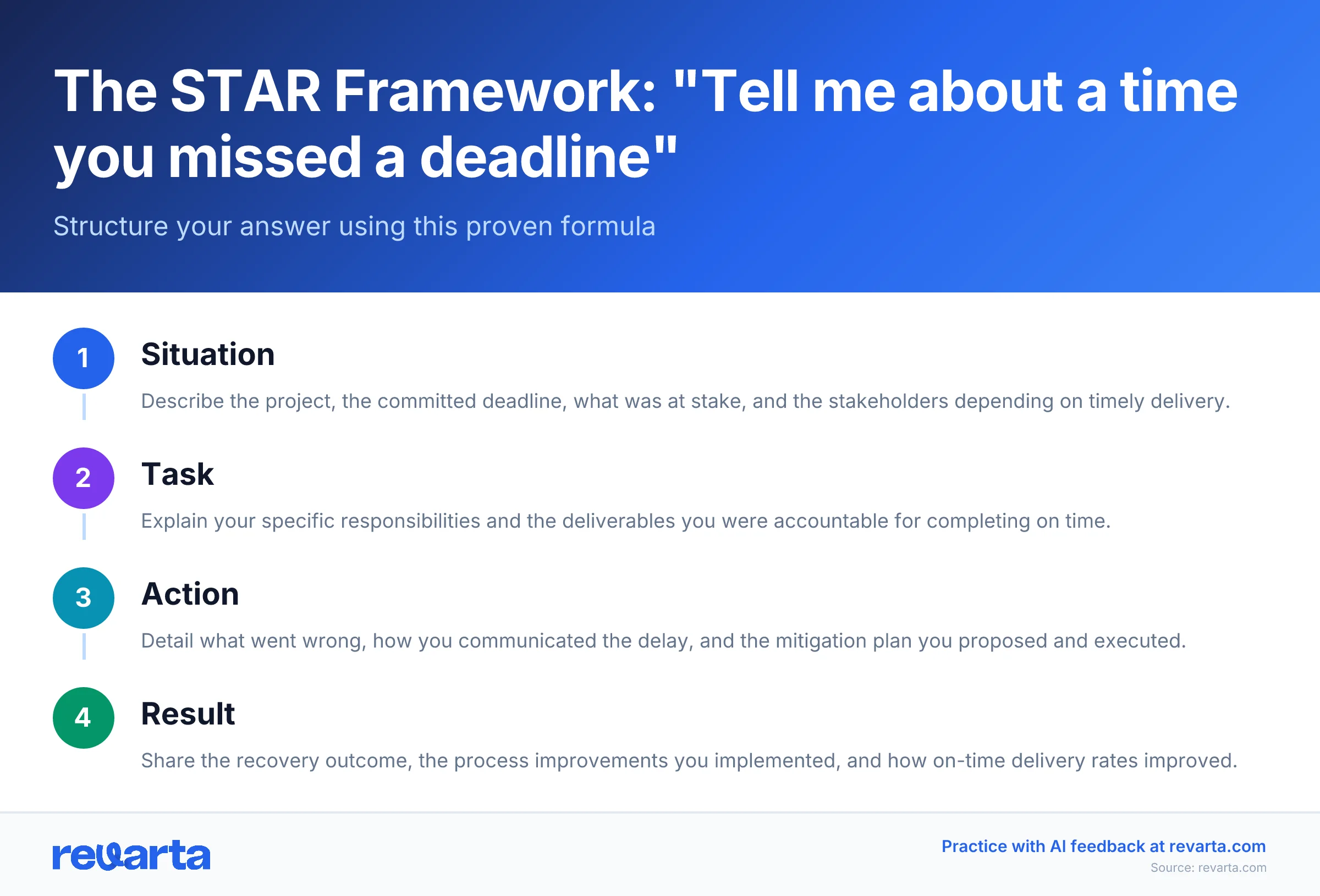
Situation (15%)
Example: "As a project manager at FinTech Solutions, I was leading implementation of a new payment processing system for a major retail client. The contract specified a launch date of November 1st to be ready for the holiday shopping season. The project involved integrating with their existing point-of-sale systems, migrating transaction data, training 500 store employees, and ensuring PCI compliance. The client had planned their entire holiday marketing campaign around this launch date."
Task (10%)
Example: "I needed to deliver a fully functional, compliant payment system by November 1st, coordinate work across engineering, compliance, training, and client teams, and ensure the system could handle projected holiday transaction volumes without errors."
Action (55%)
Example: "Throughout September, the project appeared on track according to our milestones. However, in early October—just four weeks before launch—our compliance testing revealed significant PCI security gaps that weren't caught in earlier reviews. Fixing these issues would require three weeks of additional development work.
This is where I made my critical mistake: instead of immediately communicating the timeline risk to the client, I hoped our team could work extra hours to make up the time. I didn't want to deliver bad news, so I delayed the difficult conversation for a week while we attempted to accelerate development.
By mid-October, it became clear we couldn't make the November 1st date even with overtime. I finally scheduled a call with the client VP to communicate the delay. This conversation was extremely difficult—I had to admit I had known about the risk for a week without communicating it, which understandably damaged their trust.
I took full accountability: 'Our compliance testing revealed critical security issues that will delay launch by three weeks to November 22nd. I should have communicated this risk to you immediately when we discovered it two weeks ago, and I apologize for the delay in informing you. This is my responsibility as project manager.'
The client was frustrated—justifiably—because they had already launched marketing campaigns promising the new payment system. I immediately proposed a mitigation plan: we could launch a limited version on November 1st at their flagship stores with the full rollout on November 22nd, allowing them to fulfill some of their marketing promises while we completed the security fixes.
I also brought in an additional compliance specialist at our expense to accelerate the security work, had our team work weekends (which I worked alongside them), and provided the client with daily written updates on progress.
Most importantly, I scheduled weekly calls with the client VP to rebuild trust through transparency. I didn't sugarcoat progress or make promises I wasn't certain we could keep."
Result (20%)
Example: "We successfully launched the limited version at 50 flagship stores on November 1st and completed the full rollout on November 22nd—meeting our revised timeline. The system processed over $15M in holiday transactions without any security incidents or downtime.
The client was not happy about the delay, and our account manager reported it affected our relationship for several months. However, the client eventually acknowledged our recovery effort and transparent communication during the crisis. We retained the account and expanded our work with them the following year.
Internally, this failure led to significant process improvements. I implemented: mandatory risk reviews at 75%, 50%, and 25% remaining timeline marks; 'red flag' protocols requiring immediate client communication of any risks; earlier and more comprehensive compliance testing; and realistic buffer time for complex integrations.
These changes improved our on-time delivery rate from 78% to 94% over the following year. More importantly, when we did encounter timeline risks, we now communicated them 3-4 weeks earlier than before, giving clients time to adjust plans.
This experience taught me that delaying bad news always makes situations worse. The week I spent hoping we could solve the problem without communicating it cost the client a week of planning time they could have used differently. I learned that stakeholders can handle bad news if communicated early with a plan, but they can't handle surprises.
Most significantly, I discovered that accountability means communicating problems immediately, not just fixing them afterward. My job wasn't to solve every problem silently—it was to ensure stakeholders had the information they needed when they needed it."