How to Answer "What Motivates You?": The Complete Interview Guide (2026)
"What motivates you?" is asked in over 75% of job interviews across all industries. This deceptively simple question reveals far more than your sources of inspiration—it exposes your values, work ethic, cultural fit, and long-term potential with the company. Yet most candidates stumble through generic answers about "challenges" or "success" without demonstrating genuine understanding of what drives their professional excellence.
This comprehensive guide provides everything you need to master this critical question: 15+ tailored sample answers for different career stages and industries, proven motivation frameworks, strategic alignment techniques, and AI-powered practice tools to perfect your authentic response.
Why Do Interviewers Ask "What Motivates You?"
Understanding the strategic purpose behind this question transforms your approach from generic to compelling. Interviewers use this question for multiple critical evaluation points:
Assessing Cultural and Role Alignment
Companies invest heavily in hiring decisions, with the average cost of a bad hire exceeding $15,000. Interviewers need to verify that what energizes you aligns with the actual daily responsibilities and culture of the role. If you're motivated by independent work but the role requires constant collaboration, that's a red flag for both parties.
Your motivation reveals whether you'll thrive or struggle in their specific environment. A startup motivated by stability and predictability won't succeed at a fast-paced venture-backed company experiencing rapid change.
Evaluating Long-Term Retention Potential
Employee turnover costs companies 6-9 months of an employee's salary. Hiring managers want to understand if this role and company can sustain your motivation over years, not just months. They're assessing whether you'll become disengaged once the initial excitement fades.
If your primary motivator is learning new technologies but the role involves maintaining legacy systems, you'll likely leave within a year. Interviewers use this question to predict longevity and reduce costly turnover.
Understanding Your Self-Awareness
The most successful professionals demonstrate deep understanding of what drives their best work. Interviewers assess whether you've reflected critically on your career patterns, recognizing what environments bring out your peak performance versus what situations lead to disengagement.
Candidates who haven't examined their motivations often give contradictory answers throughout the interview, revealing shallow self-knowledge. Those with genuine self-awareness demonstrate consistency between their stated motivations and their career trajectory.
Gauging Intrinsic vs. Extrinsic Motivation
Research consistently shows that intrinsically motivated employees—those driven by internal satisfaction, growth, and purpose—outperform those motivated primarily by external rewards like salary and titles. While compensation matters, interviewers want to see that you're energized by the work itself, not just the paycheck.
Candidates focused solely on extrinsic rewards often lack the resilience to push through difficult projects when external validation isn't immediately available. Intrinsic motivation predicts sustained high performance.
Revealing Your Value System
Your motivations expose your core professional values—whether you prioritize impact, innovation, collaboration, autonomy, excellence, or service. Interviewers assess whether these values align with company culture and team dynamics.
A candidate motivated by individual achievement and recognition may struggle in a highly collaborative culture that emphasizes team success over individual contributions. Understanding this alignment prevents mutual frustration.
What Interviewers Are Really Assessing
Beyond your words, interviewers evaluate multiple dimensions of your response:
Authenticity: Does your answer feel genuine, or are you saying what you think they want to hear? Authentic responses include specific examples and emotional resonance.
Specificity: Generic answers about "challenges" and "success" reveal limited self-reflection. Specific motivations tied to concrete examples demonstrate deep self-knowledge.
Consistency: Do your stated motivations align with your career history and the decisions you've made? Contradictions suggest lack of self-awareness or dishonesty.
Energy Level: Your tone and body language when discussing motivations should convey genuine enthusiasm. Flat delivery suggests you haven't truly connected with your answer.
Maturity: Entry-level candidates often focus on learning and growth; senior professionals should demonstrate motivation around impact, leadership, and organizational contribution.
Balance: The strongest answers show multiple motivation sources that complement each other, demonstrating well-rounded professional drive rather than single-minded obsession.
The Motivation Alignment Framework: Your Success Formula
The most effective answers align your genuine motivations with the role's realities and the company's values. This framework ensures authentic yet strategic responses.
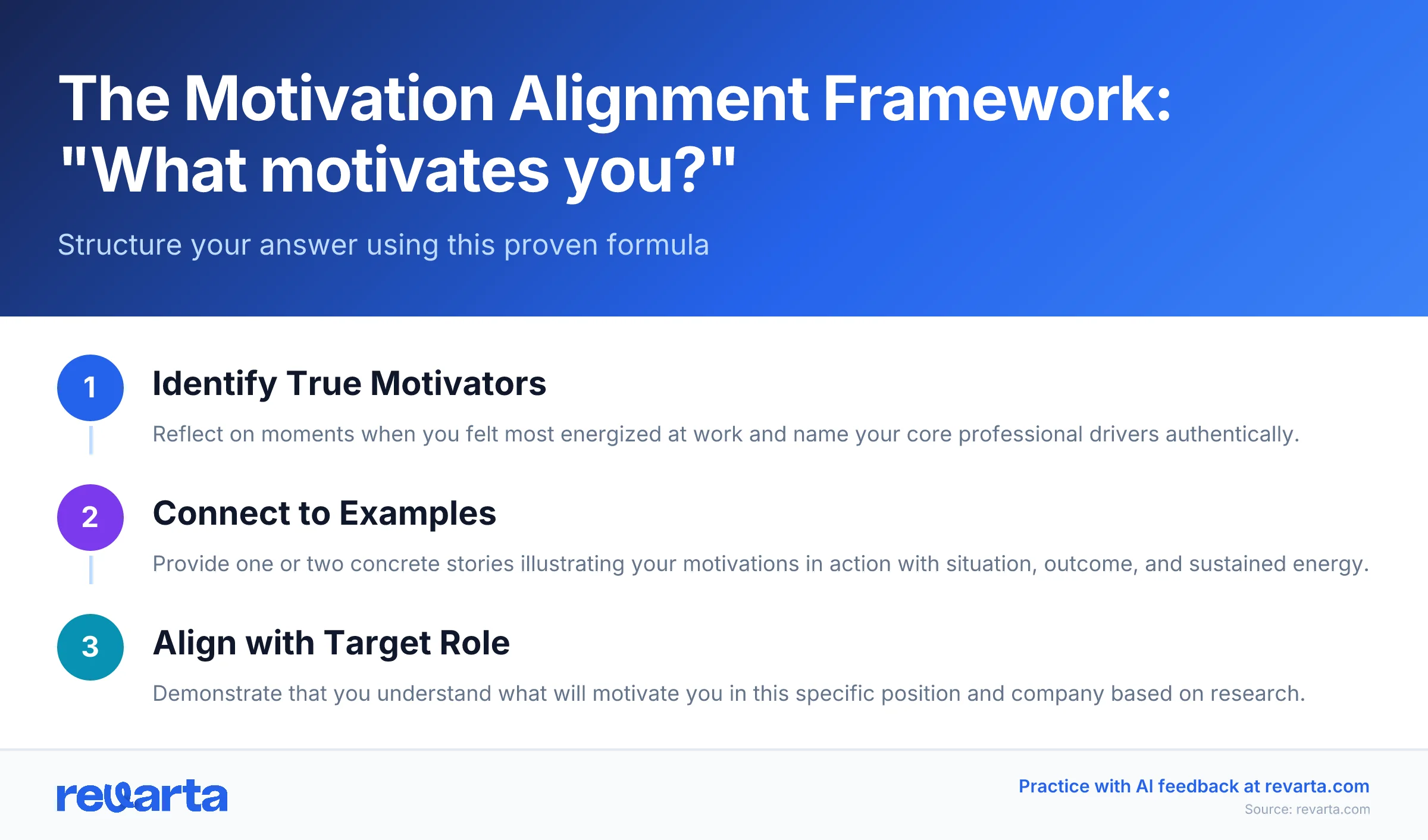
Step 1: Identify Your True Motivators (30% of answer)
Start by reflecting on moments when you've felt most energized and engaged at work. Common professional motivators include:
- Impact and Purpose: Making a meaningful difference
- Mastery and Growth: Developing expertise and learning
- Autonomy and Ownership: Having control over your work
- Recognition and Achievement: Receiving acknowledgment for accomplishments
- Collaboration and Belonging: Working with talented teams
- Innovation and Creativity: Solving novel problems
- Helping Others: Mentoring, teaching, service
- Competitive Excellence: Being the best, winning
Example:
"I'm most motivated by seeing the direct impact of my work on customers. In my current role as a product manager, what energizes me every morning is knowing that the features I'm building will help thousands of small business owners save time and grow their companies."
Step 2: Connect to Specific Examples (40% of answer)
Provide 1-2 concrete stories that illustrate your motivations in action. This transforms abstract claims into credible evidence.
Structure: Situation + Motivation in Action + Outcome + Sustained Energy
Example:
"Last year, I led a project to redesign our checkout flow. I was incredibly energized throughout the six-month timeline because I knew reducing friction could increase conversions and help more entrepreneurs succeed. I voluntarily took on extra research interviews and stayed late prototyping solutions—not because I had to, but because I was genuinely excited about the potential impact. When we launched and saw conversions increase by 28%, resulting in an additional $2M in annual merchant revenue, that validation of making a real difference sustained my motivation to tackle even more challenging problems."
Step 3: Align With the Target Role (30% of answer)
Demonstrate that you understand what will motivate you specifically in this position and company. Research their mission, culture, and challenges to make explicit connections.
Example closing: "I'm particularly excited about this senior product manager role at your company because your mission of democratizing financial access directly aligns with my motivation around impact. The opportunity to work on features that help underserved communities build credit and financial stability is exactly the kind of meaningful challenge that will drive my best work. I've seen how your team prioritizes user research and data-driven iteration, which complements my motivation to deeply understand user needs and continuously improve."
Discover more strategies for aligning your answers with company values
15+ Sample Answers for Every Situation
Entry-Level Professional Examples
Recent Graduate - Technology Role
"I'm most motivated by continuous learning and tackling problems I haven't solved before. During my computer science degree, I discovered that I'd often work on coding projects late into the night not because I had to, but because I was genuinely excited to figure out how to implement a new algorithm or optimize performance.
For example, in my senior capstone project, our team was building a machine learning model for predicting student success. When we hit a wall with accuracy, I spent an entire weekend diving into academic papers and experimenting with different neural network architectures. That challenge energized rather than discouraged me. When we finally achieved 89% accuracy—up from 72%—that breakthrough feeling reinforced my love of solving complex technical problems.
I'm excited about this junior developer position because you're working with cutting-edge technologies like GraphQL and serverless architecture that I haven't mastered yet. The opportunity to learn from senior engineers while building production systems that serve millions of users represents exactly the kind of growth and challenge that motivates my best work."
Career Changer - From Teaching to Corporate Training
"After eight years as a high school teacher, what truly motivates me is seeing people have 'aha moments' when concepts click—but I've realized I'm ready to apply that passion in a corporate environment where I can design scalable learning programs.
As a teacher, my most energizing days weren't when I delivered perfect lectures, but when I saw struggling students finally master difficult concepts through different instructional approaches I'd developed. I voluntarily ran after-school tutoring sessions because nothing felt better than witnessing that transformation. However, I reached a point where I wanted to create learning experiences that could impact hundreds or thousands of professionals rather than being limited to my classroom.
I'm motivated by this corporate training specialist role because you're developing enterprise-wide onboarding and development programs that reach employees across multiple countries. The combination of instructional design, data analysis to measure learning outcomes, and the scale of impact aligns perfectly with my evolution from individual educator to learning systems designer. The idea of creating training that accelerates thousands of professionals' growth energizes me far more than another school year of the same curriculum."
Mid-Career Professional Examples
Marketing Manager - B2B SaaS
"I'm most motivated by using data to drive measurable business results and then optimizing for even better performance. The intersection of creativity and analytics is where I thrive. I find the process of hypothesis testing, measuring outcomes, and iterating toward excellence genuinely exciting rather than tedious.
In my current role at CloudTech, I redesigned our demand generation strategy based on deep analysis of our customer journey data. What motivated me through the challenging three-month overhaul wasn't just the potential results—it was the investigative process of discovering why our previous approach wasn't working and designing a better system. I voluntarily spent evenings analyzing cohort behavior and weekends building new measurement dashboards because I was energized by the puzzle-solving aspect.
When we launched the new strategy and saw qualified leads increase by 127% while reducing cost per acquisition by 34%, that validation drove me to immediately start optimizing further. Six months later, we'd improved those metrics another 40% through continuous testing and refinement. The cycle of analyze-hypothesize-test-learn is what gets me excited to start work each Monday.
This senior marketing manager position appeals to me because you're scaling from $10M to $50M ARR, which requires exactly the kind of data-driven growth strategy development that motivates me. The opportunity to build measurement systems and optimize across the entire funnel represents the perfect challenge at this stage of my career."
Software Engineering Lead
"I'm fundamentally motivated by two complementary forces: solving complex technical challenges that seem impossible at first, and mentoring engineers to achieve breakthroughs they didn't think they were capable of. The combination of technical excellence and people development energizes my best work.
Last year, our team faced a critical scalability crisis—our API response times were degrading to the point of losing customers. What motivated me wasn't just fixing the problem, but using it as an opportunity to teach our junior engineers about distributed systems architecture. I could have solved it myself in a few days, but I invested three weeks pairing with team members, explaining tradeoffs between different approaches, and letting them implement solutions with guidance.
The energy I got from seeing our team architect a solution that reduced response times by 89% while watching three junior engineers level up their systems thinking skills was far more rewarding than if I'd solved it alone. Two of those engineers have since led their own complex projects successfully because they learned those problem-solving frameworks.
I'm excited about this engineering manager role because you're growing the team from 8 to 20 engineers while tackling significant technical challenges around real-time data processing. The opportunity to build high-performing teams that solve hard problems while developing the next generation of technical leaders combines both aspects of what drives my best work."
Senior Professional Examples
VP of Sales - Enterprise SaaS
"After 15 years in enterprise sales, I've discovered what truly motivates me is building sales organizations from good to exceptional by developing people and refining systems. I'm energized by the challenge of taking talented salespeople and transforming them into high-performing teams that consistently exceed targets.
At my current company, I inherited a team that was hitting 73% of quota and had high turnover. What motivated me wasn't just improving numbers—it was the systematic problem-solving of diagnosing what wasn't working, implementing better methodologies, and watching individuals transform into confident closers. I spent the first three months shadowing calls, analyzing pipeline data, and identifying that our qualification process was broken and our sales training was outdated.
Over the next 18 months, I redesigned our sales methodology, implemented comprehensive onboarding, established a mentorship program, and rebuilt our compensation structure. The team went from 73% to 142% of quota, but what truly energized me was seeing individual transformations—watching a struggling rep who was about to be fired become our top performer after implementing the new approach, or seeing a junior SDR I'd mentored get promoted to Account Executive and close our largest deal that year.
This Chief Revenue Officer position excites me because you're at the critical inflection point of scaling from $30M to $100M ARR. That growth phase requires building a world-class revenue organization from the ground up—exactly the kind of systemic challenge and people development opportunity that motivates me to do my best work. The chance to shape company culture while driving revenue excellence represents the perfect combination of impact and challenge."
Industry-Specific Examples
Healthcare - Registered Nurse
"I'm fundamentally motivated by being present in the most critical moments of people's lives and making a tangible difference when it matters most. What energizes me about critical care nursing is the combination of clinical expertise, quick decision-making, and the profound human connection that happens in those vulnerable moments.
I discovered this in my first year as a med-surg nurse when I cared for a patient who coded unexpectedly during my shift. During those intense minutes of coordinating the response, communicating with family, and fighting for his life, I felt completely focused and energized rather than overwhelmed. When he stabilized and eventually recovered, the gratitude from his family and the knowledge that my clinical judgment and quick action had saved a life created a sense of purpose I'd never experienced before.
That motivation led me to pursue critical care certification and specialize in ICU nursing. I voluntarily take the most complex cases because I thrive on the challenge of managing multiple interventions simultaneously and the satisfaction of seeing patients recover against difficult odds. Even after 12-hour shifts managing ventilators, titrating medications, and preventing complications, I leave energized knowing I've been someone's best advocate during their most vulnerable time.
This ICU nurse educator position combines my clinical motivation with my passion for developing the next generation of critical care nurses. The opportunity to train new nurses to excel in high-pressure environments while continuing to practice clinically represents the evolution of my purpose from individual patient impact to multiplying that impact through teaching others."
Sales - Financial Services
"I'm motivated by solving complex financial challenges for clients and earning their trust through deep expertise and genuine advocacy. What energizes me isn't closing deals—it's the moment when a client realizes I've helped them see their financial situation more clearly and given them a path to achieve goals they thought were impossible.
Early in my financial planning career, I worked with a small business owner who was convinced he couldn't afford to retire before 70 because of business debt and college expenses for three children. What motivated me through dozens of hours of analysis wasn't the commission—it was the puzzle of optimizing his tax strategy, restructuring debt, and identifying efficiencies in his business operations. When I showed him a concrete plan to retire at 62 while fully funding his children's education, his emotional reaction drove home why I love this work.
That client has since referred 23 other business owners to me, but what continues to motivate me isn't the revenue—it's that each referral represents someone I helped so substantially that they trusted me with their network. I spend significant time on continuing education not because it's required, but because I'm genuinely excited about discovering new strategies like advanced estate planning techniques or tax-efficient charitable giving that I can apply to help clients achieve more.
This senior wealth advisor position at your firm excites me because you focus on multi-generational wealth planning for business owners—exactly the kind of complex, high-impact advisory work that motivates me. The opportunity to build long-term relationships with families while solving sophisticated financial challenges represents the intersection of expertise and meaningful impact that drives my best work."
Non-Profit - Program Director
"I'm motivated by systemic impact—creating programs and solutions that address root causes rather than symptoms, and seeing measurable improvement in community outcomes over time. What energizes me is designing interventions that work at scale and using data to continuously improve their effectiveness.
In my current role running workforce development programs, I could have stayed focused on placing individual participants in jobs, which is rewarding but limited. Instead, what motivated me was identifying that our participants faced common barriers—transportation, childcare, and professional clothing—that we weren't addressing. I spent six months building partnerships with local transit authorities, childcare providers, and clothing donation programs to create wraparound services.
The energy I got from designing this ecosystem of support and then seeing our 90-day job retention rates increase from 42% to 78% reinforced my passion for systems-level solutions. We've now placed over 1,000 individuals in sustainable careers using this model, but what truly motivates me is knowing we've created a replicable framework that other programs can adopt.
This executive director position excites me because your organization works at the policy and systems level to create economic opportunity, which is exactly where I believe we can achieve transformational impact. The chance to influence workforce policy while running direct-service programs represents the perfect combination of immediate community impact and long-term systemic change that motivates my best work."
Special Situations
Returning to Workforce After Career Break
"I'm motivated by solving challenging problems through creative thinking and collaboration—but my three-year career break to care for my aging parents reinforced something deeper: I'm also motivated by work that has clear purpose and allows me to contribute to something larger than myself.
Before my break, I was motivated primarily by technical challenges and advancement. As a senior analyst in market research, I loved diving into complex data sets and uncovering insights. That intellectual stimulation was enough to drive 60-hour weeks. However, my time away caring for family forced me to reflect on what truly makes work meaningful for me. I realized I was missing a sense of purpose beyond the analytical challenge.
During my break, I volunteered with a healthcare advocacy organization, applying my research skills to analyze patient outcomes data. What energized me was using the same analytical abilities but for a mission I deeply cared about—improving patient care. I found myself more motivated doing unpaid work with clear social impact than I'd been in some of my highest-paid corporate roles.
I'm excited about this senior researcher position at your healthcare consultancy because it combines the complex analytical challenges that have always energized me with meaningful impact on healthcare delivery and patient outcomes. The opportunity to apply rigorous research methodology to solve problems that directly improve people's health represents the evolution of my professional motivations—from pure intellectual challenge to purpose-driven excellence."
Entrepreneurial Professional Joining Corporate Environment
"After five years running my own digital marketing agency, I've discovered that while I love entrepreneurial thinking and innovation, what truly motivates me is scaling impactful solutions beyond what I can achieve with limited resources. I'm ready to apply that entrepreneurial drive within an organization that has the infrastructure and reach to achieve massive impact.
As a solo entrepreneur, I was motivated by the creative freedom and direct client impact—building campaigns that drove real ROI for small businesses. My most energizing projects were when I'd develop innovative approaches that dramatically outperformed traditional tactics. For example, I created a local SEO strategy for a restaurant client that increased their online orders by 340% in six months.
However, I reached a ceiling where my impact was limited by time and resources. What would take me months to implement for one client could be deployed across hundreds of companies with proper infrastructure. That realization shifted my motivation from independence to leverage—I'm excited about applying entrepreneurial thinking at scale.
This growth marketing director role appeals to me because you're looking for someone who can bring startup agility and creative problem-solving to a scaling organization. The opportunity to experiment rapidly, take calculated risks, and deploy winning strategies across a large customer base combines my entrepreneurial mindset with the scale of impact that now motivates me most. I'm energized by the challenge of maintaining innovative thinking while working within corporate structures to achieve far greater reach."
Common Variations of This Question
Interviewers often rephrase motivation questions to gain different perspectives. Prepare for these variations:
Alternative Phrasings
- "What drives you professionally?"
- "What gets you excited to come to work?"
- "What makes you passionate about your work?"
- "What energizes you in your career?"
- "What do you find most rewarding about your work?"
- "What keeps you motivated when things get difficult?"
- "What aspects of work do you find most fulfilling?"
Specific Variations
- "What motivated you in your last role?"
- "What would motivate you in this position specifically?"
- "How do you stay motivated during challenging projects?"
- "What kind of work environment motivates you most?"
- "What demotivates you?" (Flip side—answer carefully)
Response Strategy
For all variations, use the same Motivation Alignment Framework. These questions all seek to understand your core drivers and their alignment with the role. Stay authentic while emphasizing motivations that align with the position's realities.
Advanced Strategies and Pro Tips
Research-Based Alignment
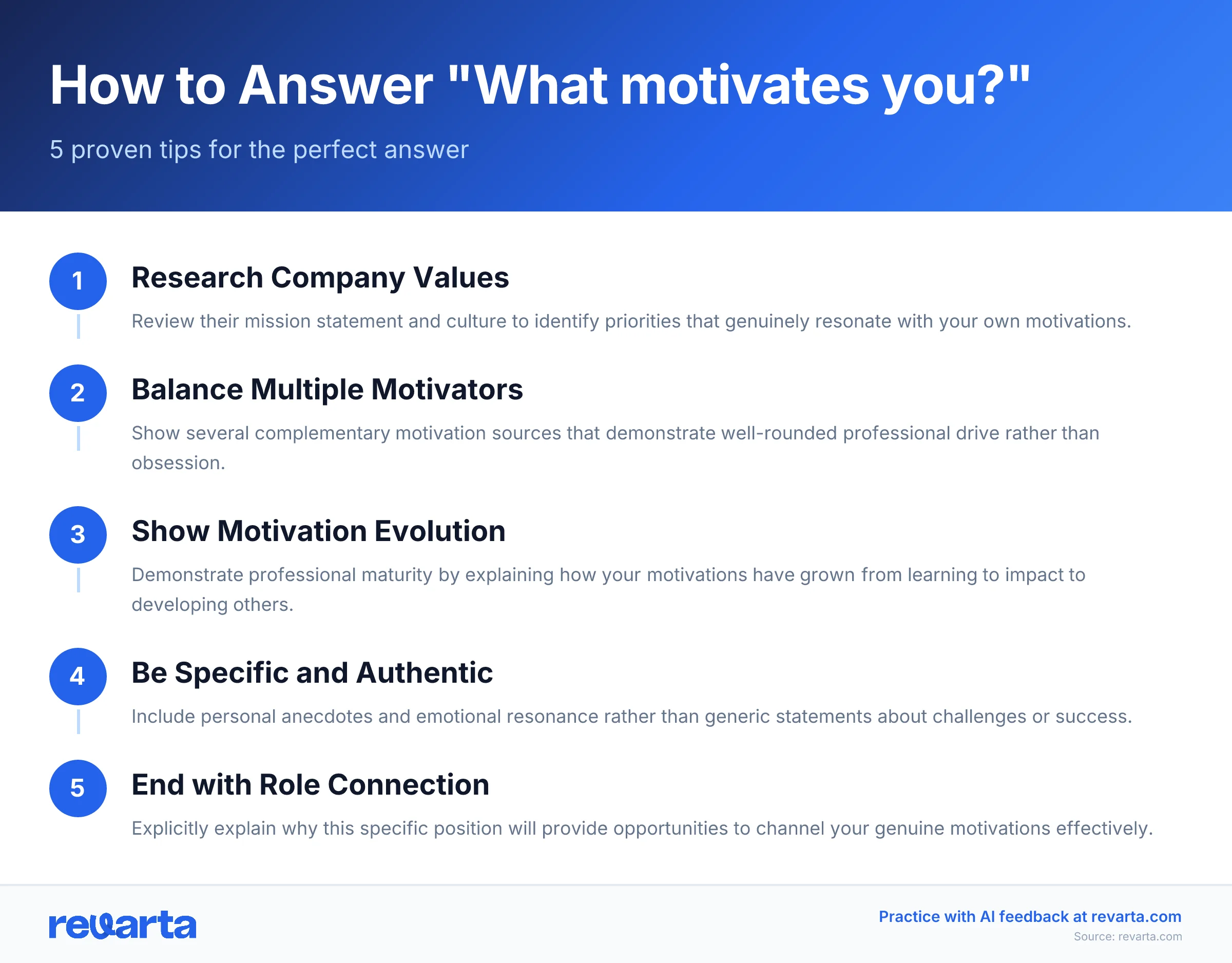
Study Company Values: Review their mission statement, social media presence, and employee reviews on Glassdoor. Identify 2-3 core values that resonate with your genuine motivations.
Analyze the Job Description: Look for repeated themes—do they emphasize innovation, collaboration, customer impact, growth? Ensure your answer addresses these priorities.
Review Recent Company News: Have they launched new products, expanded to new markets, or received industry recognition? Reference these developments when connecting your motivations to their trajectory.
Balancing Multiple Motivators
The strongest answers acknowledge that you have several complementary motivations rather than just one:
Example:
"I'm primarily motivated by technical mastery and continuous learning, but I've also discovered that collaboration with talented teammates amplifies my motivation. Solo work allows me to go deep on problems, but the creative energy of brainstorming with a strong team pushes me to develop better solutions than I'd create alone."
Showing Motivation Evolution
Demonstrate professional maturity by showing how your motivations have evolved:
Example:
"Early in my career, I was primarily motivated by learning and skill development—I wanted to become an expert. As I gained expertise, my motivation shifted toward impact—using those skills to drive meaningful results. Now, I'm most motivated by developing others and building systems that enable teams to achieve exceptional outcomes. Each phase of motivation built on the previous one."
Authenticity Over Perfection
Interviewers detect rehearsed, inauthentic answers. The most compelling responses include:
- Specific personal anecdotes, not generic statements
- Emotional resonance when discussing what energizes you
- Acknowledgment that motivations have evolved over time
- Honest connection to your career choices and trajectory
Avoid: "I'm motivated by challenges." (Too generic)
Better: "I'm energized specifically by resource-constrained challenges where creative problem-solving can deliver outsized results despite limitations."
Common Mistakes to Avoid
Content Mistakes
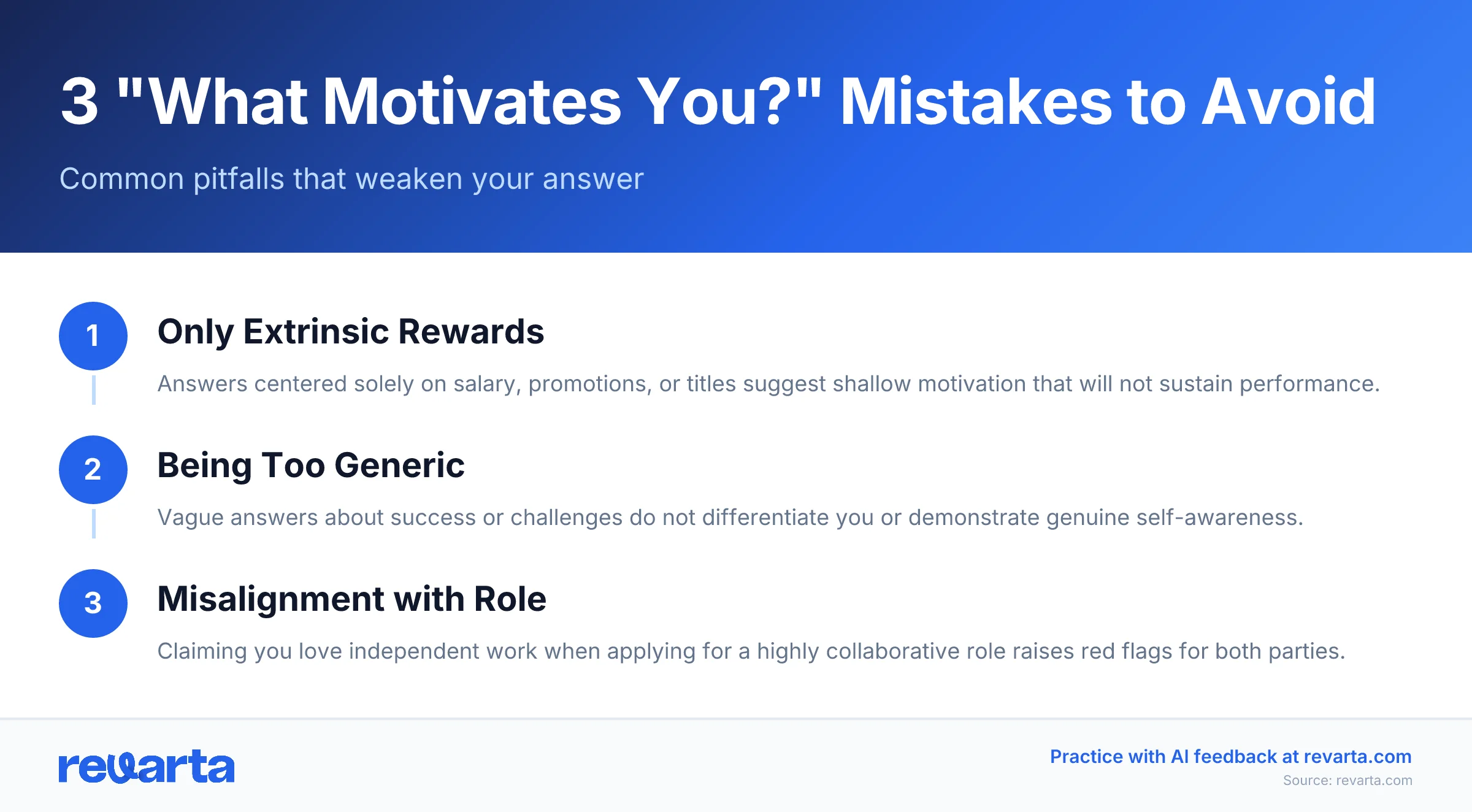
Focusing Only on Extrinsic Rewards: Answers centered solely on salary, promotions, or titles suggest shallow motivation that won't sustain performance. While compensation matters, lead with intrinsic drivers.
Being Too Generic: Vague answers about "success," "challenges," or "growth" don't differentiate you or demonstrate self-awareness. Specificity shows genuine reflection.
Misalignment with Role Realities: Claiming you're motivated by independent work when applying for a highly collaborative role, or stating you love fast-paced change when joining a stable, process-oriented company.
Sharing Motivations Unrelated to Work: Personal motivators like family, hobbies, or travel are fine in moderation but shouldn't dominate your professional motivation answer.
Complaining About Past Demotivators: Even when asked what demotivates you, frame answers positively. Instead of "I hate micromanagement," say "I'm most motivated when given autonomy to solve problems creatively."
Structure Mistakes
Lacking Concrete Examples: Claims without evidence feel hollow. Always support stated motivations with specific situations where that motivation drove your actions and results.
Rambling Without Direction: Plan your answer structure beforehand: State motivation + Example + Connection to role. Practice delivering this in 90-120 seconds.
Ending Without Connection to the Role: Don't just state your motivations—explicitly explain why this position will provide opportunities to channel those motivations effectively.
Delivery Mistakes
Low Energy When Discussing Motivations: Your tone should naturally elevate when discussing what genuinely excites you. Flat delivery suggests you're not being authentic.
Overrehearsal Leading to Robotic Delivery: While preparation is crucial, practice until your answer sounds conversational, not memorized.
Defensive Body Language: Maintain open posture and good eye contact. Closed-off body language contradicts claims about being motivated by collaboration or communication.
Industry-Specific Considerations
Technology Sector
Emphasize motivations around:
- Innovation and cutting-edge problem-solving
- Continuous learning in rapidly evolving field
- Building products that scale to impact millions
- Technical mastery and elegant solutions
- Collaboration in agile, cross-functional teams
Example phrase: "I'm motivated by architecting solutions that balance technical elegance with practical scalability—code that's beautiful under the hood but also serves real user needs at scale."
Healthcare Industry
Focus on motivations related to:
- Patient outcomes and improving lives
- Clinical excellence and evidence-based practice
- Working in high-pressure, high-stakes environments
- Continuous learning to stay current with medical advances
- Collaboration in multidisciplinary care teams
Example phrase: "I'm motivated by being present in patients' most vulnerable moments and using clinical expertise to change their outcomes—there's no greater privilege or responsibility."
Financial Services
Highlight motivations around:
- Solving complex financial challenges
- Building trusted advisor relationships
- Data analysis and risk management
- Helping clients achieve financial security
- Navigating regulatory complexity
Example phrase: "I'm motivated by solving financial puzzles that seem impossible at first—finding the combination of strategies that helps clients achieve goals they thought were out of reach."
Education and Non-Profit
Emphasize motivations involving:
- Systemic impact and community change
- Mission-driven work with clear social purpose
- Seeing growth and transformation in others
- Creative problem-solving with limited resources
- Collaborative partnerships for greater good
Example phrase: "I'm motivated by creating programs that address root causes—solutions that don't just help individuals but change systems to create opportunity for entire communities."
Follow-Up Questions to Prepare For
Your motivation answer often triggers deeper exploration. Be ready for:
About Sustained Motivation
- "How do you maintain motivation when facing obstacles or setbacks?"
- "Tell me about a time when you lost motivation. How did you recover?"
- "What happens when the initial excitement of a project fades?"
Strategy: Show resilience and self-regulation. Discuss how connecting back to impact or breaking down challenges into smaller wins reignites your drive.
About Motivation in This Role
- "Based on what you know about this position, what specifically would motivate you here?"
- "How do you think this role aligns with what motivates you?"
- "What concerns do you have about staying motivated in this position?"
Strategy: Reference specific aspects from job description and company research. Show you understand role realities, not just idealized version.
About Team Dynamics
- "How does working with others factor into your motivation?"
- "What kind of manager or team brings out your best work?"
- "How do you motivate others on your team?"
Strategy: Demonstrate that you understand motivation exists within a team context. Show how your motivations complement collaborative environments.
Practice Tools and Resources
AI-Powered Practice with Revarta
Use Revarta's interview coaching platform to:
- Record your motivation answer and receive feedback on authenticity and structure
- Practice with various question phrasings to develop flexible responses
- Get personalized suggestions based on your target industry and role level
- Simulate follow-up questions based on your specific answer
Start practicing your motivation answer with AI feedback
Self-Reflection Exercises
Before your interview, complete these exercises:
-
Peak Moments Inventory: List 5 professional moments when you felt most energized. Identify common themes.
-
Motivation vs. Task Matrix: For your current or recent role, map daily tasks against how motivated you felt. Patterns reveal true drivers.
-
Career Decision Analysis: Review major career choices (job changes, projects accepted, etc.). What motivated those decisions?
-
Energy Tracking: For one week, note tasks that energized vs. drained you. Quantify the patterns.
Recording and Review
- Record yourself answering "What motivates you?" in different ways
- Listen for authenticity—does your voice convey genuine enthusiasm?
- Time your response—aim for 90-120 seconds
- Get feedback from mentors who know you well—does it ring true?
Final Preparation Checklist
Before Every Interview
✅ Review company mission, values, and recent news
✅ Identify 2-3 company priorities that align with your genuine motivations
✅ Prepare your core motivation answer using the framework
✅ Develop 2-3 specific examples that illustrate your motivations
✅ Practice out loud at least 3 times until it sounds natural
✅ Prepare for common follow-up questions
✅ Reflect on how this specific role channels your motivations
Day of Interview
✅ Review your prepared examples one final time
✅ Connect emotionally with what genuinely excites you about the work
✅ Prepare to deliver with authentic energy and enthusiasm
✅ Remind yourself of specific ways this role aligns with your drivers
Turning Motivation Into Your Advantage
"What motivates you?" isn't just about explaining what drives you—it's your opportunity to demonstrate self-awareness, show strategic thinking about cultural fit, and paint a compelling picture of why this role will bring out your best work.
When you master this question, you:
- Differentiate yourself from candidates with generic answers
- Demonstrate maturity through thoughtful self-reflection
- Build interviewer confidence that you'll stay engaged long-term
- Create alignment between your needs and company's environment
- Show authenticity that builds trust and connection
Remember, interviewers aren't looking for perfect motivations—they're assessing honest alignment. The strongest answers reveal genuine drivers while demonstrating you've researched how this specific role will channel those motivations toward mutual success.
Conclusion
Mastering "What motivates you?" requires honest self-reflection combined with strategic alignment to the role and company. With the Motivation Alignment Framework, industry-specific guidance, and comprehensive preparation using AI-powered tools, you can transform this challenging question into a powerful demonstration of cultural fit and long-term potential.
Your motivations are unique to you—own them authentically while showing you've done the work to understand how this opportunity aligns with what drives your best work. Invest the time to craft a genuine, specific response that reveals your professional drivers and positions you as the candidate who will thrive in their environment.
Start practicing today with Revarta's AI interview coach, and turn your next "What motivates you?" moment into compelling evidence that you're the right long-term fit for the role.
Keep Preparing


