
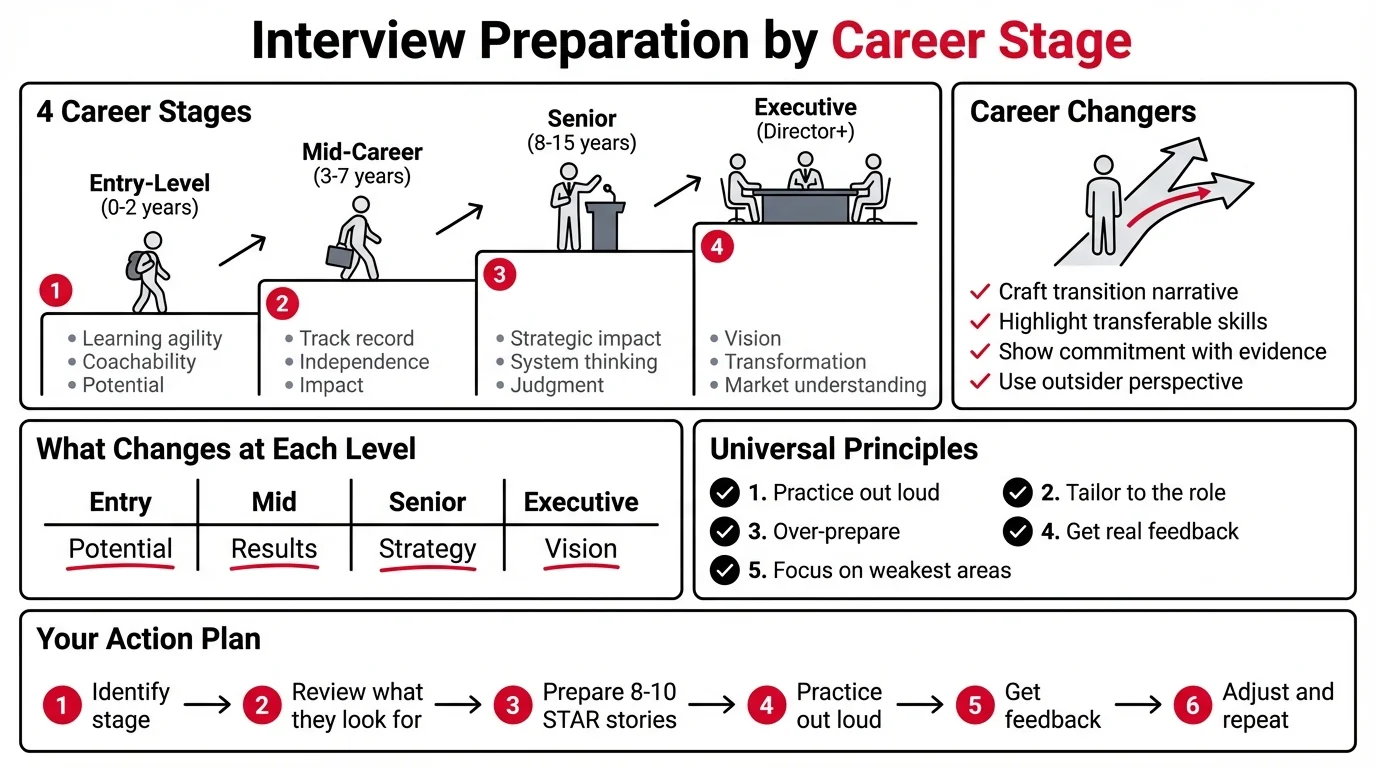
What worked for your entry-level interview won't work at the director level. What convinced your last employer won't resonate with your next one. Interview preparation isn't one-size-fits-all—it's career-stage-specific.
Here's your roadmap based on where you are now.
Why Career Stage Matters
Interviewers assess you differently depending on your experience level. A recent graduate is evaluated on potential and learning agility. A senior leader is evaluated on strategic thinking and organizational impact.
The questions change. The expectations change. The stories you tell change.
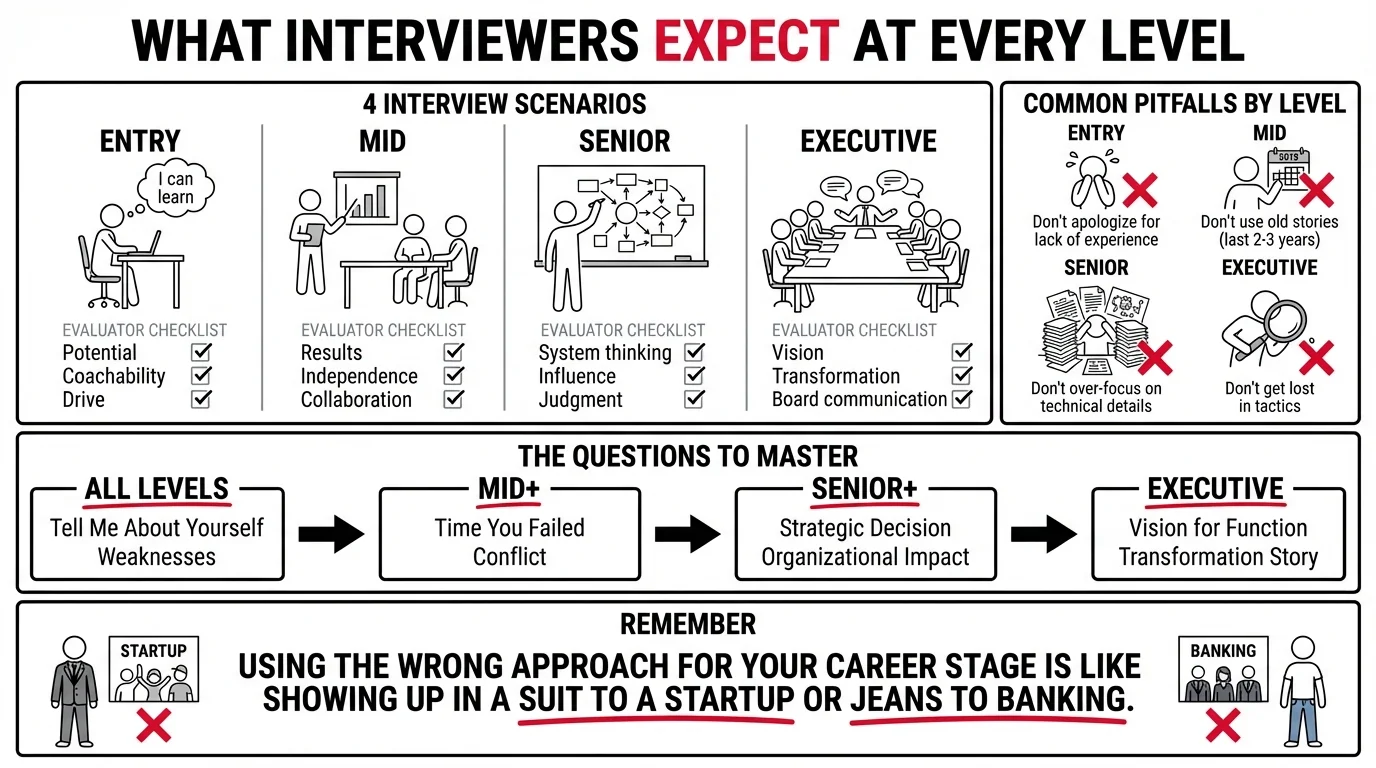
Using the wrong approach for your career stage is like showing up in a suit to a startup interview or wearing jeans to a banking interview. Technically, you're dressed—but you're sending the wrong signal.
Entry-Level Interviews (0-2 Years Experience)
What Interviewers Are Looking For
At this stage, you don't have extensive professional experience. Interviewers know this. They're assessing:
- Learning agility - Can you pick up new skills quickly?
- Coachability - Do you take feedback well?
- Cultural fit - Will you thrive in our environment?
- Potential - Where could you be in 3-5 years?
- Drive - Are you motivated and proactive?
Your Preparation Strategy
1. Mine Your Academic and Project Experience
You may not have years of work experience, but you have:
- Class projects where you collaborated with teams
- Leadership roles in student organizations
- Internships or part-time work
- Personal projects or side hustles
- Volunteer work
Frame these experiences using the STAR method just like professional examples.
Example: "In my senior capstone project (Situation), I was responsible for coordinating four team members with different schedules (Task). I created a shared project board, set up weekly check-ins, and assigned tasks based on each person's strengths (Action). We delivered two weeks early with a 95% grade (Result)."
2. Emphasize Transferable Skills
Even if your experience isn't directly related, highlight transferable skills:
- Communication (presenting, writing, explaining)
- Problem-solving (debugging, researching, troubleshooting)
- Teamwork (collaborating, resolving conflicts, contributing)
- Time management (balancing coursework, projects, work)
- Initiative (going beyond requirements, self-teaching)
3. Show You Can Learn Quickly
Prepare 2-3 stories that demonstrate learning agility:
- "Tell me about a time you had to learn something quickly"
- "Describe a situation where you faced an unfamiliar challenge"
- "Give an example of teaching yourself a new skill"
4. Address the Experience Gap Proactively
Don't apologize for limited experience. Instead, flip it:
❌ "I know I don't have much experience, but..." ✅ "While I'm early in my career, I've already demonstrated [specific skill] through [concrete example]."
5. Prepare Strong Questions
Your questions signal what you care about. Ask about:
- Growth and development opportunities
- What success looks like in the first 90 days
- The team structure and who you'll work with
- What a typical project looks like
- How the company supports early-career professionals
Learn how to structure answers effectively
Common Pitfalls to Avoid
- Over-apologizing for lack of experience
- Speaking in generalities instead of specific examples
- Not preparing STAR stories from academic/project experience
- Underselling your accomplishments
- Failing to ask thoughtful questions
Mid-Career Interviews (3-7 Years Experience)
What Interviewers Are Looking For
You're past proving you can do the work. Now they're assessing:
- Track record - Have you delivered meaningful results?
- Independence - Can you own projects end-to-end?
- Collaboration - Can you work across teams effectively?
- Impact - Have you moved the needle on important metrics?
- Growth trajectory - Are you trending upward?
Your Preparation Strategy
1. Quantify Everything
At this stage, vague statements kill your credibility. Prepare numbers:
❌ "I improved the process" ✅ "I reduced deployment time from 4 hours to 30 minutes, saving the team 3.5 hours per release"
❌ "I worked on a major project" ✅ "I led the redesign of our checkout flow, resulting in a 23% increase in conversion rate and $1.2M additional annual revenue"
2. Demonstrate Cross-Functional Leadership
You don't need formal management experience, but you need to show you can:
- Influence stakeholders across teams
- Navigate competing priorities
- Drive alignment without authority
- Communicate effectively with technical and non-technical audiences
Prepare 3-4 stories showing cross-functional collaboration and influence.
3. Show Strategic Thinking
Move beyond "here's what I did" to "here's why it mattered":
❌ "I built a new feature" ✅ "I identified a gap in our user onboarding based on analytics showing 40% drop-off. I built a contextual help feature that reduced drop-off to 18%, directly supporting our goal of reaching 1M active users."
4. Prepare for "Why Are You Leaving?" Questions
Be prepared to explain career transitions honestly without badmouthing previous employers:
✅ "I'm looking for opportunities to work on problems at greater scale" ✅ "I want to deepen my expertise in [domain] and this role offers that" ✅ "I'm seeking a company where [value] is a priority, and your work in [area] aligns with that"
5. Address Career Gaps or Pivots
If you have gaps or are switching industries, prepare a clear narrative:
- Acknowledge the transition
- Explain the reasoning
- Highlight transferable skills
- Show you've done your homework
Why behavioral interviews dominate hiring
Common Pitfalls to Avoid
- Relying on old stories - Use recent examples (last 2-3 years)
- Taking credit for team work - Use "I" for your contributions but acknowledge team context
- Lacking specificity - Vague answers signal lack of real impact
- Not preparing for "why leave" questions
- Underselling your leadership even without direct reports
Senior-Level Interviews (8-15 Years Experience)
What Interviewers Are Looking For
At senior levels, technical competence is assumed. The evaluation shifts to:
- Strategic impact - Have you influenced organizational direction?
- Leadership - Can you elevate those around you?
- System-level thinking - Do you see the bigger picture?
- Influence at scale - Can you drive change across organizations?
- Judgment - Do you make sound decisions with incomplete information?
Your Preparation Strategy
1. Lead with Business Impact
Frame everything in terms of organizational outcomes:
❌ "I led the infrastructure migration" ✅ "I led our cloud migration which reduced infrastructure costs by $2M annually, improved deployment velocity by 10x, and enabled the product team to ship features 40% faster—directly supporting our goal to reach product-market fit faster than competitors"
2. Demonstrate Organizational Leadership
Prepare stories showing:
- How you've mentored and developed others
- Times you've shaped technical/product strategy
- Examples of influencing leadership decisions
- How you've built or transformed teams
- Instances of navigating organizational complexity
3. Show You Can Handle Ambiguity
Senior roles involve less structure and more autonomy. Prepare examples of:
- Making decisions with incomplete information
- Defining strategy in unclear situations
- Navigating organizational politics
- Building consensus among skeptical stakeholders
- Pivoting when initial approaches didn't work
4. Prepare for Reverse Pitches
At this level, you're not just being evaluated—you're evaluating them. Prepare questions that signal strategic thinking:
- "What are the biggest organizational challenges this role needs to solve in year one?"
- "How does this role fit into the company's 3-year strategy?"
- "What does success look like, and how is it measured?"
- "What would prevent this role from being successful?"
- "How does the leadership team make strategic decisions?"
5. Be Ready for Technical Deep Dives
Even at senior levels, you may face technical questions. But they're testing different things:
- Depth of expertise in your domain
- Ability to make architectural trade-offs
- How you mentor others through technical challenges
- Your approach to evaluating new technologies
Why your preparation strategy matters
Common Pitfalls to Avoid
- Over-focusing on technical details instead of business impact
- Not demonstrating leadership beyond direct reports
- Weak executive presence in communication style
- Inability to articulate strategy clearly
- Underselling organizational influence
Executive Interviews (Director+ / C-Suite)
What Interviewers Are Looking For
Executive hiring is fundamentally different. You're being evaluated on:
- Vision - Can you see where the organization needs to go?
- Organizational transformation - Have you driven large-scale change?
- Board-level communication - Can you influence at the highest levels?
- People leadership - Can you build and scale high-performing organizations?
- Market understanding - Do you understand the competitive landscape?
Your Preparation Strategy
1. Think Like an Owner
Frame your experience in terms of P&L impact, market positioning, and competitive advantage:
"As VP of Engineering at [Company], I inherited a 50-person organization struggling with product-market fit. Over 18 months, I restructured the team around customer segments, implemented OKRs aligned with revenue goals, and established an engineering culture focused on speed and quality. This contributed to growing ARR from $15M to $45M and positioned us for our Series B."
2. Demonstrate Transformational Leadership
Prepare 3-5 stories of large-scale change:
- Organizational restructuring
- Culture transformation
- Strategic pivots
- Talent development at scale
- Market repositioning
3. Show Board-Level Communication
Your communication style matters as much as content:
- Clear, concise articulation of complex ideas
- Confidence without arrogance
- Strategic thinking without jargon
- Ability to tell compelling stories
- Executive presence in delivery
4. Prepare for Case-Based Discussions
Executive interviews often involve:
- Business case scenarios
- Strategic planning discussions
- Market analysis conversations
- Organizational design challenges
Be ready to think on your feet and demonstrate judgment.
5. Your Questions Are the Interview
At this level, your questions reveal whether you think like an executive:
- "What keeps the CEO/board up at night regarding this function?"
- "How does this role fit into the company's path to IPO/acquisition/profitability?"
- "What's the competitive moat, and how does this role defend or expand it?"
- "What's the leadership team's philosophy on [relevant strategic area]?"
- "What would define success in this role over 1 year, 3 years, 5 years?"
Common Pitfalls to Avoid
- Getting lost in tactical details instead of strategic vision
- Weak storytelling about organizational impact
- Not demonstrating board-level thinking
- Insufficient preparation on company/market context
- Poor executive presence or communication style
Career Changers: Special Considerations
Switching industries or roles requires a different approach.
Your Unique Challenges
- Limited directly relevant experience
- Need to prove transferable skills
- Must explain the "why now" convincingly
- Overcoming skepticism about commitment
Your Preparation Strategy
1. Craft Your Transition Narrative
Prepare a clear, compelling 60-second story explaining your pivot:
"I spent 8 years in finance developing strong analytical and stakeholder management skills. Over the last two years, I've increasingly focused on how technology can transform financial services. I taught myself Python, built several fintech projects, and realized my skills in risk analysis and regulatory compliance translate directly to product management in this space. I'm making this transition now because I want to build products that solve the problems I spent years analyzing."
2. Highlight Transferable Skills Explicitly
Don't make interviewers connect the dots. Do it for them:
"While I haven't been a product manager formally, I've demonstrated core PM skills: customer research through client interviews in my consulting role, prioritization through resource allocation decisions, and cross-functional leadership by aligning engineering and business teams."
3. Show You've Done Your Homework
Prove you understand the target role/industry:
- Take relevant courses or certifications
- Build projects in the target domain
- Network with people in the field
- Read industry publications
- Understand current challenges and trends
4. Address the Elephant in the Room
Acknowledge the transition directly:
"I know you might wonder if I'm serious about this change. Here's what I've done to prepare: [specific actions]. This isn't exploratory—this is the career I'm building."
5. Use Your Outsider Perspective
Your different background can be an advantage:
"My experience in [previous field] gives me a unique perspective on [target field challenge]. For example, [specific insight that someone without your background wouldn't have]."
Learn why "just be yourself" is bad advice
Common Pitfalls to Avoid
- Not explaining "why" convincingly
- Focusing too much on previous experience without connecting to target role
- Underselling transferable skills
- Weak evidence of commitment to the transition
- Defensive posture instead of confident narrative
Universal Principles Across All Stages
Regardless of career stage, these principles always apply:
1. Practice Out Loud
Reading about interviews ≠ practicing interviews. Speak your answers. Multiple times. Until they flow naturally.
There's something that happens when the mic turns on—pressure, nerves, real-time thinking. You can't simulate that by reading.
2. Tailor Everything to the Role
Generic answers kill credibility at every career stage. Customize your stories to the specific:
- Company (their values, challenges, culture)
- Role (responsibilities, priorities, metrics)
- Industry (trends, competitive landscape)
- Stage (startup vs. enterprise, growth stage)
3. Prepare More Than You Think You Need
Have 10-15 STAR stories prepared. You won't use all of them, but having them ready means you'll never be caught off-guard.
4. Get Real Feedback
Practice alone gets you halfway there. Real improvement comes from feedback on your actual performance.
5. Focus on Your Weakest Areas
Most people practice what they're good at because it feels comfortable. But your weakest answer is your weakest link.
Why smart people fail interviews
Practice Common Questions by Career Stage
Apply your career-stage strategy to the most common interview questions:
- All Levels: Tell Me About Yourself - Master the Present-Past-Future framework
- All Levels: What Are Your Weaknesses? - Turn weaknesses into strengths
- Mid-Senior+: Tell Me About a Time You Failed - Demonstrate resilience and learning
- All Levels: Why Should We Hire You? - Articulate your unique value
- Entry-Mid: Where Do You See Yourself in 5 Years? - Show thoughtful career planning
- Browse all common interview questions →
Your Action Plan
- Identify your career stage from the sections above
- Review what interviewers look for at your level
- Prepare 8-10 STAR stories tailored to your stage
- Practice out loud until stories flow naturally
- Get feedback on your performance
- Adjust based on feedback and practice again
Remember: Interview preparation isn't optional at any career stage. The higher you go, the more competition you face, and the more preparation matters.
Ready to Practice at Your Level?
Get personalized interview preparation tailored to your career stage. Practice speaking your answers with AI that adapts to your experience level. Build confidence through realistic preparation.
Try a Practice Question - Free • Start Free Trial
No credit card required • Unlimited practice • Expert feedback

