How to Answer "Tell Me About a Negotiation Experience": The Complete Interview Guide (2026)
"Tell me about a negotiation experience" appears in over 70% of interviews for roles involving contracts, partnerships, sales, or stakeholder management. This question reveals your ability to create value beyond zero-sum thinking, balance assertiveness with collaboration, prepare strategically for negotiations, navigate power dynamics effectively, and achieve outcomes that satisfy multiple parties. Research from Harvard's Program on Negotiation shows that professionals who approach negotiations collaboratively achieve 34% better long-term value than those who use purely competitive tactics.
This comprehensive guide provides 15+ STAR method examples, negotiation frameworks for different scenarios, and strategies for demonstrating how you create win-win outcomes rather than just claiming victory.
Why Interviewers Ask About Negotiations
Assessing Value Creation
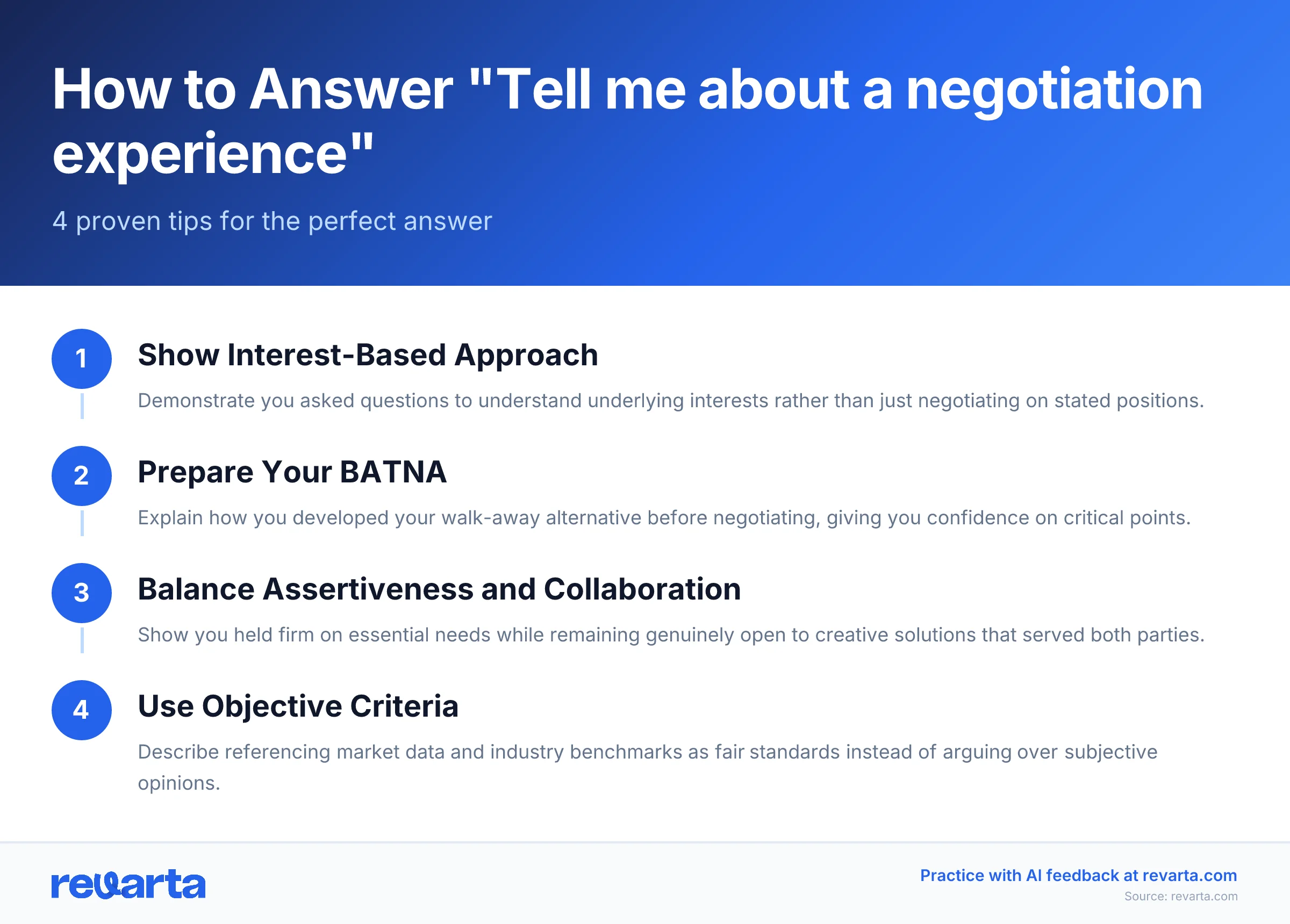
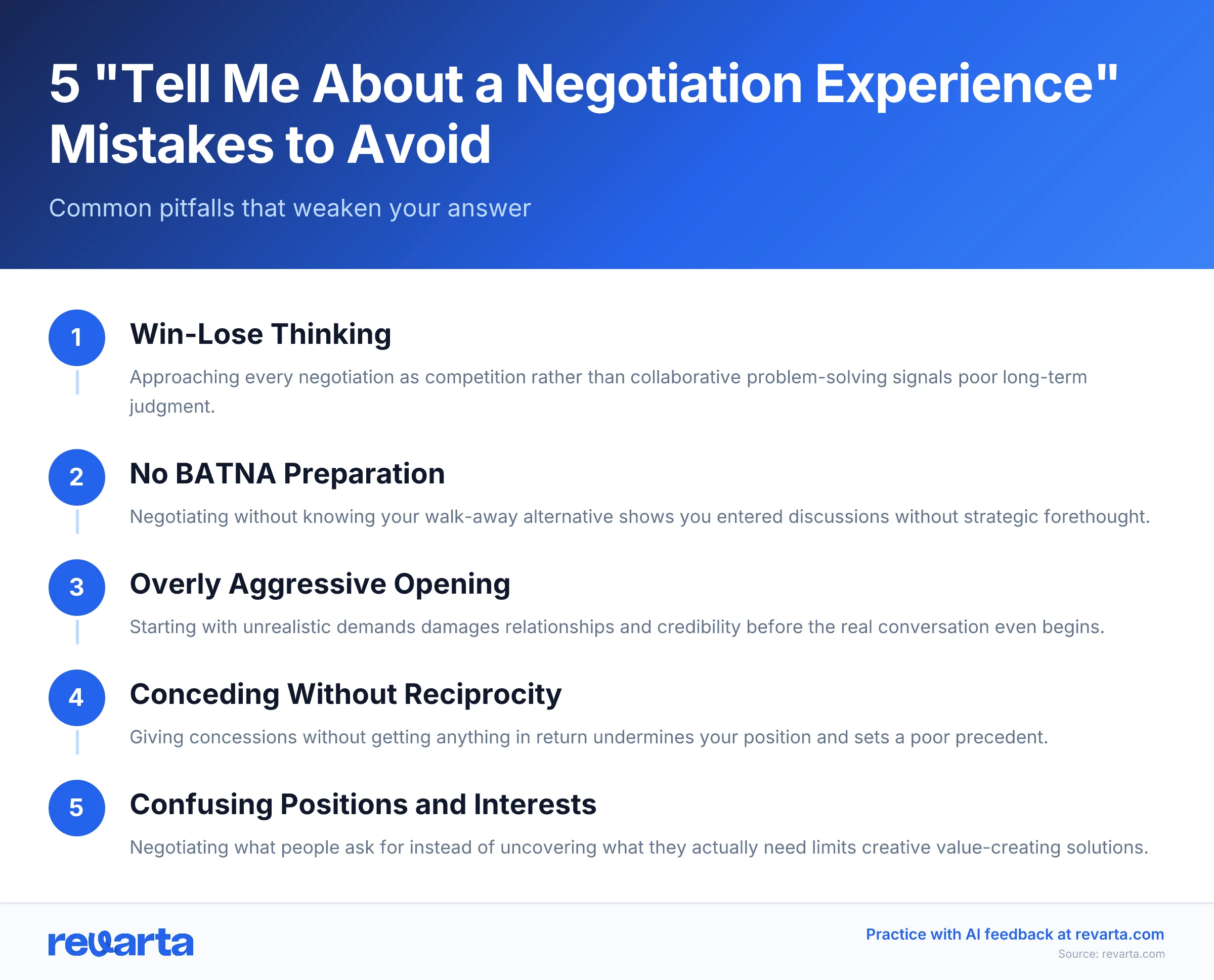
Strong negotiators expand the pie before dividing it. Your response reveals whether you identify interests beyond stated positions, find creative solutions that benefit all parties, think beyond price to other value dimensions, and create outcomes better than both parties' initial expectations.
Evaluating Preparation and Strategy
Successful negotiations require thorough preparation. Interviewers assess whether you research the other party's priorities and constraints, identify your BATNA (Best Alternative to a Negotiated Agreement), develop multiple proposals at different value points, and anticipate objections and resistance.
Understanding Communication Under Tension
Negotiations involve high-stakes communication. Your story shows whether you remain calm and professional under pressure, listen actively to understand underlying interests, ask effective questions to uncover information, and maintain relationships despite conflicting goals.
Measuring Power Dynamics Navigation
Negotiations rarely involve equal power. Interviewers evaluate whether you can negotiate effectively from weaker positions, use leverage ethically without damaging relationships, recognize when to walk away, and maintain self-respect regardless of power imbalance.
Gauging Long-Term Thinking
Short-term wins can destroy long-term relationships. Your example reveals whether you prioritize sustainable agreements over quick victories, maintain relationships through negotiation process, avoid tactics that create resentment, and structure deals that both parties will honor.
The STAR Method for Negotiation Questions
Situation (15%)
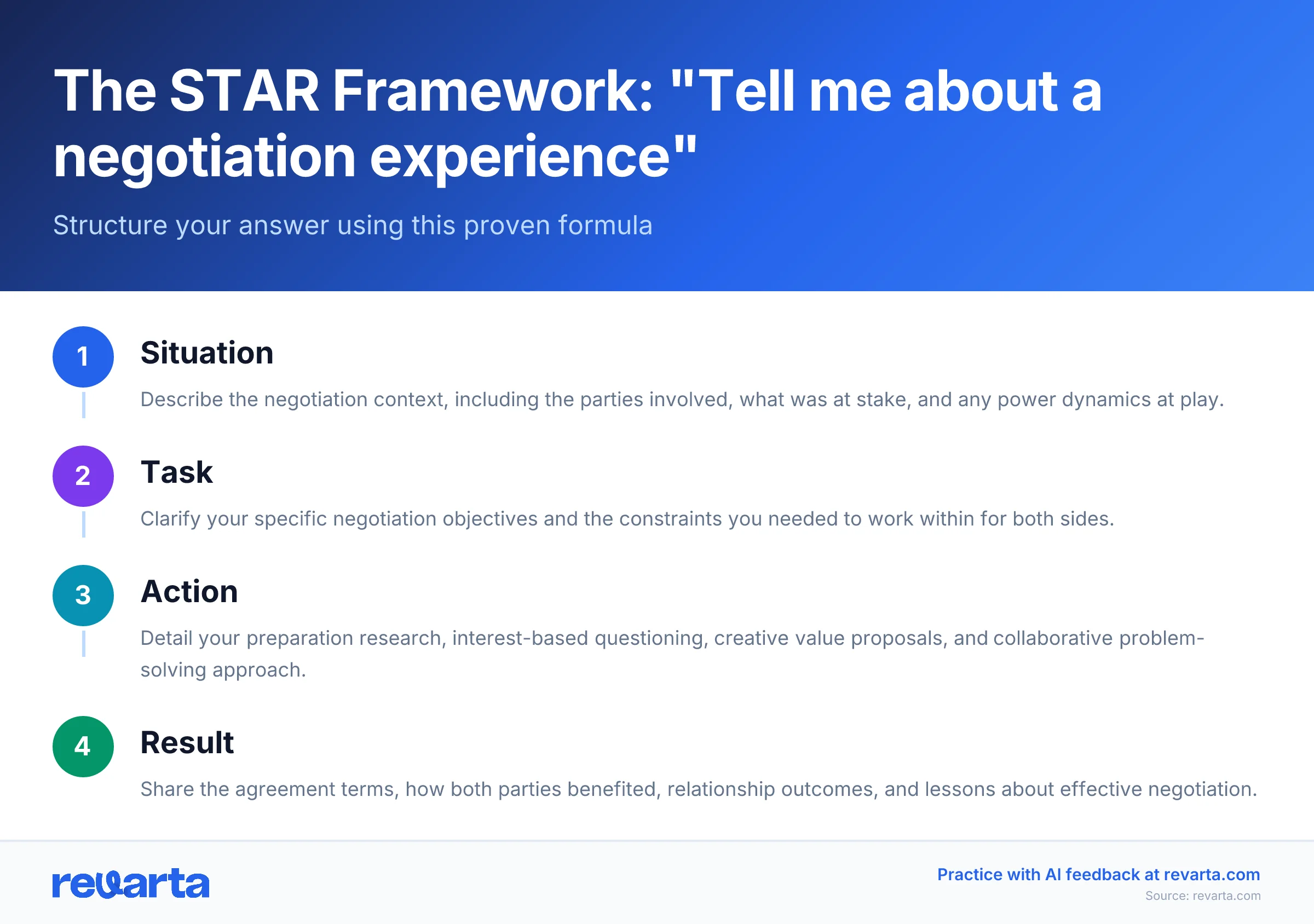
Example:
"As procurement manager at Manufacturing Co, I needed to renew our contract with our primary steel supplier. We had worked with SteelCorp for five years, but market conditions had changed significantly. Steel prices had increased 25% over the past year, and our current contract was expiring. SteelCorp's initial renewal proposal included a 22% price increase, which would add $1.8M to our annual costs and make many of our products unprofitable. However, switching suppliers would require six months of qualification testing, creating production risk during our busiest season."
Task (10%)
Example:
"I needed to negotiate a contract renewal that minimized cost increases while maintaining supply reliability, preserve our relationship with a critical supplier, and avoid the risk and disruption of supplier qualification during peak production."
Action (55%)
Example:
"Before the formal negotiation, I did extensive preparation. I researched steel market pricing trends, analyzed SteelCorp's financial position from their public filings, and identified our procurement leverage and weaknesses. I also spoke with operations to understand our true flexibility around suppliers and timing.
This research revealed several key insights: while we represented only 8% of SteelCorp's revenue, we were their largest customer in our specific steel grade. Their financial reports showed they were losing market share in other segments and couldn't afford to lose established customers. Additionally, they had recently invested in production capacity for our steel grade that wasn't fully utilized.
I also identified our BATNA (best alternative): we could qualify an alternate supplier, but it would take six months, cost $200K in testing, and create production risk. This meant we had some leverage but not enough to simply demand price concessions.
Rather than starting with demands, I scheduled a preliminary meeting with SteelCorp's sales director to understand their perspective. I asked: 'Help me understand what's driving the 22% increase. What challenges are you facing?' They explained that raw material costs had risen 15%, transportation costs were up 8%, and they needed to maintain margins.
I acknowledged their cost pressures: 'I understand your costs have increased. We're facing similar pressures throughout our supply chain.' I then shared our constraint: 'A 22% increase makes several of our product lines unprofitable. I need to find a solution that works for both of us, or I'll be forced to qualify alternative suppliers.'
Instead of negotiating on price alone, I looked for additional value dimensions. I proposed a multi-year contract (3 years instead of 1) that would give them revenue security in exchange for better pricing. I offered to increase our order volume by 15% if they could utilize their excess capacity for our steel grade at a lower incremental cost. I proposed flexible delivery terms that would smooth their production scheduling.
I also identified quality improvements that would benefit both parties: if they implemented tighter specification controls, we could reduce our own quality inspection costs and accept direct-to-production deliveries.
The negotiation took place over three meetings. In the second meeting, they countered with a 15% increase for a one-year contract. I stayed calm and reframed: 'Let's look at this differently. If I commit to a three-year contract with volume increases, what cost efficiencies does that create for you in production planning and capacity utilization?'
I brought our VP of Operations to the third meeting to discuss the operational integration opportunities. We proposed a collaborative forecasting system that would give them better demand visibility in exchange for inventory flexibility.
Throughout the process, I maintained a collaborative tone: 'We value the relationship and want to find a solution that works long-term for both companies,' while being clear about our constraints: 'I can't accept a 15% increase without additional value. Help me justify that to my leadership.'
When we approached an impasse on price, I used silence strategically. Rather than filling every pause with concessions, I let them think. After one particularly long silence, they proposed a creative solution: a tiered pricing structure where we'd get better rates as volume increased, aligning our incentives."
Result (20%)
Example:
"We reached agreement on an 8% price increase for year one with volume commitments that brought their total revenue increase to 12%, satisfying their margin needs. Years two and three had capped increases of 5% regardless of market conditions, giving us price stability. The collaborative forecasting system reduced their inventory costs, and the quality improvements saved us $150K annually in inspection costs.
Both parties were satisfied: we reduced the cost impact from $1.8M to $650K while gaining multi-year price stability. They gained long-term revenue security, higher volumes, and improved production efficiency. The relationship actually strengthened—we're now their partner for new steel grade development.
This experience taught me that the best negotiations find interests beyond the obvious trade-offs. Price was the stated issue, but both parties had deeper interests: they needed revenue security and capacity utilization; we needed cost stability and supply reliability. Addressing those underlying interests created value neither party could achieve through price negotiation alone.
I learned the power of preparation—understanding their business situation from public financial data gave me insights that shaped my strategy. I also discovered that asking questions and listening created more leverage than demands and pressure.
Most importantly, I realized that collaborative negotiation isn't weakness—it's strategic. I was clear about our constraints and willing to walk away, but I approached the conversation as joint problem-solving rather than combat. This approach created an agreement both parties wanted to honor rather than an imposed outcome creating resentment."